

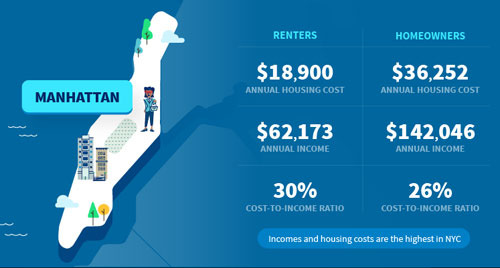
The cost of living index in New York is 188. This means it is 88% higher than the national average, which is set at 100.
New York ranks among the most expensive cities in the U.S., along with San Francisco (200) and Honolulu (188), and this figure is not just a statistic but a number that directly impacts household budgets. Let's take a closer look at where and how much more is spent, item by item.
Housing costs are key. The median rent for a one-bedroom apartment in Manhattan is around $3,000 to $5,500 per month, while two-bedrooms can easily exceed $5,000 to $6,000. Moving to other boroughs like Queens (Queens Village COL 138), Brooklyn (COL 138), the Bronx (COL 130), or Staten Island (COL 128) tends to significantly lower rent. For a two-bedroom in Queens, the realistic rent is about $2,800 to $3,800, while in the Bronx, it ranges from $1,200 to $2,200. The Flushing area, known for its Korean community, is considered a good place to find a balance between accessibility to the Korean community and rent.
Transportation costs can actually be saved by giving up a personal vehicle in New York. The MTA subway and bus unlimited pass is among the lowest public transportation costs in the nation at $127 per month. In contrast, maintaining a personal vehicle can lead to costs exceeding $1,000 per month when combining parking fees (around $500 in Manhattan), insurance (averaging $200 per month in New York State), and maintenance. This is why many Korean households with jobs in Manhattan are opting for public transportation instead of driving.
Grocery prices vary significantly depending on where you shop. For a family of four, the monthly grocery bill in Manhattan supermarkets tends to be around $1,300 to $1,800, which is 30-50% higher than the national average of about $800. Korean households that travel to shop at Korean markets in Flushing or New Jersey can save around $200 per month. Utility costs are often higher than expected due to the old building structures unique to New York City, leading to lower insulation efficiency and higher heating bills, averaging around $200 per month, which is on the higher end nationally.
Healthcare costs are also substantial. While New York State has a broad Medicaid coverage that benefits low-income households, private health insurance premiums for middle-income families can rise to $1,000 to $1,200 per month (for families). The network of Korean doctors and hospitals in New York City is the most developed in the nation, providing an environment where medical services can be accessed without language barriers.
When compared to neighboring cities, the weight of New York (188) becomes clearer. Even compared to nearby New Jersey cities like Fort Lee (155) and Tenafly (168), Manhattan remains higher, which is why more households are consistently considering commuting from Connecticut or the outskirts of New Jersey. Moving to Westchester County within New York State, like Hartsdale (155), tends to significantly lower the cost of living.
The most practical advice for Korean households living in New York is to consider their borough choice. By letting go of the insistence on Manhattan and comparing areas like Flushing in Queens, Sunset Park in Brooklyn, or Fort Lee and Palisades Park in New Jersey, it is possible to create a difference of over $10,000 to $20,000 in annual housing costs while remaining in the same living area. A COL of 188 is a figure not easily found anywhere in the U.S., but it also means that New York is a city where choices and focus are possible.
 vibeforestwalker1997
 mooncitywalker2017





 Arizona AZ Cowboy |
 Valley Hong |
 Mr Oh |
 ollege Mom |
 Helpful Life Stories |
 newyorker 101 |
 PPAP Pineapple Pen |
 Eating Gukbap and Working Hard Deer |
 NYC saladbar |
 International Court |
  Soft Feeling That Feeling |
  assa man |
  Yugo Girl I'm So Hot |
  nexaro |
  Experiences Living in America |
  arsnack |
  Nebraska Center Director TOP |
  Florida Gario |
  menmo |
  springw |
  Woooooah |
  frostpup |
  chocopup |
  Angeles Choi |
  My Heart Popper |
  comova |
  vintago |
  Sky Way |
  Top Beaches |