
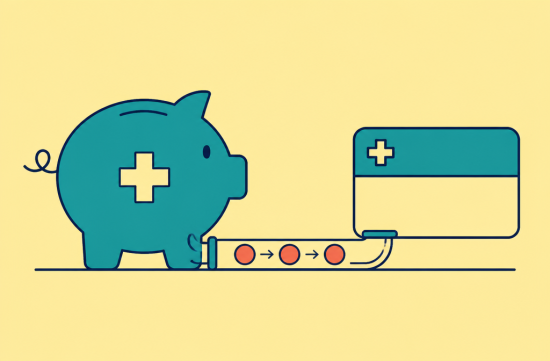
Recently, while having lunch with a business partner, the topic of HSAs came up. When he asked if the account just sits unused after retirement, I explained that it actually becomes much more useful at that time.
An HSA is a health savings account opened by individuals enrolled in a high-deductible health plan (HDHP). Contributions are tax-deductible, it grows tax-free, and withdrawals for medical expenses are also tax-free, which is why it's often referred to as a triple tax-advantaged account.
The issue is that many people think they can only use this money for hospital bills or prescription costs. However, it's surprisingly not well known that you can also pay your monthly Medicare premiums from it after retirement.
According to IRS Publication 969, premiums are generally not considered qualified medical expenses for HSAs. However, there are a few exceptions, one of which is Medicare premiums for account holders aged 65 and older.
Specifically, this includes premiums for Medicare Part B, Part D prescription drug coverage, and Medicare Advantage (Part C). If there is a Part A premium that needs to be paid, that is also included.
One important exception to note is that premiums for Medigap, which is supplemental Medicare insurance, are not tax-free through an HSA regardless of age.
It would be a mistake to assume that all Medicare-related premiums are eligible just by reading the title. If you plan to use Medigap alongside Original Medicare, you should consider that portion as an expense paid from regular income.
In terms of amounts, this can be quite significant. The standard premium for Part B in 2026 is $202.90 per month, which is an increase of $17.90 from $185 in 2025.
Over a year, just for Part B, that exceeds $2,400. Those with higher incomes who incur an additional premium known as IRMAA will face even greater burdens.
The Part B premium for 2027 is typically announced by CMS in the fall, and as of the time of writing, the confirmed figures have not yet been released. Just keep in mind that it tends to increase each year.
Many people have their Part B premiums automatically deducted from their Social Security benefits. In this case, it is generally interpreted that you can reimburse yourself from your HSA for that amount.
The conditions for a spouse's premium are slightly different. According to Publication 969, if the account holder is under 65, the Medicare premiums for a spouse aged 65 and older are generally not considered qualified medical expenses.
If there is an age difference between spouses, you need to check this carefully. The outcome can vary depending on whose name the HSA is under.
Conversely, once you enroll in Medicare, you can no longer contribute new funds to your HSA. You are free to use the money that has already accumulated, but the eligibility for additional contributions ends with Medicare enrollment.
This is where mistakes often occur. If you apply for Part A late after turning 65, it can be retroactively applied for up to six months, and any HSA contributions made during that period will be considered excess contributions.
Excess contributions incur a 6% excise tax each year if not corrected. Therefore, those who continue to work and apply for Medicare late are often advised to stop HSA contributions about six months before applying.
It's also good to be aware of the contribution limits. For 2026, the limit is $4,400 for individuals and $8,750 for families, with an additional $1,000 allowed for those aged 55 and older.
The IRS has announced the 2027 limits as $4,500 for individuals and $9,000 for families. The additional $1,000 for those aged 55 and older remains unchanged.
Once you turn 65, you won't incur a 20% penalty for withdrawing funds for non-medical expenses. However, you will still owe regular income tax, so it's beneficial to use the funds for tax-free expenses like premiums first.
From a business perspective, this is a cash flow management issue. Fixed costs continue after retirement, and using tax-free money to cover recurring expenses is a smart strategy.
Thus, I view the HSA more as a dedicated account for paying premiums after retirement rather than just a simple hospital expense account. Many people keep receipts well during their younger years and invest the balance for growth.
When it comes time to use the funds, keeping records is crucial. You should retain documentation of your Medicare premium payments and Social Security deductions each year for tax reporting purposes.
In the year you withdraw money from your HSA, you will report the usage on Form 8889. Separating the amounts used for qualified medical expenses from those that are not will make reporting much easier.
You can also pay long-term care insurance premiums with an HSA, but there are annual limits based on age. These limits change each year, so it's best to check the specific limits for that year.
In summary, premiums for Parts B, D, and Advantage can be paid tax-free from an HSA after age 65. Medigap is not eligible, and new contributions are blocked after enrolling in Medicare.
There are also specific conditions that vary, such as for a spouse's premiums and retroactive application periods. Since outcomes can differ based on individual circumstances, it's advisable to consult a tax advisor or financial expert.
Among Korean Americans, many leave their HSAs untouched because they were set up by their employers. I've seen quite a few who don't even know how much is in their account or whether it's being invested.
If retirement is still far off, now is a good time to build up your HSA. If retirement is approaching, you need to calculate the timing of your Medicare application and when to stop HSA contributions together.
Just like good cheese takes time to develop flavor, an HSA becomes more valuable the longer it is held. If I were in your position, I would plan to pay my Part B premiums from this account in the first year of retirement.
 DreamRoad
 YamWeaponLab


 orvian89 |

 looksee 78 |

 vivavida |
 MEDBIO American Doctor Blog |

 Burbank Lee |

 bigcheese |

 kiwiii |


 mygoddess blog |

 Mr. Torres |
 ssome |
 skykong |
 Shining Our Own World |
 gardener 007 |
 golfmaster |
 Nanana Nanana Nanana |
 Who's watching? |
 endone |
 RockStar |
 Casa Mia |
 You Only Live Once |
 Hardworking CPA |
 Joyce 77 |
 Runner Kim |
 My Town My Way Blog |
 My Miami Stories |
 Entip |
 Tony Park |
 Jean Claude Bundang Blog |
 DJ DC BLOG |