

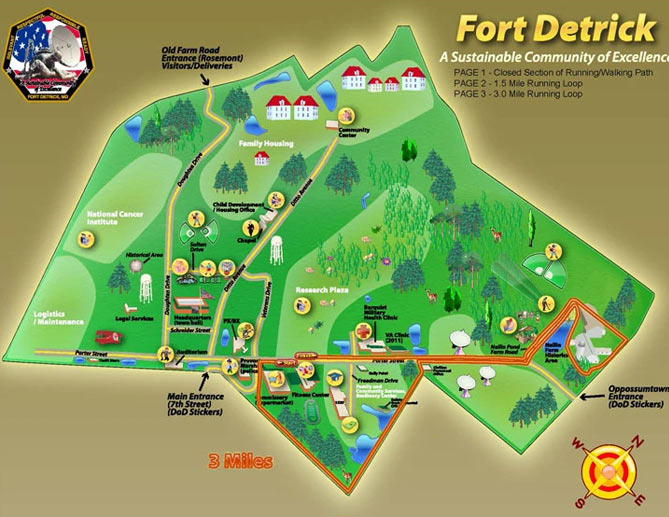
When you hear the name Fort Detrick, Maryland, the word 'military facility' usually comes to mind, but looking at the people who work there reveals a much more complex picture. It's not just soldiers; there are doctors, biotechnologists, virus researchers, data analysts, administrative staff, and contractors all working together.
The reason the city of Frederick has been able to grow as a center for science and health is thanks to the people who work here. The workforce at Fort Detrick is known to be around 10,000, with only a small portion being military personnel. Most are scientists from civilian research institutions or government agencies. For example, at the U.S. Army Medical Research Institute of Infectious Diseases (USAMRIID), military doctors and civilian PhD biologists work side by side.
They play a role in developing vaccines and treatments while researching emerging viruses, bacteria, and bioweapon threats. This is why the media often refers to it as "the front line of disease defense in the United States." During the COVID pandemic, there were reports that researchers at Fort Detrick assisted in foundational vaccine research.
In addition to research positions, engineers, cybersecurity experts, laboratory equipment maintenance staff, and administrative support personnel also work together. Given that it is a bioscience facility, safety management personnel are particularly important. To operate a Biosafety Level (BSL) 4 laboratory, everything from internal air pressure, waste disposal, to lab coat washing must be monitored, requiring specialized technicians and security personnel to work in shifts around the clock.
These individuals may not be visible, but they serve as the most crucial support for the institute. At Fort Detrick, researchers from not only the Department of Defense but also the Department of Health and Human Services (HHS), the National Cancer Institute (NCI), and the National Institutes of Health (NIH) work together.
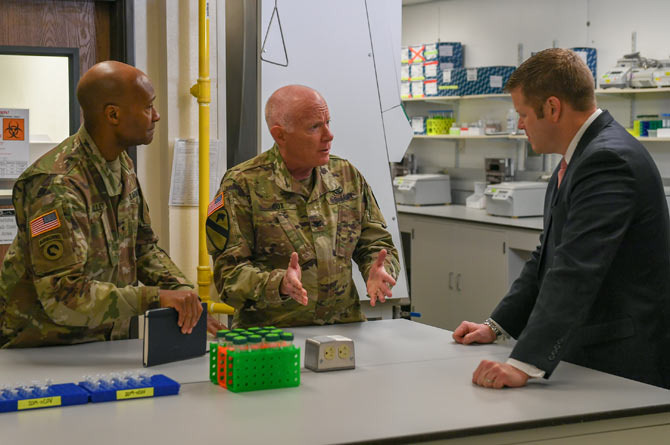
This place is not just a military base; it is closer to a 'science campus where military and civilian collaborate.' Thanks to this environment, the backgrounds of the employees are incredibly diverse. It is common to see a soldier in uniform having lunch next to a doctor in a white coat and a data scientist in casual attire.
You can easily see this scene in downtown Frederick as well. During lunch hours, if you go to a downtown café, you often see institute employees sharing coffee while discussing papers or project ideas. Most Fort Detrick employees live in Frederick or nearby cities (Hagerstown, Gaithersburg, Mount Airy, etc.).
The stable working environment and high level of welfare lead to many long-term employees. Due to the nature of health and science-related jobs, a five-day workweek is typical, and some researchers may work weekends in preparation for shift work or emergency response situations. Salary levels vary depending on position and institution, but PhD-level researchers typically earn over $100,000, while technical and administrative positions generally range from $60,000 to $80,000.
Additionally, Fort Detrick runs ongoing training programs. New employees must complete mandatory training on biosafety, data security, and research ethics, and researchers share the latest information through seminars or conference presentations each year. Especially since it is a structure where military and civilian collaborate, 'communication training' to understand each other's areas of expertise is treated as important.
Interestingly, most of the people working here have a sense of 'mission.' They do not just conduct experiments; they take pride in knowing that their research can actually save lives. Perhaps because of this, the internal atmosphere is said to be strict yet collaborative. Many stories suggest that long-term working relationships form a family-like bond.
From the perspective of Frederick residents, Fort Detrick employees represent another face of the city. After work, they are ordinary neighbors like everyone else, spending weekends with their families at local farmers' markets or Lake Waterpark. But come Monday, they return to work in world-class laboratories to ensure humanity's safety.
The workers here have transformed the economy, culture, education, and identity of the community. They are quiet yet strong individuals who move with a sense of responsibility, and perhaps because of them, Frederick has earned the nickname 'the heart of American science.'




 coloradoman |
 Living Economy Information Blog |
 Tomato Health Club blog |
 Banana Style Life |
 crystalo |
 dynamite |
 kiwiii |
  Mr. Torres |

 Korean Mom |
  My NYC |
  moo moo |
  Mr Oh |
  forevergee |
  festival |
  manchester |
  constant |
  Leapfrog Move |
  vibranto |
  Tora Tora |
  yellowbutter |
  Dolly |
  US Embassy |
  NYC saladbar |
  Finding Superfoods |
  lightyear |
  song bang |
  vexomo |
  Indiana Jones |