

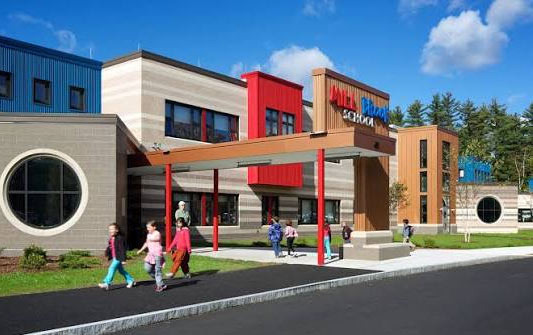
Many families think of their children's schools first when choosing a neighborhood to move to.
Concord operates under a single school district, the Concord School District.
However, the elementary and middle schools assigned vary depending on where you live, and there are differences in academic achievement levels and atmospheres among the schools.
The district serves about 5,500 students, which is average in size, and there are six elementary schools. All local students attend Concord High School for high school. Therefore, the actual choice of neighborhood is primarily determined at the elementary and middle school levels.
According to the annual School Report Card published by the New Hampshire Department of Education (NHDOE), there is a gap of about 10-20 percentage points in math and English proficiency rates even among Concord elementary schools. This means that even within the same city, the mix of schools can be quite different.
Neighborhoods near elementary schools that are rated highly for academic achievement are often found in West Concord and North Concord. Areas with a concentration of single-family homes in West Concord and North Concord are known for relatively high income levels and active parental involvement.
The elementary schools assigned to these areas are evaluated positively for their special education support, after-school programs, and community engagement activities. Data from NH School Profiles also shows that the third-grade reading proficiency rates in the western elementary school district tend to exceed the citywide average.
At the middle school level, there is Rundlett Middle School. The boundary for middle school assignments can be accurately determined using the School Finder on the Concord School District's official website (concordschools.net) or by directly contacting the district office. Make sure to check this together to avoid discovering middle school assignments later after only looking at elementary schools.
Besides schools, there are other factors that influence the character of a neighborhood. Areas close to downtown have convenient amenities but tend to have higher housing prices. In contrast, new residential developments in the outer west and north offer the advantage of larger lots and newer buildings at relatively lower prices.
In terms of safety, the crime rates in the west and north residential areas are known to be relatively low. Looking at U.S. crime statistics (FBI Crime Data), New Hampshire consistently maintains a low crime rate nationally.
When you overlay schools, housing prices, and safety on a single page, the distinctions between neighborhoods become clearer.
When you actually go house hunting, here are some things to keep in mind. First, if you find a house you like, enter the address into the School Finder to check the assigned school. It's safer to verify by address rather than just relying on the neighborhood name.
Second, attend public events like Open Houses or School Tours to get a feel for the school atmosphere and staff. Imagining a scene of your child planting seeds with friends in the school garden on a spring day makes it clear that the intangible aspects are quite important.
Third, in New Hampshire, property taxes are a major source of funding for education, so areas with higher tax rates tend to have more robust school budgets. The property tax rate in Concord is about average for New Hampshire, and specific numbers can be found on the official Concord city website or the New Hampshire Department of Revenue Administration (NHDRA) resources.
Personally, I believe that spending an hour visiting a school provides more insight than a single scorecard. The achievement numbers are like an outline, while the atmosphere you experience in person adds color. When both aspects are filled in, it seems that the picture of the neighborhood that fits our family is finally complete.



 Augusta 90 |

 Pointy |

 rissa |

 Gomo Nim |

 lattepop |

 what gives |

 abox |

 ovelion |


 Shining Our Own World |
 Raymond K. |
 gravity |
 714 Success Era Real Estate |
 Investment Beginner Company Information Encyclopedia |
 musicque |
 The Gelaton |
 Chicagonian |
 Freedom Yea |
 AZ Road Master |
 glenix39 |
 Something is popping in the situation |
 orvella |
 vella |
 comets |
 Banana |
 Yes Dorian |
 Minnesota Sonata N |
 zentar |