
When I mentioned I was going to live in Salt Lake City, I was surprised to hear people say, "Isn't that a place where earthquakes happen?"
At first, I thought, what earthquakes in Utah? It's not California, and while Nevada is right next door, Salt Lake City makes me think of snow-covered mountains and ski resorts.
However, I found out that the Wasatch Fault runs east of Salt Lake City, and Utah is an area where the risk of earthquakes cannot be ignored in the U.S.
That doesn't mean a major earthquake is coming tomorrow. We need to look at the probabilities of earthquakes accurately.
According to the Utah Geological Survey, the probability of a magnitude 6.75 or greater earthquake occurring in the Wasatch Front region within the next 50 years is estimated to be about 43%. Among these, the probability of a magnitude 6.75 or greater earthquake occurring specifically on the Wasatch Fault is about 18%.
Particularly concerning is the Salt Lake City segment. Geologists have found that in this section, large earthquakes of about magnitude 7 have occurred on average every 1,350 years, with the most recent major earthquake estimated to have happened about 1,300 years ago.
Of course, we shouldn't calculate that since it's once every 1,350 years and 1,300 years have already passed, it will happen soon. Earthquakes do not occur at regular intervals like a clock. However, it is clear that this area is a fault that has actually produced significant earthquakes.
Historical records also show that Utah is not a quiet place.
In 1934, a magnitude 6.6 earthquake occurred in Hansel Valley, north of the Great Salt Lake. It is recorded as the largest earthquake in Utah's historical period, with the ground splitting over about 5 miles and some areas experiencing vertical displacements of about 20 inches. Even far away in Salt Lake City, tall buildings shook.
In 1962, a magnitude 5.7 earthquake occurred near Richmond in Cache Valley, causing significant damage to many homes. Therefore, the earthquake risk in Utah is not just a future possibility calculated by computers but a real risk with historical records.
Right next door, Nevada is also an area with active seismic activity. In 1954, Nevada experienced strong earthquakes of magnitude 7.2 at Fairview Peak and 6.8 at Dixie Valley, and in 2008, a magnitude 6.0 earthquake occurred near the Utah border in Wells, Nevada, causing about $10.5 million in damages, despite being a small town.
And what Salt Lake residents remember most vividly is the Magna earthquake on March 18, 2020. A magnitude 5.7 earthquake occurred west of Salt Lake City, and strong shaking was felt throughout the Wasatch Front. Thousands of aftershocks were observed afterward.
The important thing is that this earthquake was much smaller than a potential magnitude 7 earthquake that could occur in the future. A magnitude 7.0 earthquake releases about 90 times more energy than a magnitude 5.7 earthquake.
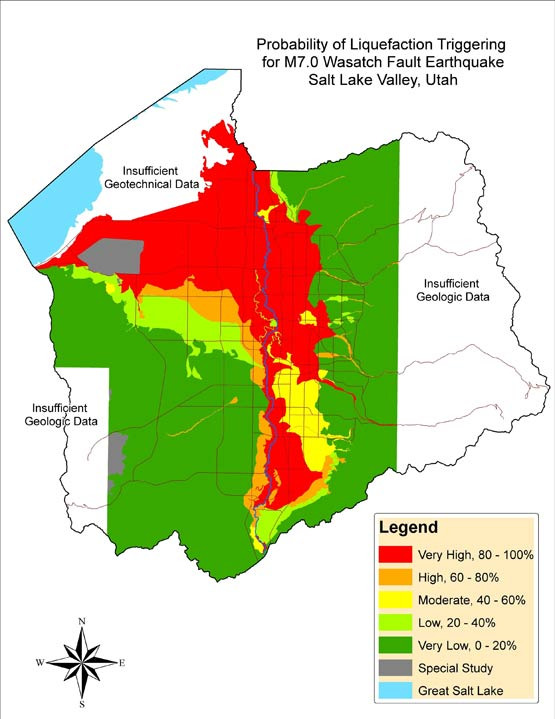
When an earthquake occurs, it's not just the shaking of buildings that we need to worry about. Some areas of the Salt Lake Valley have shallow groundwater and sandy soil, which pose a risk of liquefaction. If the ground shakes strongly and temporarily loses its strength, buildings can tilt, and roads and underground facilities can be damaged.
Near the mountains, we also need to consider the risk of landslides and falling rocks. Many people love the East Bench or hillside homes for the beautiful views of the Wasatch Mountains, but when buying a home, it's important to check not only the view but also the faults, slopes, and ground conditions.
So if I were to buy a house in Salt Lake City, I would first check if it's an old brick house. Especially unreinforced masonry buildings can be vulnerable in strong earthquakes. While new homes are not necessarily safe, current building codes in Salt Lake City do take high earthquake risks into account.
Inside the house, you can start by securing bookshelves, large cabinets, and TVs, and not placing heavy items on your bedside. It's also a good idea to prepare enough water, emergency food, flashlights, backup batteries, and first aid supplies to last a few days. When an earthquake occurs, instead of rushing outside, remember to Drop, Cover, and Hold On to protect your head and neck under a sturdy place.
After learning all this, I actually feel a bit more at ease. Salt Lake City is certainly not a safe city from earthquakes. However, it is also not a city where you can't live because of earthquakes.
When you open the window, you can enjoy the Wasatch Mountains and the clean natural environment right in front of you, but the risks of geological activity that created those mountains also exist.
Ultimately, the important thing is not to think, "There won't be any earthquakes in Utah," but to accurately understand the risks in the area where I live and prepare for them. Just as people prepare for earthquakes in California and hurricanes in Florida, if you live in Salt Lake City, it seems right to consider earthquake preparedness as a basic part of life.
 AUTOKOR



 Rice Shop Uncle BLOG |

 My Town My Way Blog |
 Arizona AZ Cowboy |

 Valley Hong |

 Mr Oh |
 loran |
 Utah, the Most Livable State |
 KGOMIO Blog |
 AliAluAlo Blog |
 breaddough |
 Michigan Enthusiast |
 Only Dentalbay |
 postcard |
 Buckwheat Muktudari Notebook |
 Kitchen Ideas |
 Jellia Angel |
 Victory 1988 |
 ASURA |
 hot chocolate |
 rapids |
 Softember |
 mykiwi blog |
 Maria Mom |
 Watch for possible danger |
 northpeak |
 Far East Movement |
 Light of the World |
 mariashin |