
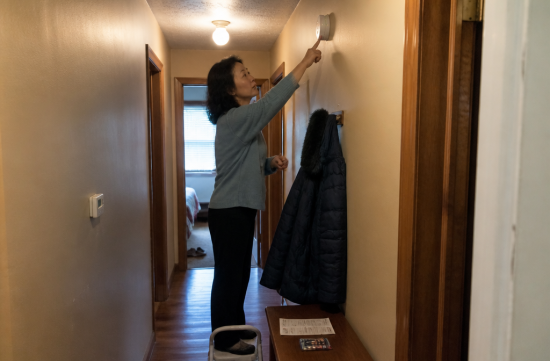
Around Thanksgiving, similar inquiries often come in. On the first night the boiler is turned on, a short beep from the detector on the ceiling sounds every minute.
Most of the time, it's just a battery issue, but if it's a carbon monoxide detector, it's not something to take lightly. And if it's a rental home, it's better to clarify who is responsible for repairs.
In Wisconsin, the obligation to install carbon monoxide detectors generally falls on the landlord. For one- or two-family homes, the standard is set by state law 101.647, while larger residential buildings follow 101.149.
The requirement applies to homes with fuel-burning appliances. This includes gas furnaces, gas stoves, gas water heaters, and fireplaces, as well as attached garages.
According to the Wisconsin Department of Health Services (DHS), there must be a detector on each floor, including the basement. This guideline applies to residential buildings constructed after June 1, 1980.
The Madison Fire Department has similar guidelines. For one- or two-family homes, detectors should be installed on each floor, primarily near bedrooms, and there are separate installation regulations for buildings with three or more units.
It's not just about installation. State law requires landlords to reasonably maintain detectors according to the manufacturer's instructions.
So, does that mean tenants don't have to do anything? Not quite. If a detector isn't working or has been removed, tenants must inform the landlord.
The key term here is written notice. Section 101.149 states that if a tenant provides written notice, the landlord must repair or replace the detector within five days of receiving the notice.
Many people think a phone call is sufficient, but I would recommend sending an email or text with the date and symptoms. This serves as evidence later if you need to verify whether five days have passed.
The battery situation is a bit ambiguous. While state law requires tenants to manage smoke detectors, it's harder to find a clear provision for carbon monoxide detectors.
Therefore, I suggest checking the lease agreement first. Some contracts specify that battery replacement is the tenant's responsibility, so if there's no clause, it's best to confirm with the landlord.
Conversely, there are things tenants absolutely should not do. State law prohibits anyone from removing or disconnecting a detector or battery unless it's for inspection, maintenance, or replacement purposes.
It's not uncommon to see people remove batteries because the detector is too loud while cooking. Living through winter with that situation is dangerous, beyond legal issues.
Checking the detectors is simpler than you might think. The U.S. Consumer Product Safety Commission (CPSC) recommends testing detectors once a month and changing batteries once a year.
Pressing the test button for a few seconds should produce a loud alarm, indicating it's functioning properly. If the sound is weak or nonexistent, try replacing the battery first.
If you've replaced the battery and the beeping continues, you should suspect the device's lifespan. Carbon monoxide sensors are not permanent.
According to manufacturer guidelines, First Alert detectors last 5-7 years, while Kidde models last 7-10 years, depending on the model. You can estimate the age by checking the manufacturing date on the back of the device.
The signals indicating the end of life differ from low battery signals. First Alert explains that a beep every minute indicates a low battery, while five beeps per minute signal the end of life.
Since signals vary by brand, check if END or ERR appears on the display. In such cases, you need to replace the device itself, and if it's a rental home, notify the landlord in writing.
It's also helpful to organize what to check on moving day. You should verify whether there are detectors on each floor, including the basement, whether the test button works, and whether the manufacturing date is not too old.
Including this information on the move-in checklist makes it easier to explain later if disputes arise. Taking a photo is also a good habit.
When an alarm actually goes off, there is a protocol to follow. Don't stay inside trying to find the cause; instead, exit the building and call 911.
Carbon monoxide is colorless and odorless. If headaches, dizziness, or nausea occur simultaneously among several family members, don't dismiss it as a cold, as health authorities consistently advise.
From the landlord's perspective, the math is simpler. The cost of a few detectors is far less than the cost of an incident or complaint.
Specific criteria may vary based on the size of the building and the year it was built. If in doubt, I recommend checking Wisconsin state law sections 101.149 and 101.647, as well as the Madison Fire Department's guidance page.
In my view, most issues with rental home detectors stem from communication rather than the law. Just clarifying who changes the battery at the outset can make winter much quieter.
Before turning on the heat, take a moment this weekend to press the test button. It only takes a few seconds.
 IronSquid
 StarlitStory









 ovelion |

 Something is popping in the situation |

 lumix88 |

 quiet river |

 Doori Ark |

 Superman Cat Blog |

 dorange |

 middlekick |

 Forever Coco is Bangga |

 winter |
 micos |
 Living Economy Information Blog |
 vintage |
 vorame |
 rosem |
 Various Knowledge and Information in the USA |
 aloeverame |
 coffeee |
 Well Done Sir |
 cantsay |
 swiftlane |
 wexlin84 |
 Victory 1988 |
 noraro |
 korando9 |
 Scade Studio |
 flingstone |
 Rynex |