
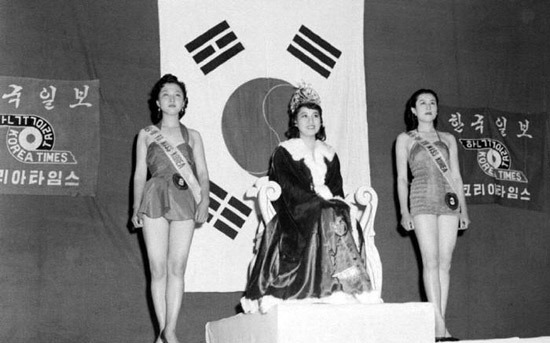
Tracing the history of beauty contests in South Korea naturally leads to the year 1957 as a starting point.
Just four years after the Korean War armistice (1953), it was a harsh time when the country was just beginning to establish its national system and seek social vitality amidst the ruins of war. The superficial justification for the first Miss Korea pageant, hosted by the Korea Daily, was clear: to select a representative beauty to attend the 'Miss Universe Pageant' held in the United States.
Although Korea had already debuted on the Miss Universe stage in 1954, there was no systematic domestic selection process, and it wasn't until 1957 that an official national representative selection was established. As indicated by the term 'ambassadors of beauty' used by the media at the time, this contest carried a strong nationalistic and diplomatic implication, showcasing a war-torn country on the international stage with a refined face.
However, the real background behind why a newspaper company would invest significant resources and manpower into a beauty pageant can be accurately found in the unique business style and management philosophy of the Korea Daily's chairman, Jang Gi-young. Known as a 'bulldozer' in the media industry for his aggressive management style, he organized the New Year Literary Contest, the Bonghwangdaegi National High School Baseball Championship, and the Miss Korea pageant in succession, drawing public attention by being the first in the media industry to implement a recruitment program for trainee reporters and hosting the Gyeongbu Station Marathon.
This was a typical 'Event Journalism' strategy where the newspaper directly planned and owned a 'national event,' simultaneously generating social buzz, increasing circulation, and boosting advertising revenue. The Miss Korea pageant was one of the core pillars of the massive media portfolio built by Jang Gi-young. In fact, the Korea Daily encouraged participation with a large announcement on the front page, and the finals became a national concern, drawing huge crowds to the event venue. From the newspaper's perspective, it was a highly efficient killer content that could monopolize national attention at minimal cost.
In summary, the birth motivation of the early Miss Korea pageant consists of three layers: the justification of selecting representatives for international competitions, the zeitgeist of enhancing the national image post-war, and the instinct of the management to maximize the newspaper's influence through events. Particularly, the third motivation provides the most practical answer to the question, "Why did a newspaper host a beauty pageant?"
Cultural Breakthrough and Nationalism in Post-War Society
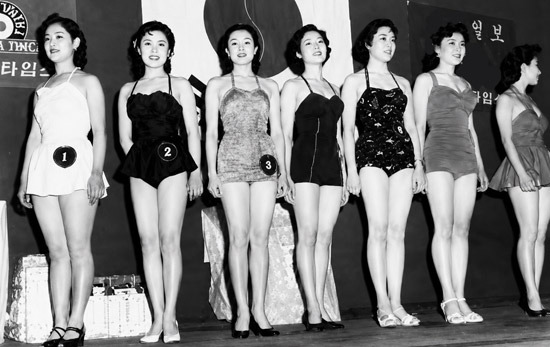
The 1957 Miss Korea pageant was not just an event to select women with excellent appearances; it was also a cultural declaration showing that post-war Korean society yearned for Western-style modernization. Moving away from the traditional image of women in hanbok, the introduction of Western-style swimwear profiles and dresses as judging criteria provided a fresh shock to the public and served as a kind of liberation. For a nation suffering from destroyed infrastructure and poverty, the Miss Korea pageant was a dazzling festival that allowed people to momentarily forget the hardships of reality.
In this process, the interests of the media and the state were closely intertwined. From the government's perspective, it was necessary to externally promote the message that "Korea is no longer a backward country mired in the horrors of war, but a sophisticated nation ready to participate as a member of the international community" through Miss Korea. Accordingly, the early Miss Korea winners were treated as public assets, not just entertainers, being mobilized for national events such as state visits and international exhibitions. The sight of Miss Koreas ascending and descending airplane steps with sashes on their shoulders symbolized Korea's diplomatic pride during the period of rapid growth.
As national justification and public enthusiasm combined, the Korea Daily's Miss Korea pageant enjoyed a monopoly for decades. On the day of the annual event, TV ratings soared, and who would win the crown became the biggest topic of conversation in the neighborhood. The success of Jang Gi-young's intended 'Event Journalism' was perfectly demonstrated by the increase in the newspaper's circulation and brand value during this golden age.
Clash of Values and Decline with Changing Times
However, as the 1990s approached, with South Korean society becoming democratized and diversified, and feminist awareness solidifying, the perception of the Miss Korea pageant faced a rapid fracture. The first criticism raised was that it quantified and commodified women based on physical measurements. There began to be fundamental questions about whether the media's act of standardizing and grading 'female beauty' aligned with the public interest function of modern democratic society.
Civil society, led by women's organizations, intensified its abolition movement, and opposition to the live broadcasts of the finals by terrestrial broadcasters surged. Ultimately, in 2002, the live broadcasts that had long delivered the pageant's glamour to homes were completely halted. As public exposure drastically decreased, the status of the pageant shrank to a level incomparable to the past, transitioning from a 'national event' to a closed event for specific industries and participants.
In this process, the biggest dilemma fell upon the host, the Korea Daily itself. The contradiction between the editorial direction of a media company that should expose social injustices and embody progressive values, and the need to maintain a beauty pageant criticized for commodifying women as a revenue model reached its breaking point.
Paradoxical Legacy of the Transfer of Hosting Rights
Here, an interesting historical paradox arises. The Miss Korea pageant, originally planned as the growth engine and best marketing portfolio of the newspaper in 1957, transformed over time into a heavy burden and a source of embarrassment that the main office wanted to shed first. Even among the internal members and reporters of the Korea Daily, voices demanding the abolition or sale of the pageant, stating that "we must end the contradiction of running a business that is contrary to the company's identity and content direction," continuously emerged.
Struggling between the credibility of the media and social criticism, the Korea Daily ultimately made a managerial decision. In 2018, the Korea Daily completely transferred the hosting rights of the Miss Korea pageant to its subsidiary, Global E&B. This was part of a restructuring effort to officially erase the label of being the host of a beauty pageant from the name of the Korea Daily, a reputable newspaper. What was once a strong driving force behind the founding and a core growth pillar of the newspaper was deemed a risk factor that could damage brand value 70 years later, leading to its separation.
Ultimately, the trajectory of the Miss Korea pageant, which began in 1957, goes beyond the rise and fall of a simple beauty contest. It marks the glamorous starting point of 'Event Journalism,' where the media held power and controlled popular culture during the post-war recovery and rapid growth periods in South Korea, and simultaneously serves as a massive sociological indicator of how past management practices are discarded and separated as ethical standards and civic consciousness evolve with the times. The lonely underside of the pageant that presented a glamorous blueprint of 'ambassadors of beauty' to post-war Korean society 70 years ago leaves us with a profound question about the role of the media and the survival conditions of cultural content in line with changing times.
 HandelSaid
 joyfulfor








 Community Cross |
 Conflite Teacher |
 SEVEN SEVEN |
 Korean Mom |
 novapixel |
 Wiscon Shin Blog |
 Superman Cat Blog |
 middlekick |
 ollege Mom |
  Pronunciation Yo |
  nuvex11 |
  Living in Florida |
  axelon47 |
  lumbus |
  Texas Migration Story |
  Scade Studio |
  love ya |
  biscuit90 |
  chicpo |
  Helpful Life Stories |
  Kitchen Ideas |
  Diana Blues |
  Agenda Center |
  journey |
  heeve |
  leman |