
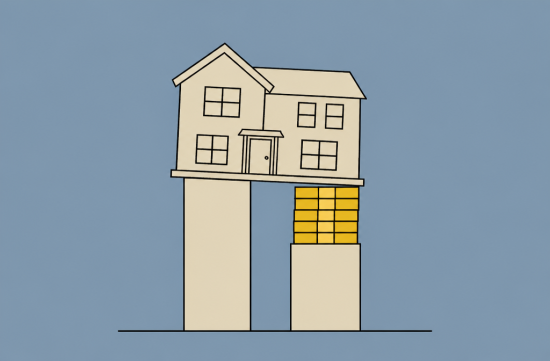
Just when you think you can take a breath after signing the contract, you get a call from the loan officer. The appraisal came in $20,000 lower than the contract price. If you've ever bought a home, you might have experienced that moment when your mind goes blank.
To put it simply, a low appraisal does not automatically break the deal. However, the options available to the buyer and the costs associated with those options can vary significantly depending on the contract terms and the type of financing.
To illustrate, let's follow a hypothetical scenario from start to finish. You contracted for $480,000 and planned to put down 20%, but the appraisal came in at $460,000.
For reference, according to Redfin, the median sale price in Davidson County in July 2026 was $480,590. This means it's a very common price range in this neighborhood.
First, we need to understand why this is a problem. In a purchase loan, the bank calculates the loan-to-value (LTV) ratio based on the lower of the contract price or the appraisal.
Under the original plan, you could borrow 80% of $480,000, which is $384,000. However, if the benchmark is lowered to $460,000, the 80% loan amount drops to $368,000.
To maintain the contract price, the buyer would need to add $16,000 to the original $96,000 they had prepared. This means that $16,000 of the $20,000 difference in appraisal would come back as a cash burden.
Now, let's look at the options one by one. The first option is to renegotiate with the seller. You can propose to lower the price to $460,000 based on the appraisal report or suggest splitting the difference somewhere in between.
This method is advantageous as it reduces the buyer's cash burden. However, if the seller has other offers or the market is leaning in favor of the seller, they may not easily accept this.
The second option is to cover the difference in cash and purchase at the original price. If it's a home you really want and you have the extra funds, this is the cleanest solution.
However, buying for more than the appraisal means starting with a lower asset value from the get-go. If you plan to resell in a few years, you need to factor this into your calculations.
The third option is to request a reconsideration of value, commonly referred to as ROV. Under Fannie Mae and Freddie Mac guidelines, you can request a review from the appraiser through your lender.
The important point here is that simply saying "it seems too low" won't suffice. You need to provide specific evidence, such as factual errors regarding square footage or number of rooms, inappropriate comparable sales, or missing comparable properties.
A buyer's request for reconsideration is only allowed once per appraisal and must be submitted before closing. Therefore, it's essential to carefully review comparable sales with your agent as soon as you receive the appraisal report.
The fourth option is to terminate the contract and walk away. The most crucial factor here is whether the contract includes an appraisal contingency.
The standard real estate purchase agreement (RF401) widely used in Tennessee has a separate section for appraisal-related items, allowing you to choose whether to include an appraisal condition.
If you included an appraisal condition, you would notify the seller using the prescribed format if the appraisal comes in low, and decide whether to waive or terminate the condition within the specified timeframe in the contract. If you miss the deadline, the condition may be considered fulfilled, so be sure to check the dates.
Conversely, if you submitted an offer without an appraisal condition due to competition, it may be difficult to retain your earnest money just because the appraisal is low. Many buyers faced challenges in the heated market a few years ago when they made such offers.
For FHA or VA loans, the situation is slightly different. FHA includes an amendatory clause, and VA includes an escape clause, which are mandatory phrases in the contract.
Thanks to these clauses, if the appraisal is lower than the contract price, the buyer can cancel the contract without losing their earnest money. Of course, they can also choose to pay the difference and proceed as planned.
FHA allows borrowing up to 96.5% of the lower of the contract price or appraisal, so while the down payment is lower, if the appraisal drops, the amount that needs to be covered can increase significantly. It's advisable to ask your loan officer for precise numbers in advance.
There are also ways to prepare in advance during the contract phase. You can include an appraisal gap coverage clause, stating that the buyer will cover the difference up to a certain amount if the appraisal comes in low.
This clause gives the seller confidence and makes your offer stand out. However, any difference beyond the limit will require renegotiation, and you must have the cash ready for the amount specified.
In summary, the four options each come with different costs and risks. Renegotiation can save money but may risk losing the deal, while cash coverage is certain but comes with a loss in asset value.
Reconsideration is only meaningful when there is a basis for it, and termination requires support from the contract terms. Which option is right depends on how much you want the house and how much cash you have available.
From my observations, most people who struggle with appraisal issues did not consider this situation when writing the contract. By setting appraisal conditions and defining a gap limit before making an offer, your options can significantly widen.
If it were me, I would generally keep the appraisal condition and only write in a gap coverage amount that I could afford for a house I really want. Anything beyond that would be too much for me.
Keep in mind that contract language and deadlines can vary by version, so be sure to confirm with your agent, loan officer, and, if necessary, a real estate attorney during actual transactions.
 BeatTheBluff
 MacaronDreamr









 ovelion |

 Something is popping in the situation |

 lumix88 |

 quiet river |

 Doori Ark |
 swiftlane |


 oceanmark |
 micos |
 Living Economy Information Blog |
 vintage |
 vorame |
 rosem |
 Various Knowledge and Information in the USA |
 aloeverame |
 coffeee |
 Well Done Sir |
 cantsay |
 winter |
 wexlin84 |
 Victory 1988 |
 noraro |
 korando9 |
 Scade Studio |
 flingstone |
 Rynex |