
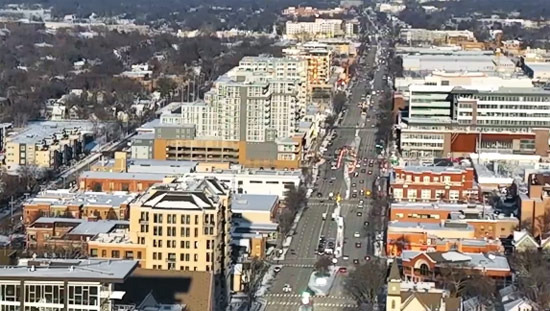
When I first moved to Madison, I was already sighing about the rent. Being the capital of Wisconsin and a college town with UW-Madison, I expected it to be expensive.
However, after doing some research, I found that even within the same city, rent can vary by hundreds of dollars depending on the neighborhood.
Where to live is the starting point of life in Madison. Each direction—north, south, east, and west—has a different vibe, and the rent prices vary significantly. If you move here without knowing this difference, you could end up paying unnecessarily high amounts. For newcomers to the city, understanding the rental market should be the first step. While researching doesn't cost anything, signing a lease without information could lead to paying hundreds of dollars more each month.
The actual numbers show a clear difference. As of 2026, the average rent in Madison for a one-bedroom is around $1,580 per month. However, in the Mayfair Park neighborhood, a one-bedroom can go down to $825. Near East and Sheridan Triangle also offer one-bedrooms for about $941. That's half the average price in the city. In the State Street area and Spring Harbor, you can find one-bedrooms for around $995, which is relatively reasonable considering they are not far from downtown. For unit types, the average for studios is $1,288, and for two-bedrooms, it's about $1,964. It's clear that depending on the neighborhood you choose, the rent can differ by over $600. Even for the same one-bedroom, the rent can nearly double depending on the area in Madison's rental market.
Of course, there are reasons for the lower prices. Mayfair Park is a bit farther from downtown, and Near East has had a reputation for safety issues in the past. However, in recent years, the overall crime rate in Madison has been steadily declining. Especially as you move northwest and to the outskirts, the perceived safety increases. Meadowood has a rent of $1,464, Sherman is at $1,499, and Bay Creek is around $1,600.
These neighborhoods offer a stable living environment for the price. They have decent access to schools and parks, and many are close to large grocery stores. While you shouldn't choose solely based on price, balancing cost and environment makes these areas realistic options. University Hill Farms is often mentioned as a neighborhood for those seeking a safe residence with a lower crime rate compared to the surrounding areas.
One thing I learned from the Madison rental market is to open a map and first calculate how many bus stops away you are from work or school. If you cling to living in the city center, the rent will skyrocket, but neighborhoods on the outskirts with well-connected Metro Transit bus routes are not bad for living. Madison has a relatively good public transportation system, making it possible to live without a car. Many people ask if it's feasible to live in this city without a car, but if you choose neighborhoods close to downtown, it is definitely possible.
When moving here, it's much more reasonable to first set a rent budget and then look for neighborhoods. When searching for listings online, it helps to first view them on a map and check the distance to bus stops.
Madison is a place where you can live next to Wisconsin's lakes and forests while keeping your wallet in check. Situated between Lake Mendota and Lake Monona, this city has the great advantage that no matter which neighborhood you choose, you are not far from nature. You don't have to give up on the natural environment just because your rent budget is tight. With a little effort, you can definitely find a neighborhood that is more livable than you might expect.
 AutumnLink
 CaffeinLvl





 cheesepup |
 breezem |
 yentra |
 virex |
 vexon87 |
 winter |
 planeto |
 marketbox |

 Wenda |
  werehere |
  problemo |
  galaxy88 |
  breezelove |
  Minnesota Sonata N |
  hazelnut |
  Korean News American Blog |
  AH LALA |
  Savion |
  pintos |
  Good Good |
  oh my salami |
  Lemonade Cider Planning Director |
  Way to easy |
  American Hardcore Band |
  Dala Dala |
  Pointy |
  Springs Korea |
  nixon |