
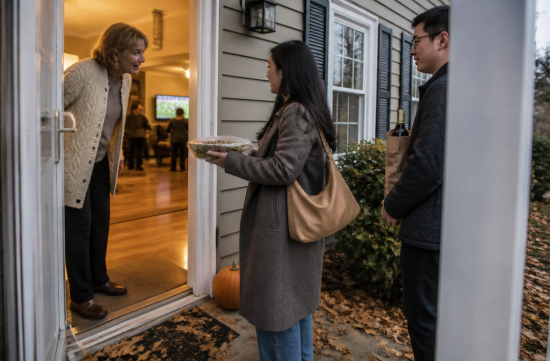
As the first American holiday after getting married approaches, my heart races oddly. This year's Thanksgiving is on Thursday, November 26, so there are just a little over three weeks left.
When it comes to Korean holidays, I have a general idea of what to expect. I prepare the pancakes, set the table, do the dishes, and gather the money envelopes.
However, if your spouse's family celebrates the holiday in an American way, the situation changes completely. At first, I didn't even know what to bring, and I spent a long time contemplating while looking at the stars at night.
The first thing that surprised me was the timing. Korean holidays last all day from morning, but in that household, everyone gathered late in the afternoon for a long dinner.
I offered to help in the kitchen early in the morning, and everyone looked at me wide-eyed. The host prepares the main dish, and it's customary for guests to arrive at the designated time.
So the first tip is this: Make sure to ask your spouse in advance, "What should I bring?"
American holiday tables often resemble potlucks, where each person brings a dish. You might be assigned a side dish, dessert, or wine.
At first, I brought a huge batch of japchae without deciding anything beforehand. Fortunately, the response was good, but it was a bit embarrassing since there was no room on the table for my dish because the sides were overflowing.
Since then, I always ask in advance. If you want to bring Korean food, saying something specific like, "Can I bring a plate of japchae?" makes it easier for the host to adjust the menu.
Speaking of food, the American Farm Bureau Federation (AFBF) conducts an annual survey on Thanksgiving dinner costs. According to the latest data available for 2025, the classic menu for ten people was $55.18.
This is a slight decrease from $58.08 in 2024. The survey usually comes out just before the holiday, so we can only refer to last year's data for now.
Looking at the numbers, it seems surprisingly modest, right? This figure only accounts for basic items like turkey, stuffing, sweet potatoes, cranberries, and pumpkin pie. That's why bringing a bottle of wine or dessert isn't a huge burden.
The second surprise was the television. The living room had football on continuously before and after the meal.
The Detroit Lions have been playing on Thanksgiving since 1934, except for six years from 1939 to 1944.
It's okay if you don't know the rules. Just asking which team they support can lead to easy conversation.
Passing around snack plates during the game or cheering together quickly makes you feel like part of the team. For someone who is shy, this time can even serve as a breather.
The third point is the expression of gratitude before the meal. Many families take turns sharing something they are thankful for that year.
At that moment, my mind went blank. So, I recommend preparing a short sentence in advance.
It doesn't have to be grand. Just saying, "I'm thankful for my new family" conveys your feelings well. Even if your English isn't perfect, speaking slowly and clearly will make everyone wait for you.
The fourth point is about doing the dishes. There is generally no pressure for the daughter-in-law to take care of the kitchen like in Korea.
Still, it's good to ask, "Can I help?" If they decline, don't insist; just thank them.
Instead, happily accept any leftovers they offer you. In the U.S., sharing leftovers is considered a kind gesture, so it's much more natural to say you'll enjoy them rather than declining.
The fifth point is about travel. According to AAA data, 81.8 million people are expected to travel more than 50 miles during Thanksgiving 2025.
The forecast for this year hasn't been released yet, but traffic jams are almost certain. It's better for your mental health to let go of the desire to visit both families in one day.
That's why many couples alternate holidays, spending Thanksgiving with one side and Christmas with the other. Changing the order each year helps reduce feelings of disappointment.
In fact, the most important thing is to communicate with your spouse in advance. Discuss what each of your families expects. If you agree on what time to arrive and when to leave, it significantly reduces the chances of awkwardness on the day.
It's also good to explain to your parents in Korea beforehand. Let them know that there are no rituals on American holidays, and that you'll video call them later in the evening to match the time difference. By communicating this in advance, there's no room for unnecessary hurt feelings.
Cultural differences aren't about who's right or wrong. They're just different rhythms at the table.
I found myself laughing a lot while looking at the stars on the way home after that first holiday. I made so many mistakes, but strangely, I felt proud.
So if it were me, I would check one dish to bring, prepare a line of gratitude, and just enjoy the rest.
Your first American holiday doesn't have to be perfect. That awkward day can become a sparkling memory later on.
 MelonHead
 RajoHarvest



 Anjollinya Blog |

 Kitchen Ideas |

 Spaghetti Flying Religion |

 Giant Squid and Sweet Potato Soup |

 choi family |

 andrew park |

 Living in New Jersey blog |

 springw |

 forestcloud |

 forestbon |
 ssome |
 skykong |
 Shining Our Own World |
 gardener 007 |
 golfmaster |
 Nanana Nanana Nanana |
 Who's watching? |
 endone |
 RockStar |
 Casa Mia |
 You Only Live Once |
 Hardworking CPA |
 Joyce 77 |
 Runner Kim |
 My Town My Way Blog |
 My Miami Stories |
 Entip |
 Tony Park |
 Jean Claude Bundang Blog |
 DJ DC BLOG |