

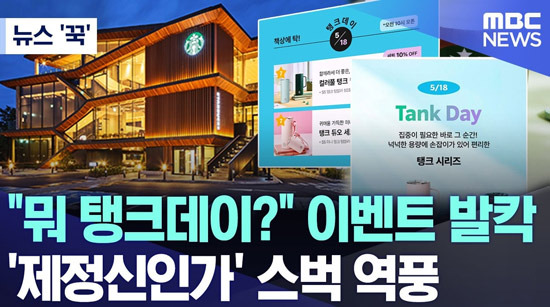
In May 2026, the event that shook social media was the 'Starbucks Korea Tank Day Incident'.
Starting on May 18 with a tumbler promotion called the Tank Series, this incident quickly escalated into nationwide outrage as it coincided with one of the most sensitive dates and expressions in modern Korean history.
Despite drastic measures, including the dismissal of the CEO within a day, the situation has not calmed down, with mentions of boycotts and contract issues with Starbucks headquarters.
Key Facts of the Incident: What Was the Problem?
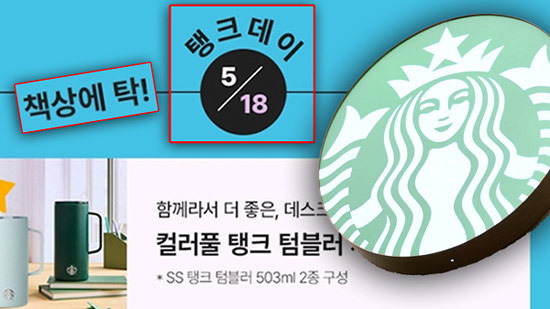
The controversy began with the 'Buddy Week' promotion conducted by Starbucks Korea. The period was from May 15 to 26, and the issue arose on May 18. In advertisements displayed on the official app and online store, the date '5/18' was prominently placed alongside the phrase 'Tank Day'.
The problem lies in this combination. May 18 is the anniversary of the Gwangju Democratization Movement, and the word 'tank' directly evokes the violent suppression by the military at that time. It was too sensitive a context to be merely a product name.
With the addition of the phrase 'Bang on the desk!', the controversy exploded. This expression recalls the symbolic statement made during the 1987 death of Park Jong-cheol, "When I banged on the desk, he died suddenly." Ultimately, a structure was created where two of the most symbolic events in Korean democratization history were evoked simultaneously within one advertisement.
Initial Response and Personnel Changes: CEO Dismissed Within a Day
The controversy spread rapidly right after the advertisement was exposed. Starbucks Korea immediately revised the wording and scaled back the event, but public opinion had already turned significantly against them.
As a result, Shinsegae Group made the decision to dismiss the CEO that evening. The marketing executive was also fired, and internal disciplinary procedures against the staff began. Along with a group-level apology, visits to organizations related to Gwangju followed, but some groups viewed this as insincere and refused to accept the official apology.
Thus, while quick actions were taken internally, a structure was formed where external public opinion was not easily settled.
Structural Issues: Is There a Possibility of Contract Termination by Headquarters?
The most frequently mentioned aspect of this incident is whether "Starbucks headquarters can terminate its business in Korea".
To put it simply, the likelihood is very low in reality.
Starbucks Korea is 67.5% owned by Shinsegae Group, and the headquarters operates on a royalty structure.
To terminate this contract, structural issues such as non-payment of royalties, continuous contract violations, or illegal activities would be necessary, rather than just a marketing controversy.
In fact, looking at global cases, there are very few instances where contracts have been broken due to isolated image controversies.
The withdrawal from Russia was a special case due to geopolitical risks at the national level.
Ultimately, this matter is more likely to be resolved through strengthened management at the headquarters level rather than contract termination.
Realistic scenarios include tightening marketing approval processes, internal reviews, and training systems to align with headquarters standards.
Many point out that this incident is not just a simple mistake but a systemic issue.
It is analyzed that Starbucks Korea has become overly focused on merchandise-centered marketing rather than being a coffee brand, leading to a weakened internal review process.
In fact, following this controversy, there have been cancellations of participation in major events and postponements of large promotions, resulting in direct revenue losses.
There are also complaints among frontline employees that the damage is being directly passed on to the stores.
Honestly, the extent to which this has escalated is something that is possible "because it is Korea". If the same marketing had been done in another country, it likely would have ended as just an awkward naming issue.
However, in Korea, specific dates and words are deeply intertwined with historical context, and touching on them immediately becomes a social issue. The problem is not just the sensitivity itself, but that companies continue to make similar mistakes despite being aware of this.
Although it is a global brand, the actual operations are local, yet local sensitivities are checked last.
In the end, apologies are made after the fact, people are let go, and the cycle repeats. It seems to be a typical pattern that arises from managing based on atmosphere rather than a system.
 MintCreator
 bluecloudexplorer2019





 Anjollinya Blog |
 Anova US Beauty Information |
 anchor |
 Korea Tiger News |
 Alpha and Omega World |
 Yo Lock Me Up |

 Weekend Movie Blog |
 Popular Song Exciting Song |
 California Information News |
  The Day the Sun Rises |
  sweetpop |
  California Kangaroo |
  zanero |
  station |
  Static |
  Star Way |
  American Blog Forge |
  MMORPG Games |
  Then you must be spring |
  Spicy Immigration Life |
  zenvor16 |
  The 2000 |
  toclick |
  wexlin84 |
  Hairy Poppins |
  daisypat |
  Taco Bell Candy Note Blog |
  MintO |
  My Town My Way Blog |