

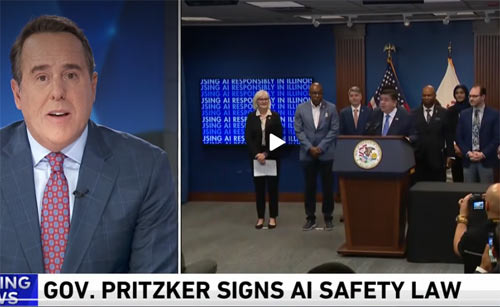
When observing the AI industry in San Jose, there's a phrase that's frequently heard these days: "AI technology is advancing too quickly, but the laws are too slow."
Recently, Illinois has officially declared its regulations by having the governor sign a strong AI safety law (AI Safety Measures Act).
From the perspective of Silicon Valley, this is not just an issue for Illinois alone. It serves as a signal for the direction of the entire U.S. AI industry moving forward.
Until now, discussions about AI have mostly focused on "how smart it has become." However, now the question of "how safe it is" is being treated with equal importance.
The core of this legislation is that AI developers like OpenAI, Anthropic, and Google must disclose their safety management practices and report any serious AI incidents that occur.
There are also protections in place for whistleblowers, allowing internal employees to report risks without facing repercussions.
In fact, similar measures are already being implemented in California and New York.
However, Illinois has one key difference.
It involves independent external audits.
For the first time in the U.S., AI companies of a certain size will be required to undergo regular safety audits by a third-party independent organization.
There are no exceptions for AI companies with annual revenues exceeding $500 million.
Based on the audit results, the effectiveness of their safety management systems will be continuously verified.
This provision is set to take effect in January 2028.
From the viewpoint of Silicon Valley, this represents a significant symbolic change.
Until now, AI companies have emphasized self-regulation, claiming, "We will manage safety ourselves."
But now the government is saying, "We will check it ourselves."
Interestingly, both OpenAI and Anthropic have publicly supported this legislation.
It may seem surprising that companies subject to regulation would actually be in favor of it.
However, from the industry's perspective, it makes sense. Currently, there is no federal-level AI legislation in the U.S.
Instead, states like California, New York, and Illinois are creating slightly different rules.
For companies, having different laws in each state can lead to skyrocketing operational costs.
Therefore, it is much easier to manage if similar rules are applied across multiple states.
In fact, OpenAI is actively providing input in the legislative processes related to AI in various state legislatures.
Creating a unified regulatory framework will ultimately benefit companies in the long run.
Another point to note is the protection of whistleblowers.
In Silicon Valley, this culture is already becoming significantly established.Many large tech companies operate internal reporting systems, but making it a legal requirement carries a different meaning.
So what about California? In fact, California is also proactive about AI regulation.
It has passed several laws regarding AI transparency, deepfake labeling, and the use of AI in elections.
With Illinois also introducing a strong safety audit system, U.S. AI companies are now in an environment where they must consider regulations from multiple states simultaneously.
When talking with startup representatives in San Jose, it's clear that the atmosphere has changed significantly from before.
A few years ago, the main concern was "how quickly can we launch models?" Now, the first questions from investors are about "is it legally compliant?", "is the data source clear?", and "can we prepare for audits?"
Especially venture capitalists are starting to evaluate AI startups not only on their technological capabilities but also on their ability to respond to regulations.
In the future, simply creating an outstanding model may not be enough for success.
Companies equipped with safety documentation, data management systems, and internal control systems are entering an era where they are recognized for their higher value.
AI competition will continue, but now it's not just about "who can create the smartest AI."It's becoming a new standard for companies to determine their competitiveness based on "who can operate AI more safely and responsibly."
 ApricotLaugh
 RegularChun






 Hajiwon Blog Hair Salon |
 tartbear |
 novapixel |
 NEXT ROUND |
 Encyclopedia of New York and Surrounding Areas |
 DOCTOR MED |
 Reggae Party |
 Breaking Bad Drama |
 Shining Our Own World |
 Happy Together 213 |
  The 2000 |
  toclick |
  wexlin84 |
  Hairy Poppins |
  daisypat |
  Taco Bell Candy Note Blog |
  MintO |
  My Town My Way Blog |
  New Mexico Friends MAX |
  Wicked - Fireyo |
  Seattle - Emerald City |
  new noah |
  xylora |
  Anjollinya Blog |
  total solution |
  Vacation on Hawaii |
  valtri |
  August Snowman |
  Way to easy |