
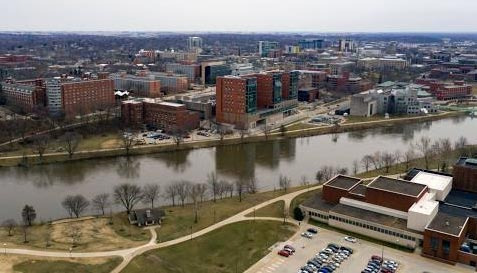
Iowa City is one of the oldest cities in Iowa, boasting a rich history and cultural heritage. This city has evolved from a political center, being an early state capital, to a hub of education and the arts today.
1. Early History: Land of the Natives
The Iowa City area has been inhabited by various Native Americans, including the Sauk and Fox tribes, for over 12,000 years. Thanks to its geographical advantage near the Mississippi River, this area became a center for trade and hunting among the natives.
2. Establishment of the City and Role as Capital
Background of Establishment (1839):
When Iowa was designated as a territory in 1838, it was decided to move the capital of the territory, and Iowa City, located west of the Mississippi River, was selected as the new capital.City Established (1839):
Iowa City was established to build a state government building, and the Old Capitol building was erected at the center of the city. This building later served as the state government building and became an iconic landmark of the city.Capital Relocation (1857):
In 1857, when the capital of Iowa was moved to Des Moines, Iowa City lost its role as the capital but began to grow as a center of education and culture instead.
3. Growth as an Educational Hub
Establishment of the University of Iowa (1847):
After the capital was relocated, Iowa City transformed into a center of education. With the establishment of the University of Iowa, the city became a hub for scholarship and research.- First Law and Medical Schools: It made history by establishing the first medical and law schools in the United States that accepted both women and men equally.
Literature and Arts:
The University of Iowa is home to the Iowa Writers' Workshop, the oldest creative writing program in the United States, producing world-renowned authors and known as a mecca of literature.
4. Modern Developments
City of Culture and Arts:
In 2008, Iowa City was designated a City of Literature by UNESCO, reflecting the unique identity of a city that loves literature and the arts.Urban Renewal:
Since the mid-20th century, Iowa City has restored historical buildings around the Old Capitol and developed a vibrant downtown area, evolving into a modern city.
5. Major Historical Events
- 1839: Establishment of Iowa City.
- 1847: Establishment of the University of Iowa.
- 1857: Capital relocated to Des Moines.
- 2008: Designated as a UNESCO City of Literature.
Iowa City continues to develop as a center of education and the arts while preserving its historical heritage as a former state capital. The University of Iowa is key to the local economy and cultural development, and the downtown area boasts a modern atmosphere and unique character.
Iowa City is a city where the past and present harmonize, offering visitors a special place to experience rich history and vibrant culture.








 Hoorah Ooorah |

 Iowa Egen Aunt |
 Iowa School News |
 dralix58 |
  Gorama Round |
  Skydiving |
  dreamport |
  Yellow Snowman |
  Toaster Pizza Magic Show |
  velvetnom |
  Anytime Journey |
  Mrs. Duluth |
  jaxter |
  Atlanta Mama |
  Baguette Blog |
  US Embassy |
  Korean Mom |
  My NYC |
  moo moo |
  Mr Oh |
  forevergee |
  festival |
  manchester |