

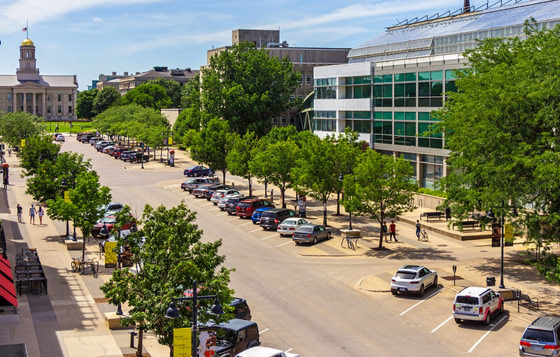
Living in Iowa City, you naturally come to feel why this place is particularly known as a 'city with a high settlement rate.'
At the same time, as you live here, you will inevitably notice some inconveniences or frustrations. With clear advantages and disadvantages, it can feel like paradise to some and just a quiet countryside to others; that is Iowa City.
The biggest advantage of Iowa City is undoubtedly its educational and healthcare environment. The University of Iowa, which ranks among the top public universities in the United States, is located here, and its medical school and hospital are recognized for their high standards nationwide. With the development of medical technology and research centered around the University of Iowa Hospitals, this small city holds significant influence in the healthcare industry.
Thanks to this, local residents can relatively easily enjoy systematic healthcare benefits, and the influx of medical personnel helps maintain the city's economy stably. In terms of education, there are abundant programs and activities available not only for college students but also for elementary and middle school students, leading to many evaluations that it is a good city to raise children.
Another advantage is the safe and calm atmosphere of the city. The crime rate is low, and people tend to be relaxed and friendly. There is no bustling or frantically fast-paced feeling like in big cities, making it an attractive environment for families or those who desire a quiet life.
Housing costs are also less burdensome than in large cities, and the natural environment is well-preserved. There are many walking paths, parks by the rivers, and bike trails throughout the city and its suburbs, making it enjoyable for outdoor activities. Not having to engage in the daily chaotic commute is a significant advantage for many.
However, the charm of this city does not resonate with everyone. The biggest disadvantage of Iowa City is the limitations of a small city. Due to its smaller population, shopping, cultural activities, and entertainment options are limited.
Elements commonly found in large cities, such as trendy restaurants, performances, and shopping malls, are relatively scarce, and especially for young professionals or outgoing individuals, it may feel like a 'boring city.' The dining culture also lacks diversity, making it easy to feel like you are repeating similar foods after living here for a long time.
Additionally, the weather can be quite a drawback. Iowa City cannot escape the extreme temperature changes and long winters typical of the Midwest. In winter, snow, ice, and strong winds make travel inconvenient, and in summer, there are many days when humidity and heat suddenly intensify.
This climate inevitably affects car maintenance, heating costs, and outdoor activities. Moreover, air travel is limited, so traveling to distant areas or abroad requires using airports in Chicago or Cedar Rapids, which can be inconvenient.
Finally, the city's economic structure heavily relies on education and healthcare, which is something to consider. While it is stable, the lack of broad industrial diversity may make it feel like opportunities are limited for professionals in fields other than specific areas or for those dreaming of starting a business.
Ultimately, the stability of the city also means it may be an environment where rapid growth or explosive diversity is difficult. In the end, Iowa City may be the ideal city for those who value stability and educational and healthcare benefits, but it could feel somewhat frustrating for those expecting diverse cultures and fast economic opportunities.







 Hoorah Ooorah |

 Iowa Egen Aunt |
 Iowa School News |
 US Embassy |
  Korean Mom |
  My NYC |
  moo moo |
  Mr Oh |
  forevergee |
  festival |
  manchester |
  constant |
  Leapfrog Move |
  vibranto |
  Tora Tora |
  yellowbutter |
  Dolly |
  NYC saladbar |
  Finding Superfoods |
  lightyear |
  song bang |
  vexomo |
  Indiana Jones |