
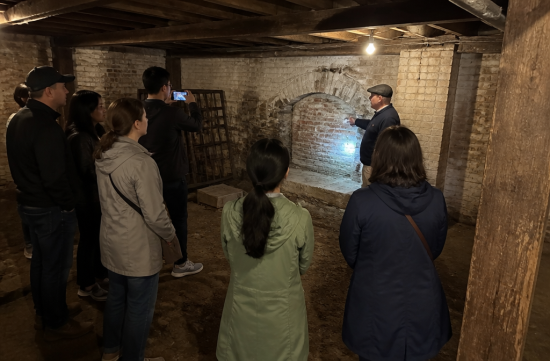
When you join a tour that goes down into the underground near Old Town, there's a story that the guide always tells. It's about a trapdoor in a bar opening up, and a man who has lost consciousness being dragged into an underground passage and loaded onto a ship.
This is the legend of Portland's 'Shanghai Tunnels.' It sounds plausible, and honestly, it's quite entertaining.
However, since I tend to focus on numbers and records, I get curious about the sources when I hear such stories. So, I did some research this time.
To cut to the chase, there were kidnappings, but there is no evidence of a tunnel network. To understand the legend properly, we need to separate these two aspects.
First, let's look at what is real. From the late 19th century to the early 20th century, there were indeed instances of sailors being forcibly put onto ships along the Columbia River in Portland and Astoria.
This practice was known as shanghaiing in English, and in industry terms, it was called crimping. The brokers who would find sailors and sell them were referred to as crimpers.
The most famous name associated with this is Joseph "Bunco" Kelly. The Oregon Encyclopedia lists him as a notorious crimper alongside Larry Sullivan and Jim Turk.
Interestingly, the charge that landed Kelly in prison was not for kidnapping sailors, but for murder in 1895.
It's noted that crimping itself was not punishable as a crime at that time. This means that the act of selling people was in a legal gray area, which is quite shocking by today's standards.
So, how did it happen? It's easy to imagine scenes of people being beaten and dragged away like in the movies, but records tell a different story.
Most often, it involved drugging drinks in bars. Barney Blalock, a historian of Portland's coastal history, believes that actual physical violence was rarely used.
Now, about the tunnels. The Oregon Encyclopedia, published by the Oregon Historical Society, summarizes that historians have found no evidence to support the existence of a tunnel network used for kidnappings.
In a 2007 report by The Oregonian, local historians stated that they found virtually no evidence during their research. Some even question whether there were tunnels beyond passages connecting building basements.
So where did this story originate? Records linking tunnels to kidnappings first appeared in newspaper articles from the 1970s.
At the center of this was a figure named Michael P. Jones. He founded the Cascade Geographic Society in 1979 and operated tunnel tours.
Jones reportedly collected stories from homeless individuals and the elderly. However, there are criticisms that his collected oral histories were mixed with his own interpretations.
He passed away in March 2020. There have also been reports that after the ownership of the buildings changed, his organization lost the space for the tours.
So, did underground spaces not exist at all? That's not the case. Basements and passages did exist, and there are suggestions that they were used for smuggling, illegal gambling, and alcohol trade during Prohibition.
Finn John from Offbeat Oregon believes that while some underground spaces may have been connected to kidnappings, it's unlikely that tunnels were needed to transport unconscious sailors to the docks, as it was common to help drunk sailors to the ships.
There are varying opinions among historians. Some, like Blalock, deny the existence of tunnels altogether, while others believe there may have been small-scale operations.
So how did this practice come to an end? One factor was technology. As sailing ships were replaced by steamships, the demand for forcibly filling ships with sailors decreased.
The other factor was legislation. The Seamen's Act, signed on March 4, 1915, eliminated the penalties for arresting and imprisoning deserting sailors.
This law is often referred to by the name of Senator La Follette, but many credit the actual designer as Andrew Furuseth, the chairman of the International Seamen's Union. Ultimately, labor organizations put an end to forced labor at sea.
I believe this point is far more significant than the legend itself. The essence of kidnapping lies not in dark tunnels, but in a labor structure where workers had no freedom to quit their jobs.
Having lived as an immigrant for a long time, I often see similar patterns. Those with unstable identities and limited language skills are more easily exploited by brokers.
Many of the sailors of that time were also foreigners who had landed in unfamiliar ports. Considering this, it's not just a story to be heard and laughed at.
This doesn't mean you shouldn't go on the tour. Just enjoy the guide's stories as entertainment, and I recommend verifying the facts through the Oregon Encyclopedia or Blalock's book, The Shanghaiers.
If I were to remember just one thing before going down the underground stairs, it would be this: the real horror isn't the trapdoor in the floor, but the legal loopholes that allowed people to be bought and sold without punishment.
 WhatDoUSA
 BusanYeocha




 Art patch |

 Rice Shop Uncle BLOG |

 Noodle Noodle |

 Chino Min |

 Glow Yo |

 mistily |

 Oregon Our Neighborhood Story |



 jammybear |
 action blog 101 |
 athome blog |
 calvor |
 Haha and Bomi Blog |
 Lee Ton |
 viba viba |
 Olivia's Blog |
 208 Master |
 crumb |
 blanke |
 Burbank Lee |
 tervox95 |
 silverado |
 Grow Your Gut Bacteria Well |
 Kim You Shin |
 Squid Q |
 gelatonew |
 river9 |
 ttano |
 Eagle in America for Five Years |