

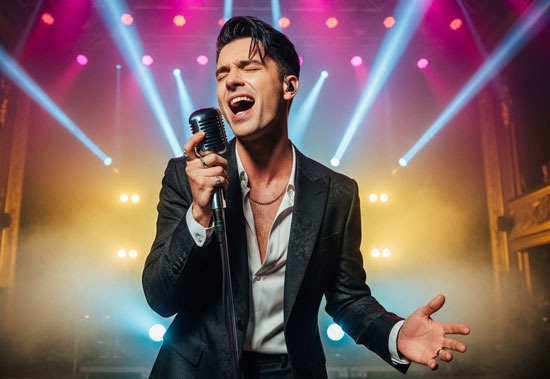
If we are in an era where AI actors are becoming increasingly natural and appearing just like real actors, then AI singers are also a future that is entirely imaginable.
However, we know well that virtual idols and characters have existed before, and most of them have failed miserably.
The AI singers currently being discussed are not simply faceless characters; they are fundamentally different in that they learn to express voice, lyrics, and emotions on their own and perform on stage.
What if they not only sing but also communicate with fans, reflect opinions to improve albums, and even analyze trends to determine their own concepts? Rather than replacing real singers, we are entering an era where they become another type of artist competing with human singers.
One of the biggest reasons for the emergence of AI singers is the industry structure. To nurture a single singer, agencies and production companies invest enormous amounts of money, time, and human resources. However, AI singers have no trainee period, pose a low risk of causing problems, do not suffer from condition issues, and do not need rest.
They can improve their skills with updates at any time, and their song production speed is fast. The near-zero possibility of moral controversies, dating rumors, contract disputes, and personality scandals is a very attractive factor for the entertainment industry. Especially for virtual humans, there are no age restrictions, and their appearance or image can be changed immediately as times change. From the company's perspective, they become a much more advantageous asset than human singers with limited lifespans.
But the most interesting aspect is that these AI singers can become not just "substitutes" but "new stars."
Fandom is not created solely for tangible people; it is formed through experiences of exchanging emotions. If AI singers create songs directly reflecting fans' opinions and analyze comments to convey emotionally resonant messages, fans can feel an emotional connection to their existence.
In a way, a kind of emotional simulation occurs between humans and machines, which can feel like real emotions to people. Since people can already feel affection for characters in games or virtual streamers, there is a strong possibility that they can also become deeply engaged with AI singers.
Of course, there are limitations. AI lacks experience. Emotions like love, loss, embarrassment, and the joy of success have depths that only humans can truly feel and express. Therefore, a more realistic approach would be a collaboration between technology and humans rather than a singer that completely replaces humans.
For example, it is likely that we will see a blurred boundary where the emotions of a human lyricist combine with AI-generated melodies, or an AI vocal based on a human singer's timbre performs instead. Ultimately, AI singers will evolve into beings that replicate human emotions to sing, and people may decide their fandom based on whether the song is "good" or "attractive" rather than whether the emotions are real or fake.
In the end, the era of AI singers will not be a time when human singers disappear, but rather a time when options expand. A stage will unfold where real human emotions and the infinite reproduction capabilities of AI compete and collaborate, and the public may enjoy both simultaneously.
It seems that the moment when technology does not eliminate art but creates new artists is approaching.






 HAWAII Korean Church News |
 Gorama Round |
 LIZ Legal Information Blog |
 Egg Steamed Pot |
 novapixel |
 Cali M Law Group |

 U.S. Weather Bureau News |
 Various Knowledge and Information in the USA |
 Tonky |
  viroma |
  cookie |
  Live and that's it |
  Alright Twain |
  eatontown blog |
  Amore |
  linex |
  Balancework |
  laro90 |
  MEDBIO American Doctor Blog |
  SWAT TEAM BLK |
  DREAM BIG |
  frostbite |
  330 Forever My Love |
  El Dorado |
  dralix58 |
  Skydiving |