
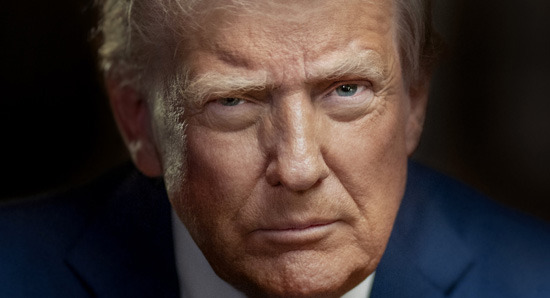
Donald Trump...
As I read about this person who is currently serving as the second-term President of the United States through Google, I couldn't help but think, "A person can politically transform this much." The Trump of his real estate mogul days in New York was far from the 'icon of the right' we know today. In fact, there are numerous photos of him cozying up with Democratic politicians at parties.
In his younger days, he was more interested in glamorous real estate projects, casinos, and events like the Miss Universe pageant than politics, and even when he did express political leanings, he was more of a 'pragmatist' aligning himself with whichever side was advantageous at the time.
However, as time passed into the 1980s and 90s, his words and actions began to take on a more conservative hue. With the decline of manufacturing in the U.S. and the expansion of global trade, Trump early on claimed that "China and Japan are stealing America's wealth."
At the time, it was merely seen as the grumbling of a billionaire in the real estate industry, but looking back, this became the foundation of his political brand. In short, he had sown the seeds of "America First" early on.
In the early 2000s, he even considered running for president as a Reform Party candidate, and back then, he had a much more flexible stance on issues like abortion and gun control than he does now. However, public response was lukewarm, and he returned to his main business.
During this time, he gained widespread popularity through reality shows like 'The Apprentice,' where his celebrity image was much stronger than his political one. In fact, until this point, no one could have imagined that he would rise as the savior of the American conservative movement.
Trump truly began to exert influence on the political stage during the Obama era. Particularly, he captured the attention of the radical conservative base by leading the spread of the birth certificate conspiracy theory, known as the 'birther movement.'
There was already distrust of 'elite politicians' in Washington within the Republican Party, and Trump became the figure who expressed that distrust with his blunt speech and aggressive attitude. His shocking statement during the 2015 presidential campaign that "Mexican immigrants are criminals" shook the American political landscape.
That statement earned him widespread condemnation from mainstream media, but at the same time, it garnered fervent support from conservative voters. Ultimately, he solidified his image as an "honest outsider against political correctness" and paved a different path from the Republican mainstream.
Interestingly, Trump's shift in political stance was not solely due to personal beliefs. As a businessman, he had always excelled at matching supply to demand, and this was directly applied to politics.
He quickly caught on to the real anxieties of American society, particularly the collapse of the middle class, the outsourcing of manufacturing jobs, and dissatisfaction with immigration issues. He expressed these raw feelings in a radical manner, gaining public empathy. It was as if he conducted market research and branding within the political arena.
From this perspective, Trump's rise as a hope for the American right was perhaps inevitable.
Instead of the sophisticated political language of Washington, he used a simple and direct slogan: "Make America Great Again." His strong criticism aimed at illegal immigrants and China, along with a constant emphasis on the narrative of 'we must fight against them,' provided a powerful catharsis for conservative voters disillusioned with existing politicians.
Ultimately, Trump won the presidency in the 2016 election, defeating the established Republican candidates, which signified a complete shift of his political stance to the center of the conservative movement. Of course, there were still many contradictions within that. He was once friendly with Democratic politicians and had a history of opportunistically changing his statements on social issues.
However, ironically, even those contradictions were packaged as an image of a 'flexible negotiator' and were seen as an advantage by his supporters.
Looking back at how Trump became the hope of the American right, the answer is quite simple. He was the only politician who voiced the anxieties of American society louder and more directly than anyone else when they were feeling insecure.
By bringing to light the issues that existing politicians avoided with calculated language, he provided a sense of relief. In the process, his stance gradually tilted more towards conservatism, and he has now firmly established himself as an icon of the American right.
Trump's political journey resembles that of a businessman. Initially, he oscillated between the left and right, but then he discovered the market that would consume him most fervently and went all in there.
So perhaps right-wing supporters now see Trump as a 'hope' that represents their voice.






 El Dorado |
 Eldorado 88 |

 Washington Monument |
  laro90 |
  MEDBIO American Doctor Blog |
  SWAT TEAM BLK |
  DREAM BIG |
  frostbite |
  330 Forever My Love |
  dralix58 |
  Gorama Round |
  Skydiving |
  dreamport |
  Yellow Snowman |
  Toaster Pizza Magic Show |
  velvetnom |
  Anytime Journey |
  Mrs. Duluth |
  jaxter |
  Atlanta Mama |
  Baguette Blog |
  Tan Sol |