

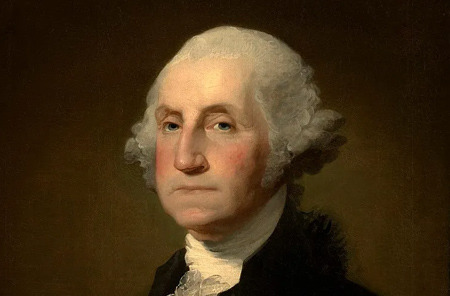
The first President of the United States, George Washington, is an indispensable figure in American history.
Without him, the America we know today would likely be very different. Washington is not only the first President but is also referred to as the Father of His Country. His legacy has had a significant impact not only politically but also militarily, culturally, and economically.
George Washington was born on February 22, 1732, in Westmoreland County, Virginia. He was born to a wealthy plantation owner and grew up among the landowning class. However, at the time Washington was growing up, America, which was a British colony, had not yet achieved independence. During this period, his education was mostly self-taught, and he consistently studied subjects like mathematics, geography, and history.
Washington first came to prominence during the French and Indian War (1754–1763). The Seven Years' War, which took place in Europe during the 1750s and 60s, had a significant global impact. The war in Europe affected the New World, leading to the outbreak of the French and Indian War (1754-1763). This war was primarily fought between France and Britain over dominance in the New World, with French colonial forces and Indian tribes fighting against the British colonies.
George Washington gained his first military experience in this war. At the time, he served as an officer in the Virginia colonial militia, supporting the British Army. Washington made some contributions during this war, but overall, he did not achieve significant victories in battle. Nevertheless, he built connections in the New World and gained military reputation, later emerging as a key figure in the American Revolutionary War.
British Tax Increases and Colonial Resistance
The French and Indian War placed a heavy burden on Britain, leading the British government to seek ways to cover the war costs from the colonies. As part of this, they imposed taxes on the colonies and enacted laws prohibiting settlement in the newly acquired French colonial territories. This led to growing discontent among the colonists. In particular, as colonial development and trade freedoms were restricted, colonists faced economic hardships, prompting them to advocate for an independent stance.
This situation triggered the American Revolutionary War in 1775, and the colonists declared independence against British taxes and control. At this time, the Continental Congress was looking for a Commander-in-Chief of the Continental Army and chose George Washington, who had built a military reputation in previous wars.
One of his most famous achievements is his leadership during the American Revolutionary War. In 1775, when the war with Britain began, the Continental Congress appointed Washington as the Commander-in-Chief of the Continental Army.
Although Washington was appointed as Commander-in-Chief of the Continental Army, he faced many difficulties initially. At that time, the Continental Army was in a much weaker military state compared to the British Army, and most soldiers were militia members with experience only in battles against Native Americans or French colonial forces. Additionally, they had never fought against the well-trained British Army. Washington also made several tactical mistakes and suffered a series of defeats against the British Army.
The early battles of the Continental Army were challenging due to their disorganized nature. As a new commander, Washington made several tactical mistakes, but there were not many alternatives available. Figures like Benedict Arnold, Daniel Morgan, and Nathanael Greene played active roles, but among them, Benedict Arnold initially played a significant role. However, Arnold later committed betrayal, causing great disillusionment for Washington and the Continental Army.
One of the most famous anecdotes from the war is the crossing of the Delaware River in 1776. During the winter, under harsh weather and pressure from the British Army, Washington led his troops across the Delaware River to launch a surprise attack. This operation resulted in a victory at the Battle of Trenton, boosting the morale of the army and changing the course of the war.
However, it was not easy until the end of the war. Washington, nevertheless, never gave up and ultimately defeated British General Cornwallis at the Battle of Yorktown in 1781, securing American independence.
He maintained the army's morale through leadership and determination, leading the battles with a spirit of never giving up. In particular, victories at the Battle of Trenton and the Battle of Princeton became turning points that raised the morale of the Continental Army, leading to gradual victories against the British Army.
At the Battle of Yorktown (1781), Washington decisively defeated the British Army, ultimately achieving American independence. After the Revolutionary War, Washington was elected as the first President of the United States, laying the foundation for the new nation.
Role as the First President
After the Revolutionary War ended in 1783, Washington played a crucial role in rebuilding the nation. At that time, America was politically and economically very unstable. Washington played an important role in the 1787 Philadelphia Constitutional Convention, resulting in the birth of the United States Constitution. Then, in 1789, he was elected as the first President of the United States.
As President, Washington made truly significant decisions. One of the most important was establishing America's neutrality policy. At that time, there was fierce fighting between France and Britain in Europe, and Washington argued that America should maintain neutrality in foreign affairs. This was an important measure to prevent America from getting entangled among the great powers during a politically tumultuous time.
Despite early military failures, George Washington demonstrated strong leadership and patience, leading to victory in the American Revolutionary War. He cannot be evaluated solely by the victories and defeats on the battlefield; as the Father of His Country, he played a crucial role in leading the Continental Army and shaping the nation anew. Washington had early tactical mistakes and faced betrayal, but the leadership and vision he displayed hold significant meaning in American history.
Washington's leadership was not limited to his term in office. He had a profound influence on America's political, social, and economic systems. He valued the rule of law and national unity, laying the groundwork for America to grow into a stronger nation. Washington is regarded as a leader who fought for American democracy and freedom as a selfless leader.
His legacy is rooted not only in political influence but also in his morality and humility, as well as his leadership that united America. Today, Washington D.C. stands as a city honoring him, with many monuments and statues erected in his memory.
He will be remembered in American history as a leader in war, a political leader, and a moral leader. Washington's achievements and his spirit continue to embody the core values of America today.





 El Dorado |
 lightyear |
 Moscow Kim |
 coloradoman |
 Montgomery Mom |
 Eldorado 88 |

 Washington Denzel DJ |
  Tonky |
  viroma |
  cookie |
  Live and that's it |
  Alright Twain |
  eatontown blog |
  HAWAII Korean Church News |
  Amore |
  linex |
  Balancework |
  laro90 |
  MEDBIO American Doctor Blog |
  SWAT TEAM BLK |
  DREAM BIG |
  frostbite |
  330 Forever My Love |
  dralix58 |
  Gorama Round |
  Skydiving |