

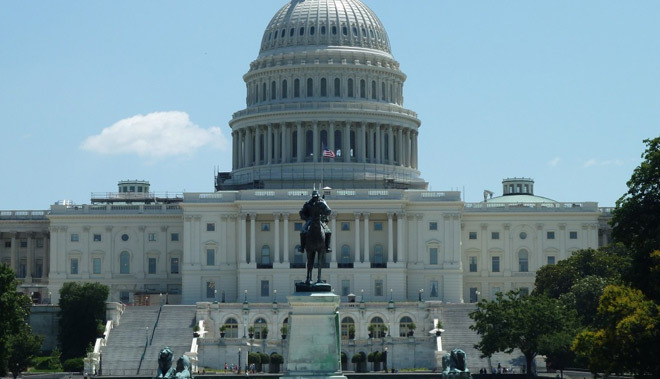
When thinking of Washington DC, the first thing that comes to mind is the United States Capitol.
It is the very building seen countless times in TV news and movies. From a distance, it appears as a solitary white classical structure standing quietly, but inside, it holds over 200 years of history since the founding of America, filled with numerous political events, anger and conflict, compromise and drama.
Right after American independence, the capital was not initially DC. It was briefly in New York before moving to Philadelphia, and in a compromise to build a new capital for political balance between the North and South, land along the Potomac River was chosen. It is well known that George Washington was among those who participated in that proposal.
In 1793, construction of the Capitol began when President Washington himself turned the first shovel. However, the construction was not smooth. The budget was always lacking, completion schedules were continually delayed, and the architect changed midway. The initial appearance of the Capitol was also completely different from what it is today. There was no dome, and it had a relatively simple structure before the wings were added on both sides.
Then, the War of 1812 broke out, and in 1814, British troops invaded Washington DC and set fire to the building, causing most of the interior to be destroyed. The phrase "the British burned the White House" from history books refers to this event. What remained were only parts of the outer walls and traces of burning. It was truly a pile of ashes. Nevertheless, the decision to rebuild rather than demolish the building changed the fate of the current Capitol.
During the reconstruction, the massive dome, which is now a symbol, was included in the design. The tall, round dome is not merely decorative but is called a structure symbolizing American ideals. The technology to stack iron structures and delicate panels was not easy, so the construction period was long.
There is a story that construction continued without interruption even during the Civil War, which is said to convey the message that "the Union shall not be shaken." Ultimately, in 1866, the dome was completed. Finally, the silhouette of the Capitol as we know it was finished.
Upon entering the building, the central rotunda immediately catches the eye. The ceiling of the massive circular hall is adorned with murals depicting the myth of American founding, and a ring-shaped corridor leads to the separation of the Senate and the House of Representatives. The Senate and House of Representatives are arranged in separate wings like distinct buildings, which is why it is also referred to in English as "The Hill." This is the place where bills move back and forth between the Senate and House, fighting, negotiating, and refining.
The steps in front of the Capitol are also famous as the site of presidential inaugurations. In the cold winter, the scene of the president, dressed in a thick coat, placing a hand on the Bible and taking the oath is a recurring image in American history. Looking down, the path stretching towards the Mall ends with a clear view of the Washington Monument. The city's design itself was created considering symbolic sight axes.
Of course, history is not only beautiful. The Capitol is the birthplace of democracy, but it has also been a center of conflict and division. Legislators raised their voices over the issue of slavery, and just before the Civil War, there are records of some throwing desks and others wielding canes in fights inside the Capitol. This building is a microcosm of American politics. A place where ideals and reality collide, where bills are born and discarded, sometimes offering hope and at other times disappointment.
As time passes, visiting DC, this Capitol is more than just a tourist spot. People take photos against the backdrop of the white walls and dome, enjoying lunch on the lawn, students on group tours, and citizens holding protest signs somewhere. Even in the peaceful scenery, the weight of what this place has endured remains in every corner of the building.
The completion of this building was not simply due to stacking bricks and marble. History, war, compromise, criticism, cheers, and division—every emotion and event has layered upon each other to create the Capitol we see today. From a distance, it appears as an elegant white dome, but up close, it shows scratches and traces.
Thus, the Capitol is thought of not just as a building but as a symbol of politics born from the interplay of ideals and reality.







 SEVEN SEVEN |
 Korean Mom |
 novapixel |
 Peter Pan Pet |
 horse |
 El Dorado |
 Eldorado 88 |


 phoenixia |
  viewtop |
  loverun |
  Kim Do Sun |
  yentra |
  Make My Day |
  Victory 1988 |
  Tonky |
  viroma |
  cookie |
  Live and that's it |
  Alright Twain |
  eatontown blog |
  HAWAII Korean Church News |
  Amore |
  linex |
  Balancework |
  laro90 |
  MEDBIO American Doctor Blog |