
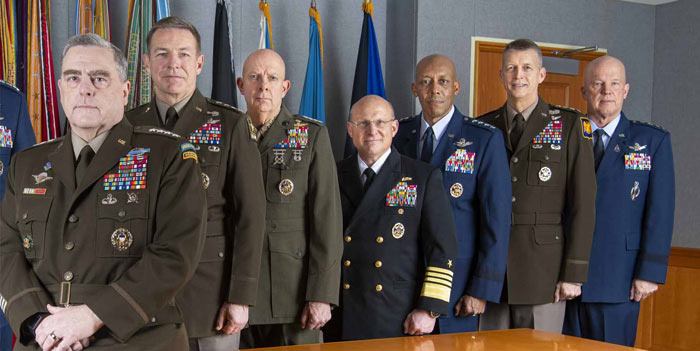
Becoming a general in the U.S. military, which is equivalent to earning a star in our language, is a path that only a very small number of people can take. It may be even more difficult and have a lower probability than becoming a CEO of a large corporation.
It is said that there are about 800 generals with one star or more in the U.S. And the average salary for a one-star general is about $220,000. Depending on the duty station, housing and living allowances can further increase the effective salary and quality of life.
The first way to become a general is to graduate from a regular military academy such as West Point, the Naval Academy in Annapolis, or the Air Force Academy in Colorado Springs. The second way is to be selected as a candidate officer through the ROTC program at a civilian college. The third way is to enlist as a regular soldier and go through the OCS (Officer Candidate School) to become an officer. Among these, graduates from military academies have significant advantages in networking and education, while ROTC graduates are also produced in large numbers, and OCS has relatively fewer candidates but remains an open possibility.
After commissioning, most start as second lieutenants (O-1) and after 18 to 24 months, they are promoted to first lieutenant (O-2), and by the fourth to fifth year, they reach captain (O-3). Up to this point, promotions are almost automatic, and most pass without significant issues.
However, from the rank of major (O-4) onwards, promotion reviews begin, and this is where filtering starts. In the U.S. military, as ranks increase, positions become limited, so excellent evaluations, combat experience, degrees, leadership, and networking have a significant impact on promotions.
It is said that less than 30% of commissioned officers reach the rank of colonel (O-6). In other words, the majority are already filtered out by this point.
So, what about becoming a general? The number of generals (General/Flag Officers) in the U.S. military is legally defined.
There are about 800 active-duty generals and admirals, and among them, there are fewer than 40 four-star generals across all branches.
For example, thousands of officers are commissioned each year in the Army, but ultimately, less than 1% earn stars.
In terms of probability, the path from being commissioned as an officer to becoming a general is between 0.5% and 1%, and reaching four stars is at a level of about 0.01%.
To become a general, it is not enough to simply fill ranks; there are several essential conditions.
First, there is the requirement of positional experience. You must have key command experience such as battalion commander, brigade commander, or division commander. Second, academic and strategic abilities are required, which means completing courses at the Command and General Staff College or War College. Third, practical experience is crucial, as there are almost no generals without overseas deployments or combat experience. Lastly, political acumen and networking are also important.
General appointments are made by the President with the consent of the Senate, so they are connected not only to internal military reputation but also to Washington politics.
Ultimately, becoming a general in the U.S. military is not just about skill.
It requires consistently delivering results over a long period, along with luck, timing, and networking. Therefore, the rank of general is not just a single star but the result of over 30 years of experience, countless competitions, and the survival of only a few among thousands.
Statistically, about 1 in 100 officers can earn a star, while the reality is that the rest either stop at colonel or retire before that.
In summary, the way to become a general in the U.S. military starts with commissioning as an officer through military academies, ROTC, or OCS, and then requires exceptional command and tactical abilities, educational qualifications, practical experience, and political trust.
The probability is extremely low, but precisely because of that rarity, from the moment you earn a star, you become a leader representing the entire U.S. military.







 Eldorado 88 |


 Washington Monument |
 heartbreaker |
  Korean Mom |
  My NYC |
  moo moo |
  Mr Oh |
  forevergee |
  festival |
  manchester |
  constant |
  Leapfrog Move |
  vibranto |
  Tora Tora |
  yellowbutter |
  Dolly |
  US Embassy |
  NYC saladbar |
  Finding Superfoods |
  lightyear |
  song bang |
  vexomo |
  Indiana Jones |