

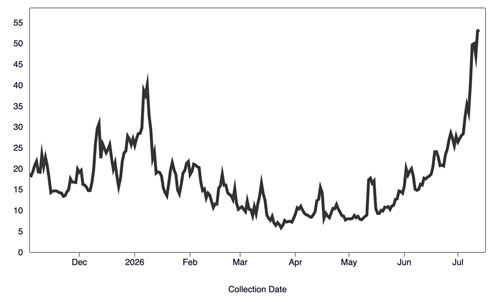
Seeing the news that COVID-19 cases are rising again honestly makes me sigh. It makes me think, "Is it still not over?"
It's been a while since we took off our masks, and I thought life had almost returned to normal, but now we hear that infections are increasing again.
According to data from the California Department of Public Health, the positivity rate for COVID-19 tests has increased to nearly three times higher than it was a month ago.
In LA County, the positivity rate rose from 1.52% in the first week of July to 4.28% in just one week, and Orange County also saw an increase from 1.3% to around 3% over the course of a month.
However, this is not a situation where we can say the pandemic is starting again like in 2020 or 2021. While the numbers are definitely rising, many things are different now compared to then.
The biggest difference is that our bodies are not encountering COVID for the first time.
Many people have been vaccinated and have experienced infection at least once, giving them some level of immunity.
So, while the number of infections may rise, the number of severe cases and deaths does not increase as sharply as it did before.
But why does it tend to rise again every summer?
In the past, we thought it was a virus that only spread in winter like the flu, but COVID does not necessarily follow that pattern.
During the summer, indoor activities increase due to air conditioning, and the number of travelers rises, leading to more opportunities for people to come into contact with each other.
Additionally, the analysis suggests that the immunity effect has naturally weakened a bit due to the low number of infections in recent months.
Another factor is the nature of the virus.
The COVID virus survives by continuously making small mutations, similar to the flu. Even if the mutations are not significant, changes that can evade existing immunity and cause infections continue to occur.
Therefore, rather than completely disappearing, it seems to be establishing a pattern of recurring seasonal outbreaks.
Many people are most curious about when it will finally disappear.
It is likely that it will be quite difficult for it to completely vanish. Viruses that humanity has eradicated, like smallpox, are very rare.
COVID is already widely spread around the world and is found in animals, so it is more likely to become a managed infectious disease like the flu rather than being completely eradicated.
So, there is no need to be overly fearful, but we should not ignore it either.
Especially for seniors over 65, pregnant women, and those with weakened immune systems, there is still a risk of severe progression.
This is precisely why health authorities continue to recommend the latest vaccinations.
I no longer feel anxious every time I see COVID news like I used to. Instead, if I feel chills or have a fever, I rest, and if I have a bad cough, I try to avoid crowded places.
I also pay more attention to basic hygiene habits like handwashing.
Ultimately, it seems that COVID is becoming an infectious disease that we need to manage together rather than a disease that will completely disappear from our lives.
 SilverStar







 Yo Lock Me Up |
 Rice Shop Uncle BLOG |
 My Town My Way Blog |
 Arizona AZ Cowboy |
 Valley Hong |
 Agenda Center |
 Ariana By the Way |
 Toaster Pizza Magic Show |
 As Always Today |
 Total Beauty |
  Podongi Dad Blog |
  nexium |
  Washington Monument |
  dynamic |
  Key spots |
  berrypup |
  Oh my Julia |
  bibigoo |
  silents |
  Team Korea Psychoanalysis Research |
  North Dakota Ragdoll Cat Owner |
  El Dorado |
  Cap Com |
  Trot King News |
  Blondee |
  some fame |
  rapidfire |
  walnutbo |
  Shinbaram Dr. Blog |