
Before moving to Madison, the first thing I looked up was crime statistics. Since it's a college town with UW-Madison, I thought it would be relatively safe, but living there, the experience can vary greatly by neighborhood. After reviewing the data, I was able to form a clearer picture.
There are scary stories online as well as reassurances about safety, but looking at actual numbers was much more helpful than emotional assessments. If I had known this information beforehand, I would have felt much more at ease, so I decided to compile it myself. College towns tend to have higher statistical numbers due to a large transient population, but understanding that context allows for a more realistic judgment.
The overall crime rate in Madison is about 28.55 incidents per 1,000 residents. This places it in the 37th percentile for safety among U.S. cities, meaning it is safer than 37% of cities nationwide but less safe than the remaining 63%. Compared to the national average, the violent crime rate is 17.5% lower, which is a positive aspect.
However, when compared to the Wisconsin state average, the overall crime rate is somewhat higher. This is partly due to the high number of reports from the downtown area, which has a lot of foot traffic. The central downtown area accounts for about 9,031 incidents annually, making up the largest share, and many of these are minor property crimes occurring in busy areas. From my own experience living there, I found that there were hardly any places that felt uncomfortable to walk around during the day.
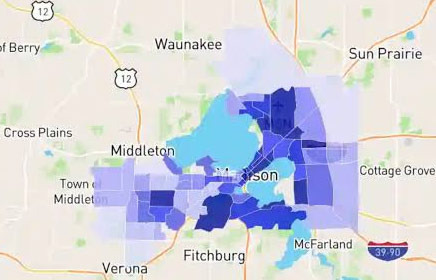
There are clear differences between neighborhoods. The area that Madison residents commonly identify as the safest is in the northwest part of the city. Residents in the northwest have a crime victimization rate of 1 in 52, while the central downtown area has a rate of 1 in 25. That's nearly a twofold difference.
University Hill Farms is frequently mentioned as a safe neighborhood due to its noticeably lower crime rate compared to surrounding areas. In contrast, Vera Court and Clarendon Hills are classified as relatively dangerous areas as of 2025. If you're considering moving, it's a good idea to visit these two neighborhoods and check out the atmosphere both during the day and at night.
Importantly, this data is not just a collection of numbers. A significant portion of the incidents occurring in downtown Madison are property crimes happening in busy areas. There are more incidents of vehicle theft or pickpocketing than violent crimes. Even within the same neighborhood, the experience can vary greatly depending on the specific alley or time of day. You can check Madison's crime map for free on sites like CrimeGrade.
By searching for a specific address, you can see the crime frequency for that location, so I recommend checking it out before moving. The map clearly shows which blocks are relatively quiet. Using such tools allows you to choose a neighborhood based on concrete information rather than vague anxiety.
While finding a safe neighborhood is important, my honest experience is that there are hardly any places in Madison that feel uncomfortable to walk around alone during the day. As long as you are cautious at night or in certain areas, the vibrant and orderly atmosphere typical of a college town makes life quite pleasant. Areas around Lake Mendota or near the UW-Madison campus tend to be relatively safe even at night due to the number of people around.
Before making your choice, be sure to take a look at the data. Knowing the data can make a difference in your overall satisfaction with your living situation. To truly enjoy this beautiful city, like Silver Garden, it's essential to establish a safe base first. From that foundation, you can leisurely enjoy Madison's nature and culture.
 LakeTalk
 MorningGlow92





 American Hardcore Band |
 Rice Shop Uncle BLOG |
 Baguette Blog |
 solvix18 |
 novapixel |
 winter |
 marketbox |
 My Love Bambino Alaview |
 planeto |
  coloradoman |
  lumora |
  Valley Bang |
  pravix22 |
  Cohesive Kong |
  werehere |
  problemo |
  galaxy88 |
  breezelove |
  hazelnut |
  Korean News American Blog |
  AH LALA |
  Savion |
  pintos |
  Good Good |
  oh my salami |
  Lemonade Cider Planning Director |
  Way to easy |