

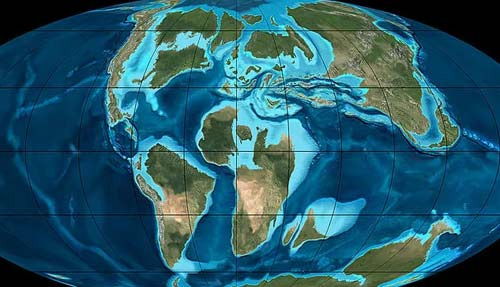
100 million years ago, in terms of periods, it was the mid-Cretaceous period. The Cretaceous period lasted about 79 million years, from 145 million years ago to 66 million years ago.
During the Cretaceous, sea levels were high, and temperatures were also elevated. As a result, mollusks and corals thrived, and the Cretaceous strata are mostly limestone made up of calcium carbonate secreted by these organisms, which is where the name Cretaceous comes from. This is a direct translation of the English name Cretaceous Period, derived from the Latin word 'creta' (chalk).
When transitioning from the Jurassic to the Cretaceous, unusual temperatures caused snowfall and glaciers to form, but temperatures began to rise in the early Cretaceous, likely due to a mini ice age caused by the Tamu Massif eruption. The Atlantic Ocean was gradually widening, and the Gondwana continent began to separate into South America, India, Australia, Africa, and Antarctica.
Dinosaurs had already dominated the Earth's ecosystems long before the Cretaceous, and during this time, they truly ruled the world, creating a much more mysterious and exotic world than we can imagine today.
Continents and Oceans
-
At this time, the Earth was not yet fully divided into continents, but they had not completely moved to their current positions either.
-
South America and Africa were just beginning to split apart, and the Atlantic Ocean was gradually widening.
-
Sea levels were extremely high, so many areas that are now land were once underwater.
For example, the central region of present-day America was covered by a vast sea (Western Interior Seaway).
Climate
-
The entire Earth had a nearly tropical climate.
-
There was no ice at the poles. Trees were growing, and dinosaurs lived as far north as the polar regions.
-
The Earth was warm and humid, with jungle-like forests spread across the continents.
The Age of Dinosaurs
-
This goes without saying. It was the heyday of dinosaurs.
-
Tyrannosaurus rex, Triceratops, and Spinosaurus were among the large carnivorous and herbivorous dinosaurs that roamed.
-
In the skies, pterosaurs flew, and
-
in the oceans, monstrous marine reptiles like Mosasaurus swam.
The Plant World
-
From this time, flowering plants (angiosperms) began to flourish.
-
The ancestors of the various flowers and fruit plants we see today first appeared during this period.
-
Previously, mainly ferns and conifers were abundant.
The title of the movie and novel is "Jurassic Park," yet the cover prominently displays the skeleton of a Cretaceous dinosaur, the T. rex, and it is said that among the 16 species of prehistoric life restored by Dr. Wu in the Jurassic Park novel, only 5 species are from the Jurassic (Othnielia, Dilophosaurus, Apatosaurus, Stegosaurus, and Brachiosaurus).
According to the movie's content, it should be called Cretaceous Park instead of Jurassic Park! Haha.






 Korean Mom |
 novapixel |
 Peter Pan Pet |
 horse |
 Sunset Oregon |
 xylora |
 wendra |
 Aura-Infused WACAM |
 Texas Migration Story |
 There Are Such Things in the World |
  dralix58 |
  Gorama Round |
  Skydiving |
  dreamport |
  Yellow Snowman |
  Toaster Pizza Magic Show |
  velvetnom |
  Anytime Journey |
  Mrs. Duluth |
  jaxter |
  Atlanta Mama |
  Baguette Blog |
  US Embassy |
  My NYC |
  moo moo |
  Mr Oh |
  forevergee |
  festival |
  manchester |