
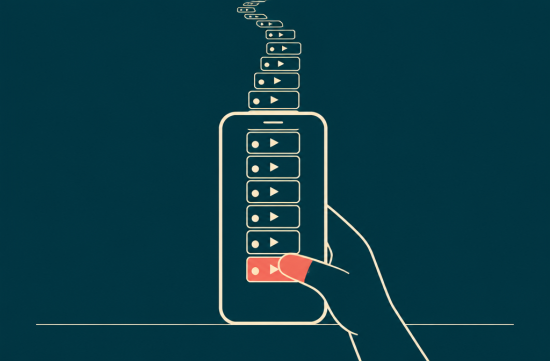
Every time I sneak a peek into my child's room after dinner, I see the same scene. Their fingers are swiping quickly across the screen, and one video barely lasts 15 seconds before moving on to the next.
When I ask them to do their homework, they say, "Just one more video," but I have yet to see them finish that one. I'm sure many of you can relate.
This time, instead of relying on my instincts, I looked for research and official data to see if short-form content really affects attention spans. The conclusion turned out to be more complex than I expected, which was actually helpful.
First, it's not just our kids. A survey conducted by the Pew Research Center in December 2025 involved 1,458 American teenagers aged 13 to 17.
The survey found that three out of four teens reported using YouTube daily. Additionally, one in five said they watch YouTube or TikTok "almost constantly."
Among the five major platforms, one in three teens reported using at least one of them almost constantly. This ratio has remained relatively stable over the past few years.
So, what about attention spans? A meta-analysis published in the Psychological Bulletin in 2025 examined the relationship between short-form videos, cognitive function, and mental health.
This study compiled data from 71 research papers involving 98,299 participants. In terms of scale, it carries significant weight.
The results indicated that increased viewing of short-form content is associated with lower cognitive function scores. Among these, the connection was most pronounced in attention and impulse control, or inhibitory control.
The researchers noted that this trend appeared similarly in samples of both adolescents and adults across various platforms. They also proposed a hypothesis that repeated exposure to fast-paced, stimulating videos could lead the brain to become accustomed to such content.
At this point, you might feel like confiscating your child's phone. But hold on, there's an important part to consider.
In this meta-analysis, only 14 studies focused on cognitive function, all of which were conducted in China. Most of these studies examined individuals who used short-form content in problematic or compulsive ways.
Another point is that this is a correlational study. It's difficult to determine whether short-form content decreases attention spans or if individuals who struggle with attention are simply more drawn to short-form content.
Critical analyses also highlighted that the correlation was much stronger with how engrossed viewers were rather than the total viewing time itself. This point resonated with me the most.
Ultimately, it suggests that "how long did you watch" may be less important than "can you stop watching?" From a parent's perspective, this clarifies what needs to be done.
The American Academy of Pediatrics (AAP) has also shifted its stance. In early 2026, they released a new policy statement regarding digital environments and children and adolescents, no longer providing a fixed upper limit on screen time.
Instead, they recommend monitoring whether screen time interferes with sleep, exercise, and family face-to-face interactions. They also pointed out that the structure of apps designed to keep users engaged for long periods is problematic.
The Family Media Plan that the AAP has long recommended can be created for free at healthychildren.org. It's a tool for setting rules together with your child, which tends to yield better responses than one-sided lectures.
There are also movements in schools. Chris Reykdal, the superintendent of Washington state, has requested that each school district limit cell phone use during classes before the start of the 2025-26 school year.
The state legislature has not yet passed a statewide ban, but they have tasked the Office of Superintendent of Public Instruction (OSPI) to study the issue. Governor Ferguson and Superintendent Reykdal have stated their goal to implement a plan that prohibits phone use from the start of school to the end by September 2027.
The Tacoma school district has varying rules across schools. In June 2025, parents and students requested a ban from the start to the end of the school day from the school board.
So, it's best to check your child's school rules directly on the school handbook or district website for the most accurate information, as these can change at the beginning of the school year.
What can we do at home? Personally, I would start with "practicing to stop" rather than just setting time limits.
Keep the phone in another room before starting homework. After finishing one video, choose the next one manually instead of letting it autoplay. Don't take the phone to bed.
Even these small changes can break the cycle of infinite scrolling. It allows the child to realize, "Oh, I've been watching for 30 minutes."
And honestly, it starts with the parents. If I'm scrolling through Reels at the dinner table, I have no grounds to tell my child not to.
If your child's inability to focus is significantly impacting daily life, don't just blame short-form content; consult a pediatrician. There may be sleep issues or other underlying causes.
It's currently difficult to definitively say whether short-form content is harmful to the brain or if it's completely harmless. However, I believe that raising a child who knows how to stop is definitely a worthwhile endeavor. How about putting down our phones and going for a walk together tonight?
 goldencloudwalker1911
 GimmeHeart


 Texas Migration Story |

 seadoll |

 Round and Round Children's Song Kingdom |

 new sugar |

 Way to easy |

 explorer |

 highschool |

 phoenixia |

 endone |

 Good Neighborhood, Wealthy District Information |
 ssome |
 skykong |
 Shining Our Own World |
 gardener 007 |
 golfmaster |
 Nanana Nanana Nanana |
 Who's watching? |
 RockStar |
 Casa Mia |
 You Only Live Once |
 Hardworking CPA |
 Joyce 77 |
 Runner Kim |
 My Town My Way Blog |
 My Miami Stories |
 Entip |
 Tony Park |
 Jean Claude Bundang Blog |
 DJ DC BLOG |