
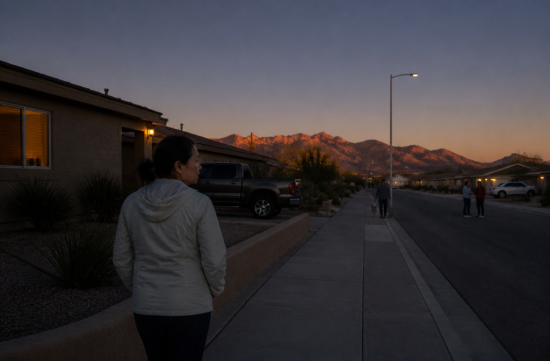
This Sunday marks the end of daylight saving time. At 2 AM on November 1st, the clocks will turn back one hour to 1 AM.
Currently, the sun sets after 6 PM, but starting next week, the sky will already be dark on the way home from work.
Every year around this time, the evening feels strangely short and heavy. I thought I was the only one, but when I asked around, many people feel similarly. After dinner, I often feel unmotivated and find myself reminiscing about the past.
In this desert town, even though the sky is clear during the day, when the sun drops behind the mountains, it feels like my spirits sink along with it.
This year, I decided to explore the reasons behind this and plan how to spend my evenings in advance.
First, looking at the numbers, the average sunset time in this area in November is around 5:08 PM. Just a month ago, it was around 6:30 PM, so the difference is quite noticeable.
With the clocks turning back an hour and the days getting shorter, it's no wonder our bodies struggle to keep up. Sunset times will gradually get earlier until early December.
Upon investigating the reasons, the key factor is light. Our body's biological clock uses light to determine the start and end of the day.
Research shows that morning light advances our biological clock, while evening light delays it.
The hormone melatonin, which induces sleep, is also sensitive to light. It increases in darkness and decreases in bright light.
Interestingly, experiments have shown that even ordinary indoor lighting can significantly suppress melatonin. Moreover, sensitivity varies greatly among individuals.
So, when the sun sets early, our bodies feel like it's already night, while the bright lights and screens inside the house still signal daytime. This mismatch seems to create a peculiar fatigue in the evenings.
One thing I want to clarify is that there is a separate condition called seasonal affective disorder (SAD) that recurs every fall and winter.
According to the National Institute of Mental Health (NIMH), symptoms gradually appear in late fall, often accompanied by increased sleepiness and cravings for sweets or carbohydrates, leading to decreased energy.
NIMH suggests one treatment method is to use a light therapy box with 10,000 lux for about 30 to 45 minutes in the morning. However, it may not be suitable for everyone depending on the medications they are taking.
Light evening blues and conditions requiring treatment are different. If daily life becomes difficult for several weeks, it's advisable to consult a doctor rather than endure it alone.
Fortunately, I'm not at that level, so I decided to start making changes in my daily life.
The first is morning sunlight. During the seasons when the sun rises late, I try to step outside for at least 10 minutes before work to look at the sky. The morning sunlight here is generous even in winter, so I don't feel it's a waste of time.
The second is taking a walk before sunset. After lunch, I try to walk for a bit or take a stroll around the neighborhood right after work while the sun is still up. Walking while watching the sunset paint the mountains red gives me a sense of closure for the day.
There's also a small study suggesting that receiving plenty of bright light during the day can reduce the impact of nighttime lighting. While the sample size is small, I think it's worth a try.
The third is gradually dimming indoor lights. After dinner, I turn off the ceiling lights and only keep one warm-colored lamp on. Even though the house may seem suddenly dark, it becomes more comfortable after a few days.
The fourth is keeping my phone away for an hour before bedtime. Honestly, this is the hardest part for me. I compromised by moving the charger to the living room outside the bedroom.
The fifth is to set one task to do in the evening. When it gets dark early, time feels suspended, and I find myself just lying on the couch staring at the screen.
This year, I decided to spend some time brewing warm barley tea and reading a few pages of a book I've been putting off. Sometimes, I write a short diary entry. It doesn't have to be grand; just naming the evening helps me feel a bit more organized.
And I try not to go to bed too early. If I lie down just because it's dark, I tend to wake up in the middle of the night and end up tossing and turning.
Every year, discussions arise about abolishing daylight saving time altogether, but no conclusion has been reached yet. So for now, it's practical to learn how to live with the changing clocks. Regardless of how the system changes, the shortened days will remain.
Looking back, the shortening of days is something I cannot prevent. However, I can choose how to fill that empty time.
The winter evenings in the desert are quieter than expected, and the stars are quite visible. If I can accept the time spent in darkness as a time to rest rather than endure, perhaps it won't feel so heavy.
This weekend, as we turn the clocks back, it would be nice for each of us to establish our own evening routine. I plan to start with 10 minutes of morning sunlight.
 OceanDream
 YogurtAI






 Anjollinya Blog |

 Kitchen Ideas |

 Spaghetti Flying Religion |

 Giant Squid and Sweet Potato Soup |

 choi family |

 Tomex Train Uncle |
 hexon |

 U.S. Weather Bureau News |

 clarion |

 don63 |
 ssome |
 skykong |
 Shining Our Own World |
 gardener 007 |
 golfmaster |
 Nanana Nanana Nanana |
 Who's watching? |
 endone |
 RockStar |
 Casa Mia |
 You Only Live Once |
 Hardworking CPA |
 Joyce 77 |
 Runner Kim |
 My Town My Way Blog |
 My Miami Stories |
 Entip |
 Tony Park |
 Jean Claude Bundang Blog |
 DJ DC BLOG |