

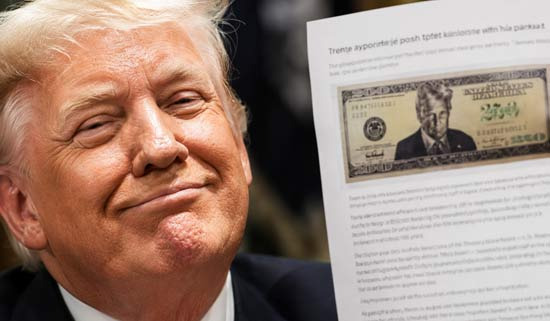
Seeing President Donald Trump brings a lot of complicated thoughts to mind.
When he boldly states things like, "I am the best" and "No one knows better than I do," he seems like someone with sky-high self-esteem.
However, this outrageous news has come out: there are plans to issue a new '$250 bill' featuring Donald Trump's face to commemorate the 250th anniversary of American independence.
"I know he has a strong sense of showmanship, but isn't this a bit much? Why is he so obsessed with idolizing his own face?
Is he actually someone with extremely low self-esteem, contrary to appearances? Or has age dulled his judgment?" These questions naturally arise.
The Desire to Break a 160-Year-Old Taboo: The Story Behind the 'Trump $250 Bill'
According to reports, this is not just a rumor.
According to a scoop from The Washington Post, high-ranking political officials at the U.S. Treasury and the Bureau of Engraving and Printing (BEP), Brandon Beach and Mike Brown, have already drafted a specific mock-up.
The front of the bill would feature Trump's portrait, alongside his own signature and that of Treasury Secretary Scott Bessen. In fact, the British artist Ian Alexander, who created this design, testified that "Trump reviewed the design and absolutely loved it."
The problem is that this idea directly confronts a 160-year-old legal taboo in the U.S. There is a strong law known as the 'Thayer Amendment,' enacted in 1866 during the Civil War. At that time, a Treasury official was heavily criticized for insisting on putting his own face on currency, leading Congress to establish the principle that "no living person can have their face on U.S. currency."
For Trump to actually appear on a bill, Congress would have to amend this 160-year-old law just for him.
Moreover, there would be tremendous administrative and logistical chaos and risks involved, such as counterfeit prevention tests and coordination with the Federal Reserve and Secret Service. The Treasury has stated that they are "only conducting due diligence on the idea," but the fact that Trump himself is pushing for it after seeing the idea suggests a lot.
The Psychology of 'Low Self-Esteem' Hidden Behind Great Showmanship
Psychologists often analyze that those who are excessively ostentatious and seek to deify or idolize themselves paradoxically hide extremely fragile and low self-esteem.
This is sometimes referred to as 'Defensive Narcissism.'
A person with a solid inner self and high self-esteem does not doubt their own worth, even if others do not recognize them or their face is not engraved on currency. This is why many U.S. presidents who have left great legacies historically have been extremely wary of idolizing themselves during their lifetimes.
But Trump is different. He constantly craves external validation and praise. The media must praise him, his aides must be absolutely obedient, and now he wants his face on the nation's currency to be remembered forever. This is despite breaking a legal taboo that no U.S. president has dared to cross for 160 years.
Ultimately, it can be seen that unless he proves "I am this significant of a person" with visible material (currency), a psychological deficiency is at play that cannot fill his inner anxiety and need for recognition. Outwardly, he may appear to be the strongest person in the world, but internally, he may be a reflection of a fragile self-esteem that is anxious about others' evaluations and historical assessments.
Is it Age? The Obsession with 'Legacy' in Old Age
The question, "Why is this happening? Is it because of age?" is also a very reasonable point. As people age and enter the twilight of their lives, they become extremely obsessed with the traces they will leave in the world, or their 'legacy.'
Especially for someone like Trump, who has spent a lifetime at the pinnacle of power and fame, that obsession may be beyond imagination.
Currently, President Trump is of advanced age. He is likely aware of the biological limits of time. Even if I leave this world, even if my power fades, if my face is engraved on the money that Americans use every day for hundreds of years? He likely thinks there is no more certain and eternal legacy than that.
In his younger years, Trump might have been satisfied with visual showmanship by prominently displaying his name on buildings like "Trump Tower" or "Trump Golf Course." However, at his age now, he may have developed a delusional obsession to elevate himself to the same level as America's 'Founding Fathers' like George Washington or Abraham Lincoln, beyond mere businessman's ostentation.
The combination of age, which clouds judgment, and the flattery of political yes-men who treat him as if he were a "lifetime president" has likely led him to mistake such unreasonable demands as "completely reasonable."
What Remains is Only Arrogance and Bitterness
Trump's push for the $250 bill can also be seen as an extension of his trademark 'thunderbolt-like showmanship.'
It could be a brilliant marketing move to insert himself as the protagonist in the grand celebration of the 250th anniversary of national independence.
However, the idea of changing laws, shaking up systems, and putting the face of a living president on currency leaves a deep bitterness among the public.
Outwardly, he pretends to be confident, but ultimately, it reveals his arrogance and the fragility of his inner self, wanting to be above the law and insisting on having his face on currency.
This absurd 'Trump bill' incident that has shaken the political landscape may be a bitter reflection of how easily a person at the pinnacle of power can become undone in the face of age and obsession.
 RiverBlog
 FilialFedor
 goldenvalleybuilder1910
 FloridaGario



 Moscow Kim |
 coloradoman |
 Montgomery Mom |
 GOGO SING |
 Hajiwon Blog Hair Salon |
 heartbreaker |
 Washington Monument |
 Eldorado 88 |

 Lemon EV Car |
  Finding Superfoods |
  lightyear |
  song bang |
  vexomo |
  Indiana Jones |
  meloncat |
  novapixel |
  mortrix |
  Esther 1983 |
  fortbliss |
  My Two Way |
  toastyfox |
  FLORIDA Acus |
  tracker |
  TONTON COFFEE |
  sunrise |
  ultron78 |
  uplifted |
  Folding Instructions |