

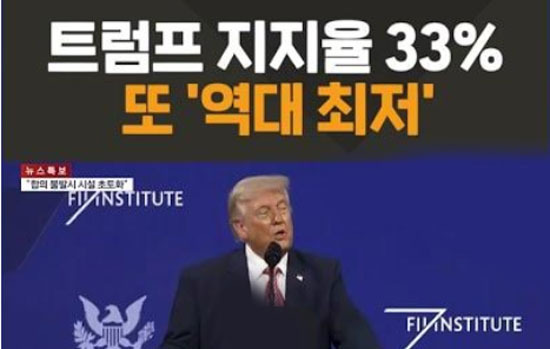
These days, looking at the news since the start of the Iran war, I sense that we have already passed the point of simply saying, "Oh, the president's approval rating has dropped a bit?"
President Donald Trump's approval rating is 33%.
This number is close to a scream coming from the simultaneous cracks in the economic, political trust, and diplomatic justifications that have supported the United States.
The issues surrounding Jeffrey Epstein, which are noisy and associated with Trump, are not just sensational scandals.This is like pouring fuel on the public's distrust of the American power elite.
"The privileged are never punished for their crimes."
The moment this perception spreads, the foundation of democracy, 'trust in the system,' collapses.
The immoral past of the powerful stirs anger that goes beyond political cynicism among ordinary citizens who are enduring economic pain.
In a situation where trust has already hit rock bottom, such issues erupt and shake the very foundation of the Trump administration's governance.
The Quagmire of Diplomacy: The Iran War and 'Lessons from Ukraine'
What's more serious is the external situation. As military tensions with Iran prolong, the initial slogan of 'Strong America' has lost its meaning.
Here, the interesting (and actually frightening) point is Iran's logic.
The West's claim: "Give up your nuclear weapons, and we will guarantee your safety and economy."
Iran's interpretation: "Look at Ukraine. When they gave up their nuclear weapons, didn't war break out? Nuclear weapons are the only lifeline for regime survival."
By using the Ukraine case as a basis for 'prohibiting nuclear disarmament,' diplomatic solutions have effectively disappeared. As pressure increases, Iran resists more fiercely, and the burden falls squarely on the United States. The approval rating for Iran's policies, in the low 30s, is evidence that the citizens view this war as 'pouring water into a bottomless pit' rather than a 'game they can win.'
The Economic Pressure: Margin Call Named Oil
The aftermath of the Middle Eastern war directly hits the wallets of Americans. Soaring oil prices are not just a number.
They are an 'inflation bomb' that pushes up the cost of living, from grocery prices to logistics. Flights are being canceled across various regions, including Europe. When consumption decreases and the market shrinks, the arrows point back to politics. The outcry is, "You promised to fill my wallet, so why are you throwing money into a war zone?"
Shaking Stronghold: Cracks within the Republican Party
At this point, the Republican Party cannot remain quiet. It's not just the attacks from the opposition that are the problem. The exodus of Latinos and independents: Those who supported Trump for practical reasons are turning their backs due to high prices. Fatigue among non-college-educated whites: Even within the core support base, doubts are sprouting about whether this direction is correct.
This is déjà vu from 20 years ago when President George W. Bush fell into the swamp of 30% approval ratings due to the prolonged Iraq war. As the war drags on and the economy deteriorates, even the concrete support base will inevitably show cracks.
The 2026 Midterm Elections: Not Just an Election
To summarize the current situation in the U.S. in one sentence: "Economic instability built on leverage + political distrust symbolized by Epstein + endless war risks have converged in one place."
In this interconnected phase, a small shock could become a 'black swan' that collapses the entire system. Those who have studied history may feel a chilling familiarity in the current flow. Just before a bubble bursts, people always say, "This time it's different," but history has punished that arrogance without exception.
The crisis the Republican Party faces ahead of the 2026 midterm elections is not just a matter of counting votes.
This is a warning from the times demanding a fundamental reassessment of all strategies that the U.S. has pursued.
The history of President George W. Bush falling into the swamp of 30% approval ratings due to the Iraq war is being reenacted 20 years later.
Can the U.S. break this pattern, or will it continue on the same path?
 USAToday



 novapixel |
 Victory 1988 |
 washington mom |

 El Dorado |
 Another Eden Channel BLOG |
 Everything Students Can Do |
 Holey Moley |
  Arizona AZ Cowboy |
  springw |
  Woooooah |
  frostpup |
  chocopup |
  Angeles Choi |
  My Heart Popper |
  comova |
  vintago |
  Sky Way |
  Top Beaches |
  folyfoly |
  ground |
  averagestudent |
  hot chocolate |
  SODA MAKER |
  james kim |
  All About Cars |
  lomira98 |
  calmbridge |