

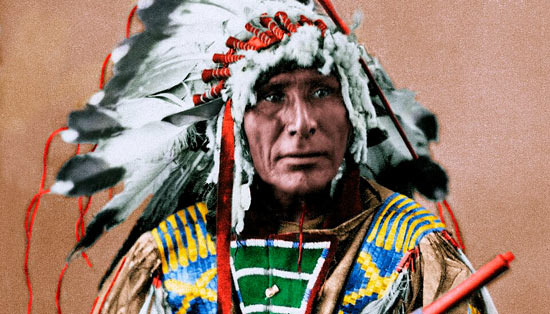
According to many records and traditions, these shamans had already sensed the impending catastrophe before the white settlers arrived, warned their people, and tried to hold onto hope even in desperate situations. Spiritual leaders from various tribes spoke of having seen a foreboding future in the form of visions and prophecies before the white people covered the continent.
There are stories of seeing iron horses crossing the land, endless lines appearing on the ground, and white-skinned people approaching like shadows. Black Elk, a great spiritual figure of the Lakota Sioux tribe, recounted a vision from his childhood where he saw the tribe's sacred tree withering and the circle of his people breaking apart.
Later, he quietly lamented that the scenes he had witnessed had become reality. In the traditions of the Blackfeet tribe, there is a prophecy that buffalo will disappear and the land will be cut into squares. The buffalo were their foundation for survival and spiritual companions, so their extinction symbolized not just resource depletion but the end of the world.
As these prophecies began to come true, the Indians had already lost most of their land and were living confined in reservations. In this despair, a figure emerged: Wovoka of the Paiute tribe. He spread the message that if they danced the ghost dance, the white people would disappear, the dead ancestors would return, and the vanished buffalo would once again cover the land.
This was less about predicting the future and more about a final spiritual resistance against an unbearable reality. People believed that this dance would protect them with clothing that could not be pierced by white men's bullets. However, the end of this faith led to the massacre at Wounded Knee in 1890, erasing that hope along with the lives of many.
So why couldn't the shamans, who had foreseen all this, prevent the tragedy? The reason is that they believed the future they saw was a crisis that could not be avoided by human choice. In their worldview, the world was a cycle of order, and the invasion by white people was not just the defeat of one tribe but a disaster that disrupted the balance of the entire land.
For those who had lived in harmony with nature, the physical power of Western civilization, which sought to conquer nature, must have felt like an unstoppable wave. Additionally, alcohol, disease, and new religious systems undermined their communities from within, and many shamans sensed that their spiritual power was gradually weakening. They were spiritually aware of the end of an era.
However, the message they left was not one of complete despair. Various tribal traditions tell of a time when the seventh generation will rise to reconnect the broken circle and heal the wounded land. The shamans of the westward expansion era saw the future of their people collapsing, but at the same time, they left behind the seeds of hope that would one day awaken again in the form of prophecy.
Ultimately, the future they saw may not have been a complete end but rather a long and harsh winter. Countless shamans and tribes witnessed their downfall in tears, but the spiritual legacy they left remains a root that supports the identity and spirit of Native Americans to this day.
Their prophecies are not just myths of the past but stories of memory and survival that continue to this day.





 fortbliss |
 Folding Instructions |
 yentra |
 Cali M Law Group |
 quanta7 |
 Eldorado 88 |
 heartbreaker |
 Washington Monument |

 Korean Mom |
  My NYC |
  moo moo |
  Mr Oh |
  forevergee |
  festival |
  manchester |
  constant |
  Leapfrog Move |
  vibranto |
  Tora Tora |
  yellowbutter |
  Dolly |
  US Embassy |
  NYC saladbar |
  Finding Superfoods |
  lightyear |
  song bang |
  vexomo |
  Indiana Jones |