
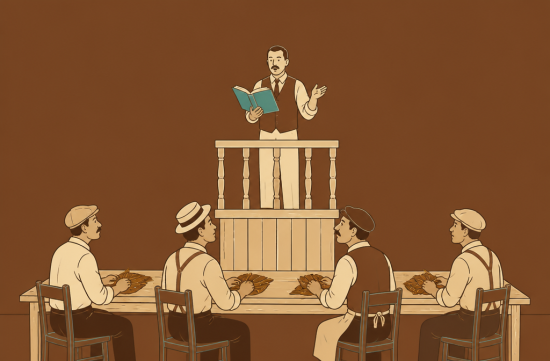
On December 21, 1865, someone began reading a newspaper aloud in front of workers at a tobacco factory called El Figaro in Havana. No one could have predicted that this would spark a major strike in Tampa 66 years later.
Recently, while walking through Ybor City, I saw the word lector on a sign in front of an old cigar factory building. It means "reader" in Spanish, referring to a profession where someone read books aloud in the factory.
At first, I thought it was just a romantic old story. However, the more I looked into it, the more I realized it was a serious history intertwined with labor, money, and politics.
To picture the scene, imagine dozens or hundreds of people sitting at long work tables rolling tobacco leaves, while someone stands on a raised platform reading aloud in a loud voice.
Rolling cigars keeps the hands busy but leaves the ears empty. To alleviate the boredom of repeating the same motion all day, this practice of reading aloud began in Cuba.
This practice crossed over to Florida as the cigar industry moved. Vicente Martinez Ybor relocated his factory to Tampa in 1886, and the neighborhood that developed around it is now known as Ybor City.
Workers from Cuba, Spain, and Italy flocked to the area, bringing their hometown habits with them. It is said that almost every large factory had a lector.
The part that surprised me the most was the issue of money. The workers, not the company, collected the lector's salary from their own pockets.
What to read was also decided by a vote among the workers. From the owner's perspective, it was a way to increase productivity for free, so they probably didn't pay much attention at first.
The reading list is interesting as well. In the mornings, it was mostly newspapers, including local Spanish-language papers and articles from the Tampa Tribune, which were translated and read aloud in Spanish on the spot.
In the afternoons, it was novels. Works like Don Quixote, The Count of Monte Cristo, and Les Misérables echoed through the factory, meaning that workers who had never set foot in a school were hearing classics.
The lector was not just someone who read. They had to change their tone for each character and were quite respected among the workers.
In modern terms, they were like an audiobook, podcast, and news radio all rolled into one. It was also a subscription model where listeners paid directly, which seems quite modern.
The problem was that the reading material included labor movement literature and socialist newspapers. Listening to this every day would inevitably deepen thoughts about wages and working conditions.
Historians evaluate the lector as a key figure in raising the political consciousness of workers. This began to look increasingly dangerous in the eyes of factory owners.
Ultimately, it all came to a head in 1931. In the midst of the Great Depression, with workers' gatherings and arrests continuing, the Tampa Cigar Manufacturers Association officially banned reading in the factory, claiming that the lector incited strikes.
The workers went on strike again, demanding the return of the lector, but the factory doors were closed. The duration and end date of the strike vary slightly in different accounts, but the outcome was the same.
The lector never returned. That role was replaced by radio, meaning that human voices were replaced by machines.
Honestly, I felt a bit bitter at this point. The company unilaterally cut off the knowledge and discussion time that workers had been paying for themselves.
Of course, I understand the factory owners' logic. With a recession and strikes, it would have been hard for the company to survive. Still, I think it was a regrettable choice to eliminate voices as a solution.
Interestingly, this tradition has not died out in Cuba. Even today, you can see lectores reading newspapers and books in Cuban cigar factories.
There are still traces of it in Tampa. The company operating the cigar factory El Reloj, built in 1910, has been working to reintroduce the lector tradition.
From a Korean perspective, there are oddly overlapping scenes. It reminds me of the story of a person in an old village who read novels aloud to those who couldn't read.
In that sense, both East and West seem similar in that those who couldn't read were made aware of the world through stories. However, the difference is that in Ybor City, the costs were shared by the workers.
It resonated with me that the immigrant community pooled their money to create a pathway for learning. It doesn't seem too different from how our first-generation Korean immigrants established churches or weekend Korean schools.
When you visit Ybor City, you usually just see cigar shops and Cuban sandwiches. Next time, I encourage you to pause in front of the old factory building and imagine the voices that once echoed inside.
If you explore the history of the cigar industry at places like the Ybor City Museum State Park, this story will feel much more three-dimensional. It's a good idea to check the official site for operating hours before your visit.
After learning this story, I started to hear the podcasts I listen to on my commute a bit differently. Workers in Tampa nearly 100 years ago went on strike to protect their time for listening and thinking while working.
 KingComedy



 West Kong |

 Princess Park |

 Art patch |

 Rice Shop Uncle BLOG |

 Noodle Noodle |

 Splendid Mission |


 Kyo Sho |


 Living in Florida |

 US Home Buying Information Home Insurance |
 puddingcat |
 Coco Chanel |
 Nando Raldo |
 The 2000 |
 Mr Bull Jung |
 American Travel Cruise Information |
 vanillatop |
 namico |
 Karina's Blog |
 ASURA |
 Misstic M |
 parlon |
 Mrs New Mex |
 MBTI Detective Agency |
 ShyShy dating |
 hihihi |
 kiwifox |
 Silent Sea |
 Masa Masa |
 dewyo |