
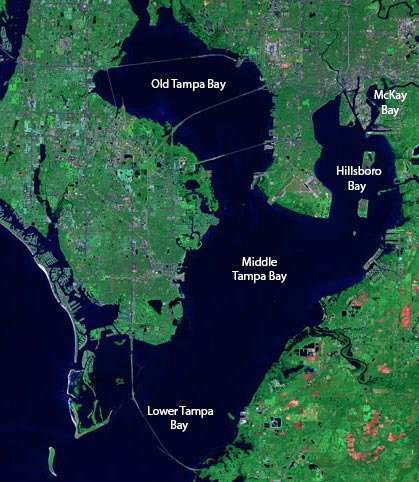
To truly understand a city, it's more revealing to look at who lives there, where people are coming from, and the age demographics, rather than just visiting a few tourist spots. Tampa is one of those cities. At first glance, it seems like just another coastal city in Florida, but the numbers reveal that it is changing much more rapidly than one might expect.
First, the population of Tampa itself is around 400,000. However, when considering the metropolitan area, the scale is much larger. The total population of Hillsborough County has already surpassed 1.5 million, and when including Pinellas County and Pasco County, the Tampa Bay metro area exceeds 3.3 million. It is consistently recognized as one of the areas in the U.S. with a growing population. Locals often mention that there are more cars on the roads and that new apartments and housing developments are continuously being built.
Especially after COVID, the changes have accelerated. There has been a significant increase in people moving from high-cost areas like New York, New Jersey, and California to Florida. Due to relatively lower tax burdens and warm weather, many remote workers and retirees have relocated here. As a result, these days, Tampa feels different; it's not just the typical retirement city vibe of Florida, but there is also a noticeable increase in the young professional population.
The racial composition also reflects Tampa's unique characteristics. While the white population is the largest, the Hispanic and Latino populations are also quite significant. This ties back to Tampa's history. Particularly, Ybor City was historically a center for Cuban immigrants and the cigar industry, so it still has a strong Hispanic cultural influence. In fact, it's not uncommon to encounter Spanish speakers in Tampa. The Black community also has a relatively high representation and greatly influences the local culture.
In contrast, the Asian population is relatively low compared to major cities like LA or New York. The Asian population, including Koreans, is still a minority. Therefore, the scale of Korean restaurants and businesses is not as large as in other major western cities. However, in recent years, the Korean community has been gradually growing within the overall population increase in Florida.
There is also an unexpected aspect regarding age demographics. Many people associate Florida with retirement cities, but Tampa itself is surprisingly young. The median age is in the mid-30s, and there is a significant student population. This is largely influenced by the University of South Florida and the University of Tampa. Recently, there has been an increase in companies related to finance, healthcare, and startups, which continues to attract young professionals.
Thus, Tampa is no longer just seen as a "Florida retirement city"; it has changed significantly. The population is continuously growing, there is a high influx of newcomers, and the atmosphere of the city is rapidly evolving. Just looking at the numbers, you can feel that this city is currently in a phase of growth.
 StarRunner
 GreatTown



 novapixel |
 UNI Lover |
 NE Hodori Preik |
 parlon |
 Ohio Ohayoung Hello |
 Kyo Sho |


 Splendid Mission |

 My Two Way |
  Panorama Kstar |
  HVAC will prosper |
  Automation Logic User |
  MAX009 BLOG |
  K-POP TV News |
  mortrix |
  My Beloved Hometown Hwagae Market |
  yorvik12 |
  Tart Tart |
  Min's blog |
  Tora Tora |
  pixel77 |
  cuteasducks |
  Lemon Kim |
  What can make money? |
  An ant castle |
  Haha and Bomi Blog |
  glenview 89 |
  Valley Hong |