
When I first moved to Lynnwood, I didn't hear much about natural disasters.
However, once I learned that Washington State is on a fault line, my perspective on the neighborhood changed.
New residents often lack information about local natural disaster risks, so I thought it would be good to cover this topic.
So, I compiled the current status of natural disasters around Lynnwood.
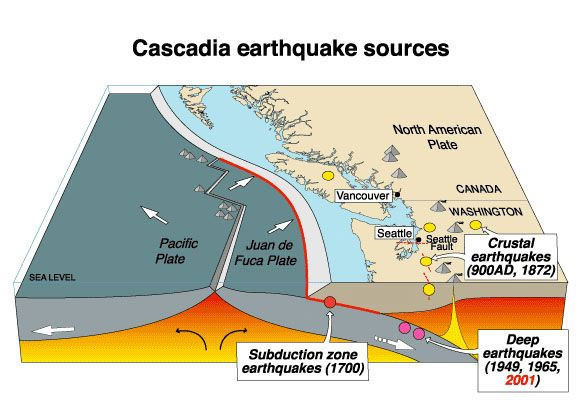
The most realistic threat is indeed earthquakes. There is an 82% chance of a significant earthquake occurring within 50 kilometers of Lynnwood in the next 50 years.
Since 1931, there have been 1,281 recorded earthquakes in this area, so it's not just someone else's problem.
The largest earthquake within 30 miles was a magnitude 5.8 in 1996, and on February 28, 2001, a magnitude 6.8 occurred 15 miles southwest of Tacoma.
This was the largest event since 1900 near Lynnwood, causing building damage and road cracks in various locations.
In the bigger picture, we cannot overlook the Cascadia Subduction Zone. Geologists analyze that if this fault moves, it could trigger a massive earthquake of magnitude 9.0 or higher, and Lynnwood is within its impact zone. Living in the Pacific Northwest, this risk is not something to take lightly.
Fortunately, related research and preparedness manuals are continually updated, and local authorities provide ongoing education for residents.
Regular earthquake drills in schools are part of this effort.
Flooding and inundation are also concerns. The western part of Washington State receives a lot of rainfall, especially during winter storms, so the mix of flatlands and low-lying areas in Lynnwood creates a risk of flooding in places with poor drainage.
In fact, during heavy rain, reports have noted water pooling on low-lying roads and in underground spaces. Choosing a higher elevation when selecting a home is one way to reduce flood risk. Checking the FEMA flood map for specific addresses can also help when signing rental agreements.
We cannot overlook the risk of landslides in Washington State. According to the state's Department of Natural Resources (DNR), heavy rainfall is the leading cause of landslides. While the terrain around Lynnwood is generally gentle, there have been past incidents in the Snohomish County hillside areas.
A major landslide in the Oso area in 2014 occurred about an hour's drive from Lynnwood. This makes it clear that the landslide risk in Washington State is not just someone else's issue. Those living near slopes should be particularly cautious.
If you're preparing for natural disasters in Lynnwood, earthquake preparedness should be the top priority. Securing furniture, stocking emergency food and water, and having a family evacuation plan are the basics.
You can get a free earthquake preparedness checklist from the Washington State Emergency Management Division (EMD) website, which is worth checking out.
It might also be a good idea to look into earthquake insurance. While it may seem like an unnecessary expense, thinking about the moments when you might need it can provide peace of mind.
The principle for emergency kits is to include enough water and food to last at least 72 hours. The difference between those who prepare and those who don't becomes stark when a disaster strikes.
It's also important to share this information with family or neighbors in advance. Having someone nearby to help when something happens can be a great source of strength.
Personally, I would recommend starting by preparing an emergency kit today.
 JeanBundang
 GomtangPooh
 DallasDreamUp







 crystalx |
 compass |

 forward |

 harvest |










 Mia Flori |

 Fun Flex Life |

 Helpful Life Stories |

 John Denver |

 silents |
 Top |
 DOCTOR MED |
 zorvik79 |
 There Are Such Things in the World |
 liquid asset |
 Banana |
 nova nova |
 Cahty Chung |
 NFL Forever |
 denvik37 |
 Choco Choco Star |
 Entering Art Directly |
 Mini Mee |
 Exciting chichichi |
 My Circle |
 dermoon |
 Starbucks Reserve Roastery Closure |