

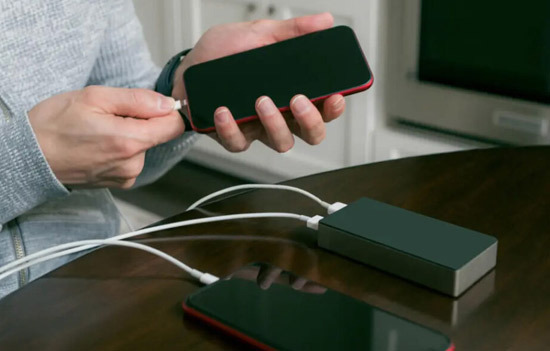
When using a portable charger, you may notice that some charge quickly while others seem to take longer to fill the battery.
The biggest difference is the output wattage (W). In the past, chargers were around 5W or 10W, but now 25W and 45W are standard.
Simply put, it's about how much electricity can be pushed in. Around 15W is considered regular fast charging, and you can definitely feel a difference starting from 25W. Especially with the latest smartphones, some support up to 45W.
However, that's not the end of the story. Even with the same 45W charger, the charging speed can feel different for a reason.
It's all about whether it supports PD, or Power Delivery. This is a method where the charger and device negotiate "how fast to charge." If it supports PD 3.0 or higher, you'll feel that it charges faster even at the same wattage.
When the concept of PPS is involved, the difference becomes even more pronounced. This is especially noticeable with Samsung devices, as this feature adjusts the voltage in real-time based on the battery's condition. In simple terms, it pushes a lot of power at first, and as the battery fills up, it reduces heat while charging steadily. So, it's not just "fast" but feels "efficiently fast all the way through."
Another aspect many people overlook is the cable. Just having a good portable charger doesn't solve everything.
The C to C cable needs to support at least 60W to achieve the proper speed. In fact, even with a 45W charger, if the cable only supports 15W, it will charge slowly. You've probably experienced how changing the cable can completely alter the charging speed.
Additionally, the increasingly popular GaN chargers are also a factor. Made from gallium nitride, they have the advantage of lower heat and higher efficiency. So, even at the same output, they are smaller and maintain high output without getting hot, unlike older chargers that would feel warm.
Another important point is "how much the phone can handle." No matter how powerful a 100W charger is, if the phone only supports up to 25W, that's all it will take. So, having a higher wattage isn't always the answer. Matching the maximum speed supported by your device is the most efficient approach.
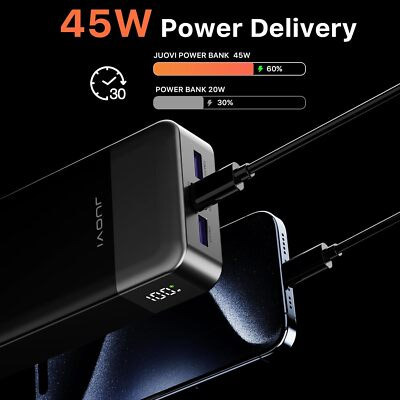
Based on my experience, here's a summary of the charging speed perception:
15W or less → just slow
18W → basic fast feeling
25W → definitely fast
45W → "this is really fast" level
The difference is especially noticeable when charging from 20% to 70% battery.
How quickly it charges in this range is crucial when you're in a hurry.
Ultimately, charging speed isn't determined by just one factor; it requires the combination of "charger + cable + phone support specs" to work properly.
If any one of these is lacking, you won't achieve the expected speed.
So, the combination I personally recommend is as follows:
Supports PD 3.0 or higher
25W to 45W output
Supports PPS
C to C cable over 60W
GaN charger
With this combination, most smartphones will reach a level where there's "no charging stress."
The main reason for using a portable charger is to "escape battery anxiety."
When you're out, especially during travel or business trips, relying on your smartphone for maps, payments, and communication makes it feel like life stops the moment the battery runs out. The biggest advantage is being able to charge anytime without frantically searching for a café or outlet.
In the end, portable chargers have become more than just auxiliary devices; they serve as safety devices that save time and reduce stress.







 novapixel |
 NEXT ROUND |
 Encyclopedia of New York and Surrounding Areas |
 washington mom |
 California Dreamer |
 jammybear |

 Information on All Regions of the United States |
  Oregon Our Neighborhood Story |
 U.S. Weather Bureau News |
  newyorker 101 |
  coffeee |
  |
|  Christopher |
  sylven |
  Sammy Beach |
  Bliss O |
  blue ocean |
  greenlight |
  Watanaka Karametibaksa |
  castle |
  xelton52 |
  carefree |
  vrixen73 |
  AZ Road Master |
  Victory 1988 |
  summita |
  business lim |
  Colorado Lee |
  Make My Day |