
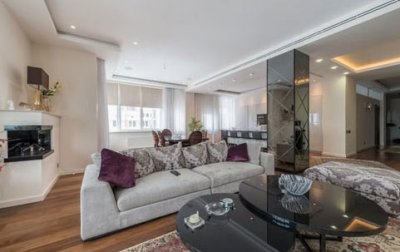
Taking a family considering a move to the Chicago suburbs as an example, the first noticeable difference between new and established homes in Arlington Heights is not the rent, but the neighborhood atmosphere. The older areas have a strong feel of quiet residential neighborhoods with large trees, while the newly developed areas are designed with commercial facilities, allowing easy walking access to restaurants and cafes.
Arlington Heights has not seen much development of rental housing in the past. According to a report by the Daily Herald, a new eight-story building called Arbor House has recently been constructed, adding 301 units to the suburban market. This building is set to begin occupancy in the spring of 2026, with rents starting from $1,895 for studios up to three-bedroom units.
The average rent across Arlington Heights is around $1,924. By unit type, studios average $1,887, one-bedrooms $1,921, two-bedrooms $2,353, and three-bedrooms $2,667. Compared to Arbor House's starting price of $1,895, it is clear that new constructions are not necessarily more expensive than the overall average, which reflects the rarity of new housing in the area.
If this family considers a new home, they can enjoy amenities such as a golf simulator, catering kitchen, ping pong table, outdoor pool, fitness center, and co-working space. However, it should be noted that the more amenities available, the higher the management fees will be. Choosing an established home may lower management costs, but if the heating and cooling systems are old, heating bills during Illinois' cold winters could be higher than expected.
The warranty from the builder is also a strength of new constructions. For the first few years, there is less burden if equipment malfunctions occur. In contrast, established homes may be approaching the time for major replacements, such as plumbing or roofing, and if the building is not well-maintained, unexpected repair costs may arise.
Arlington Heights is a popular area for Korean families looking for good school districts. If schools are a priority, it is advisable to check ratings from GreatSchools or Niche, but since school district boundaries change frequently, it is important to verify the assigned school for the specific address before signing a lease.
Illinois has relatively high property taxes, and Cook County often sees significant tax increases with each reassessment, so families moving from other states may miss important details if they simply compare based on their previous residence.
Commuting conditions should also be considered. Arlington Heights is accessible to downtown Chicago via the Union Pacific Northwest line. Both new and established homes can see significant rent differences based on their distance from the train station, often making proximity to the station more influential on rent than the age of the building.
In addition to winter heating costs, snow removal management costs should also be considered. Most new buildings include snow removal and landscaping management in their fees, but if an established home is an individual property, these costs may need to be covered separately. All these detailed costs must be factored in to accurately gauge actual monthly expenses.
In addition to property taxes, Illinois state income tax should also be included in calculations. Illinois applies a flat rate income tax, which is relatively low, but when combined with local taxes, the overall burden can feel different. Families moving from other states should consider recalculating their rental budget based on their net pay.
When looking solely at school districts, Arlington Heights ranks highly among Chicago suburbs. Many blocks have both new and established homes within the same school district boundaries, so if schools are the top priority, checking the assigned school should come before considering the age of the building.
If, like this family, neighborhood atmosphere is a priority, it may be better to walk through both new and established homes to make a decision rather than relying solely on numbers. This article is not investment or legal advice, and it is recommended to consult with professionals before making any agreements.
 GoofyGorilla
 midnightforestbuilder1948







 cheesepup |
 breezem |
 yentra |
 virex |
 vexon87 |
 Arlington house |

 My Beloved Hometown Hwagae Market |
 Gleeee |
  MacMorningBlog |
  ASURA |
  Elastico |
  shaket |
  vionoo |
  chocolate |
  Whisper |
  Star Voyager |
  InDiGo |
  Rocky Mountains |
  Whoever It Is, I Don't Know |
  Why Not Me |
  Plastic Rose |
  Rice Shop Uncle BLOG |
  Victory 1988 |
  Gook Rule |
  Rowland Mama |
  Coco and Lulu |
  Baguette Blog |