
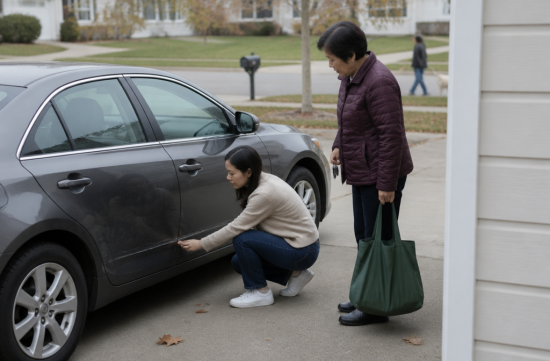
Last weekend, I borrowed my mom's car and noticed a scratch under the passenger door. It was a mark I hadn't seen before, but my mom just said, "I don't know where that came from."
That comment stuck with me oddly. Thankfully, she wasn't hurt, but I wondered why she couldn't remember it.
That night, I started looking into various things. When should parents stop driving, and how should I bring it up?
The first thing I learned is that age isn't the determining factor. The National Highway Traffic Safety Administration (NHTSA) clearly states that the ability to drive is based on actual driving skills, not age.
So saying, "You're over seventy, so it's time to stop" isn't convincing. It only hurts their feelings.
So what should we look for? AAA has identified some specific signs.
They suggest checking if your parents have received two or more traffic tickets or warnings in the last two years. Also, consider if they've had two or more accidents or near misses.
Getting lost on familiar routes is also a sign. An increase in small dents or scratches on the car counts too.
If they have difficulty getting in and out of the car or seem uncomfortable gripping the steering wheel due to arthritis, that's another indicator.
However, AAA doesn't consider just one of these signs as a definitive problem. They advise caution when multiple signs overlap or when the same issue occurs repeatedly.
I felt somewhat reassured by this. I realized I shouldn't rush to confront my mom over just one scratch; I could observe her a bit longer.
NHTSA also mentions medications. If a health issue arises or if their medication changes, driving can become difficult regardless of age.
If they've started a new medication, make sure to discuss any side effects like drowsiness or dizziness with a doctor or pharmacist. That's not something I can judge myself.
On the other hand, if your parents have begun avoiding night driving or highways, that might indicate they're adjusting their driving habits. I would actually want to commend such changes.
The best approach is to ride along with them. Not just once, but several times, during the day and at night.
Observe their reactions to traffic lights, whether they check over their shoulder when changing lanes, and quietly watch their timing for unprotected left turns. If you have siblings, it's also good to take notes on what each of you sees.
NHTSA recommends gathering observations from multiple people, as family judgments can sometimes be incorrect. They advise against drawing conclusions based on just one person's feelings.
And it's better to start the conversation earlier than you might think. Most people delay until driving seems dangerous, leading to heated arguments.
According to the AAA Foundation's LongROAD study, 82.7% of older drivers had never discussed driving safety with family or doctors. I was surprised to see that number.
NHTSA suggests a sequence: gather information, make a plan, and follow through. It's simple but surprisingly challenging.
When discussing, you should bring alternatives. Who will handle grocery shopping? How will you get to the doctor's appointment? Who will drive to church on Sundays? Be specific.
Giving up driving isn't just about losing a car; it's about relinquishing the freedom to go anywhere alone. If you just say, "It's time to stop," without alternatives, anyone would become defensive.
It's also helpful to know about Kansas laws. In Kansas, drivers over 65 have a four-year license renewal period, while those aged 21 to 64 have six years.
Many places inform that those over 65 cannot renew online and must do so in person. Vision tests are also conducted during renewal.
So, the license renewal period can naturally become an opportunity to bring up the topic. You can casually ask during the visit if they've been experiencing any nighttime vision issues or how they're feeling.
Kansas is not a mandatory reporting state for doctors. However, the state's Division of Vehicles has stated that they review information sent by family members, medical professionals, police, and the general public.
In complicated cases, the Medical Advisory Board helps make judgments based on expert opinions. If a license is revoked, a written request for an administrative hearing can be made within 30 days.
Still, I think of this as a last resort. I wouldn't want to report my parents without their knowledge. Once trust is broken, it can hinder all future conversations.
Procedures and criteria can vary based on individual circumstances, so be sure to check directly with the Division of Vehicles or experts.
This weekend, I plan to sit in the passenger seat while driving to the Korean market with my mom. I want to keep it casual, just chatting together. I think I can bring up the scratch later without it being too late.
Let's take a step forward so our parents can continue to travel safely and confidently for a long time. We can all do this.
 OrangeSky
 HistoryTeach


 orvian89 |

 looksee 78 |

 vivavida |
 MEDBIO American Doctor Blog |

 Burbank Lee |

 Kansas City Representative Singer |


 business life |


 1004 Man |
 ssome |
 skykong |
 Shining Our Own World |
 gardener 007 |
 golfmaster |
 Nanana Nanana Nanana |
 Who's watching? |
 endone |
 RockStar |
 Casa Mia |
 You Only Live Once |
 Hardworking CPA |
 Joyce 77 |
 Runner Kim |
 My Town My Way Blog |
 My Miami Stories |
 Entip |
 Tony Park |
 DJ DC BLOG |