

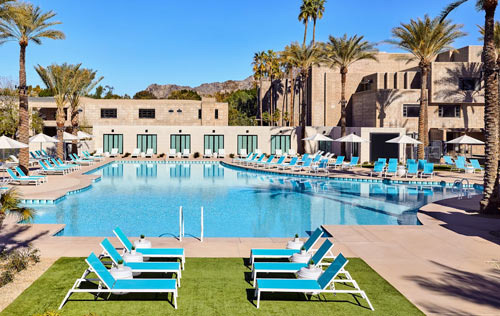
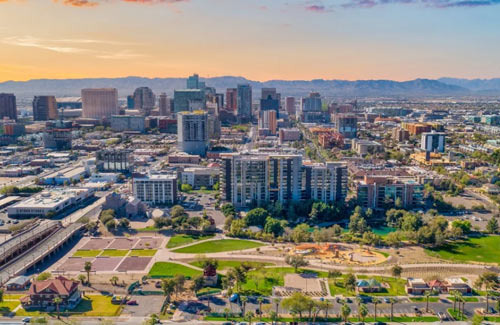
Phoenix, the representative city of Arizona, is one of the largest cities in the United States.
The population of Phoenix alone is about 1.6 million, and the metropolitan area, including surrounding cities, reaches approximately 5 million.
It is considered one of the most influential urban areas in the southwestern United States, second only to Los Angeles.
The history of Phoenix dates back to 1867 when it was officially established as a city, and the name Phoenix is derived from the mythical phoenix bird.
In the past, the ancient Hohokam civilization built complex irrigation systems in this area, and it is said that the name Phoenix was given to signify the rebirth of a new city over the remnants of that civilization.
Today, Phoenix is not just a simple desert city but one of the fastest-growing metropolitan areas in the United States.
While it used to be known primarily as a retirement destination, it is rapidly transforming into a hub for high-tech industries and manufacturing. Especially after TSMC's large-scale semiconductor factory investment, the influx of engineers and technical workers has significantly increased, diversifying the economic structure.
Housing prices in Phoenix vary significantly by area. Even within the same metropolitan area, it is common to see differences of more than double depending on the neighborhood.
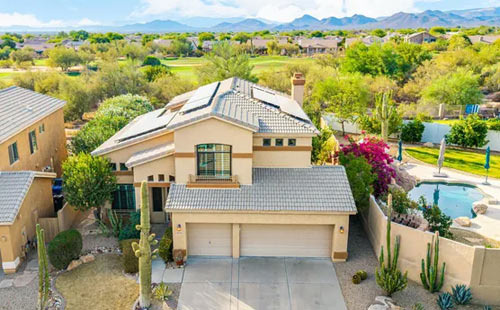
The most affordable areas are some parts of southern Phoenix and the western areas of Maryvale and parts of Glendale.
In these areas, you can find older 2-3 bedroom single-family homes for around $250,000 to $350,000.
Condos can sometimes be found in the range of $150,000 to $250,000. However, it is essential to carefully check school districts, crime rates, and the condition of the homes.
The most preferred areas for the middle class include Chandler, Gilbert, Mesa, and Peoria. Typical 3-4 bedroom single-family homes in these areas generally range from $450,000 to $700,000. Condos usually trade between $250,000 and $400,000. Considering school districts and living environments, these areas are regarded as the most balanced.
In upscale neighborhoods like Scottsdale, prices definitely rise. Typical single-family homes are commonly priced between $700,000 and $1.2 million, and luxury communities often exceed $2 million. Condos are also generally priced above $400,000 to $800,000.
Paradise Valley, considered the most luxurious residential area in Phoenix, is almost a world of its own. This area is centered around large lots and mansions, with properties often listed between $3 million and $10 million.
Ultimately, in the Phoenix metropolitan area, it is easy to understand that around $300,000 can get you an affordable single-family home, $500,000 to $700,000 can secure a home in a good neighborhood preferred by middle-class families, and over $1 million can buy you a luxury residence. Condos are generally priced at about 60-70% of single-family home prices.
The climate is an essential factor when describing Phoenix. Summers are incredibly hot.
From June to August, it is common for daytime highs to exceed 110°F (about 43°C), and during some periods, it can go even higher.
First-time visitors often describe it as feeling like "opening an oven door." However, some residents say that the very low humidity makes it surprisingly bearable.
In contrast, winter is Phoenix's biggest attraction. From December to February, daytime temperatures typically remain around 65-70°F (18-21°C). This is why so-called snowbirds from the northern U.S. and Canada flock here every year to escape the cold. The golf courses and resorts are also busiest during the winter.
From a tourist's perspective, the surrounding areas are often more famous than Phoenix itself. Notably, the Grand Canyon is about a 3.5-hour drive away, and the world-renowned tourist destination Sedona can be reached in about 2 hours. Tucson to the south is also within a day trip distance.
In downtown Phoenix, the Heard Museum is one of the most famous cultural attractions. It is regarded as a museum that deeply introduces American Indian art and history. Additionally, the Desert Botanical Garden allows visitors to see the unique plant ecosystem of the Sonoran Desert, and Camelback Mountain is a popular hiking spot for both locals and tourists.
Administratively, it belongs to Maricopa County and also serves as the state capital of Arizona. However, the actual living area extends far beyond the boundaries of Phoenix. Scottsdale, Tempe, Chandler, Gilbert, and Mesa essentially form one massive living area, and many immigrants often settle in one of these cities.
If you expect flashy public transportation or the atmosphere of an old historical city, you might find it somewhat dull. However, for those who enjoy warm winters, a growing economy, a relatively reasonable housing market, and the unique landscapes of the desert, it is a highly attractive city. For those considering life as an immigrant in the U.S., Phoenix is no longer a hidden option but has established itself as a major city worth serious consideration.
 BeardSmoothie
 DreamMaker
 VelvetValley97





 Who's watching? |
 My Love DS |
 Unknown Dog Walk blog |
 Coastal city |
 nero kim |
 Toaster Pizza Magic Show |
 business lim |

 Wenda |
  Roman Pan |
  Nuchuhan Exploration BLOG |
  Strawberry Pancake Warrior |
  What can make money? |
  Egg Steamed Pot |
  New Jersey News Local Stories |
  Study Abroad Life Know-How Tips |
  Leapfrog Move |
  US Regional Information Local News |
  Finding Superfoods |
  COLO COLO |
  morixa |
  USA Hyundai Kia |
  OC Real Estate Business Information |
  My Town My Way Blog |