
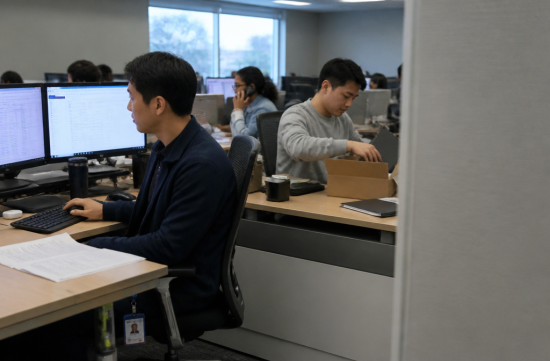
A little while ago, I had coffee with a friend. He's been working at a Korean conglomerate's U.S. branch for a few years, and as soon as we sat down, he sighed heavily.
The expatriate manager at the next table gets help with rent, support for his kids' tuition, and even a company car. Meanwhile, my friend, who does the same job on the same team, only has his salary and a 401k match.
This is a story that many Korean professionals in this area have likely heard at least once. I experienced the same frustrations when I worked at a similar company in the past.
So today, I want to unpack this issue from a structural perspective rather than an emotional one. Why does this disparity exist, and how far is it legally acceptable?
First, let's look at the status of expatriates. They typically enter the U.S. on an E-2 investor visa or an L-1 expatriate visa.
The E-2 visa is based on a treaty between the U.S. and South Korea. It was signed in November 1956 in Seoul and came into effect in November 1957 under the U.S.-Korea Treaty of Friendship, Commerce, and Navigation.
There's an interesting clause in Article 8, Section 1 of this treaty. It states that companies from the other country can bring in executives, accountants, and technical experts of their choosing.
This means that the headquarters selecting and sending their own people is a path opened by the treaty. Up to this point, it makes sense.
So why does the disparity in treatment arise? The expatriate package is originally designed to cover the costs associated with working abroad.
It's common for packages to include housing, children's tuition, return airfare, and overseas work allowances. Labor law firms explain that when you combine these costs, it becomes significantly more expensive than hiring someone locally for the same position.
The problem is that local employees see this as preferential treatment based solely on nationality. Honestly, I felt the same way.
U.S. federal law Title VII prohibits employment discrimination based on national origin. This applies to companies with 15 or more employees, while California state law (FEHA) applies to those with 5 or more employees.
There's a key case to be aware of. On June 15, 1982, the U.S. Supreme Court unanimously ruled in the case of Sumitomo Shoji America v. Avagliano.
Local female employees sued the New York branch of a Japanese company for only hiring Japanese men for management and sales positions. The company used its trade treaty with Japan as a defense.
The Supreme Court's conclusion was straightforward. A subsidiary established in the U.S. is considered a U.S. company, and thus cannot evade Title VII scrutiny by citing the treaty.
However, this doesn't mean that all expatriate treatment is illegal. Companies typically defend themselves in two ways.
One is the necessity of the job, and the other is the argument that expatriates and local employees are not comparable in the first place. Courts will look into whether the salary is paid by the headquarters, whether they report to a headquarters supervisor, and whether they are evaluated by the headquarters.
Ultimately, the picture is this: packages that cover overseas work costs can be fairly defensible, but if promotions or base salaries vary based on nationality while doing the same job, that's a different story.
So, what should local employees focus on right now? I would first check whether I'm correctly classified as exempt.
In California, the minimum wage in 2026 will be $16.90 per hour, meaning the salary threshold for white-collar exempt employees is $70,304. If your salary falls below this, you are eligible for overtime.
Just exceeding the salary threshold isn't enough. The actual work performed must meet the criteria for management, administrative, or professional roles to qualify as exempt.
Due to the unique overtime culture in Korean companies, there are more cases of misclassification than you might think. If your title is manager but you're only doing assigned tasks, it's worth reviewing.
Also, make sure to keep records. When you miss out on a promotion, note who was promoted and on what basis, along with dates in emails or memos. Be sure to keep your offer letter and job description as well.
One more thing to add: expatriates don't have it easy either. During a crackdown at the Georgia Battery plant in September 2025, 475 people were arrested, over 300 of whom were Korean.
Since then, visa issues have come up on the negotiation table between the U.S. and Korea, and the anxiety among those dispatched has increased. It's also a situation where after living with their families for several years, they might have to pack up and move again.
So, I don't think it's fair to blame individual expatriates. The focus should be on the company's HR design.
I once wrote in another article that it's easier to just accept things as they are. Looking back, that was a bit of a cowardly statement.
People doing the same job in the same office should be held to the same standards. That's the minimum that the laws in this country aim to uphold, and I believe it's the basic respect that everyone deserves.
If you're currently in an unfair situation, don't suffer in silence. Contact the California Civil Rights Department (CRD) or consult with an employment lawyer. Bringing records will help resolve the situation much faster.
 USACradle
 NightVibe




 CA Real Estate |

 limestone |

 loran |

 DeArizona Blog |

 Swift Falcon |

 Good Neighborhood, Wealthy District Information |

 US Home Buying Information Home Insurance |


 Gongs Blog |

 ssome |
 skykong |
 Shining Our Own World |
 gardener 007 |
 golfmaster |
 Nanana Nanana Nanana |
 Who's watching? |
 endone |
 RockStar |
 Casa Mia |
 You Only Live Once |
 Hardworking CPA |
 Joyce 77 |
 Runner Kim |
 My Town My Way Blog |
 My Miami Stories |
 Entip |
 Tony Park |
 Jean Claude Bundang Blog |
 DJ DC BLOG |