
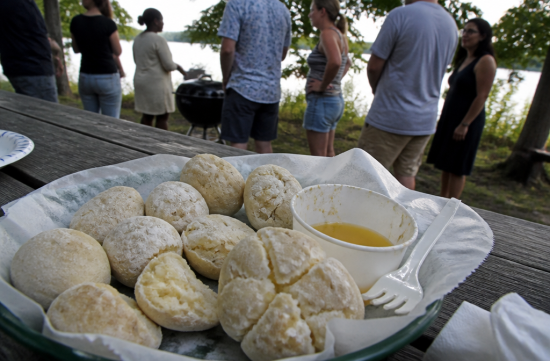
Today, I'm going to start off a bit playfully. Did you all know that Syracuse is nicknamed Salt City?
At first, I thought it was just because they spread a lot of salt on the roads in winter. When it snows, cars get covered in white salt, so it seemed plausible.
But it turns out that was completely wrong. This nickname actually comes from the salt industry in the 1800s.
And it's not from salt mines, but rather from springs that produce saltwater. Local historical records specifically state that there were no salt mines in this area.
The stage is set at the southern end of Onondaga Lake. In the past, this lake was even called Salt Lake.
The first recorded mention was in 1654. French Jesuit missionary Simon Le Moyne saw these salt springs and reported them to the governor of New France.
Interestingly, the original inhabitants of this land, the Onondaga people, did not drink that water. They believed that evil spirits lived in it, so you can imagine how strong the salty taste must have been.
It's like biting into what you thought was a sweet cherry, only to find out it was a salt candy. I can just picture the surprise.
After the Revolutionary War, the situation changed dramatically. In 1788, the Fort Stanwix Treaty designated a separate area around the salt springs.
Then in 1797, the New York State Legislature designated a one-mile-wide area surrounding the southern half of the lake as the Onondaga Salt Springs Reservation. This marked the beginning of serious salt production managed by the state government.
There were mainly two methods of production. One was slowly evaporating saltwater in the sun, and the other was boiling it in large kettles. You can imagine the scene with saltwater evaporation pans lined up along the lakeshore.
As demand continued to grow, the spring water alone became insufficient. So they dug shallow wells to draw up more concentrated saltwater.
The game-changer was the Erie Canal. With the canal, this salt was shipped out to various places in the Northeast. Once the path was opened, the market expanded significantly.
According to local historical society records, taxes on salt helped fund the construction of the canal. Salt built the canal, and the canal, in turn, sold the salt.
Thanks to this, the city experienced explosive growth, and the name Salt City stuck. Isn't it surprising that Onondaga County was once one of the top salt-producing areas in the U.S.?
The peak is often cited around 1862, when many people made their living from salt. Just imagining the lakeshore filled with the smoke from boiling salt all day long is beyond comprehension.
However, there's no such thing as eternal prosperity. As competition from other regions intensified and the concentrated saltwater began to dwindle, production significantly decreased around 1900.
The easiest place to see traces of that era is the Salt Museum in Liverpool. It's a place where you can still feel the atmosphere of the old production facilities. It's located inside Onondaga Lake Park, on the north side of the lake.
The museum building was constructed in the 1930s and is said to have been made from wood sourced from an old salt factory. The building itself is a relic of the salt era, which makes it even more endearing.
And now, I'm getting to my favorite part. It's about food—salt potatoes.
These are small white potatoes boiled whole in very salty water and then dipped in melted butter. The key point is the white salt crust that forms on the skin.
The origin is often attributed to Irish immigrants working in the salt industry in the 1800s. It's said that they boiled the potatoes along with the saltwater.
The first commercial record of them sold is said to be from a northern town in the 1880s. In 2021, a historical marker for salt potatoes was even erected in front of the Salt Museum.
A historical marker for just one potato? The love for potatoes in this town is truly genuine. You can even see bags of salt and potatoes sold together at the grocery store. Now I understand why everyone feels disappointed if these aren't part of summer barbecues.
Knowing all this, I now see winter road salt in a different light. It's no wonder this city has such a deep connection with salt.
While sipping a latte at a café and looking out at the lake, it's fascinating to think that the saltwater below helped nurture this city. It's like a town that's tart on the outside but solid on the inside, like a cherry.
If you haven't visited the Salt Museum yet, I recommend combining it with a lakeside walk on a nice weekend. Just be sure to check the operating hours as they may vary by season.
Today, I had fun rambling on my own, but since it was a salty history lesson, I'll argue that it's charming enough. Next time, I'll return with a review of my salt potatoes eating experience.
 SojuBoy
 SquidSpinKill


 Art patch |

 Rice Shop Uncle BLOG |

 Noodle Noodle |

 Chino Min |

 Glow Yo |

 passive |

 namico |
 Belgray Miscellany |



 action blog 101 |
 athome blog |
 calvor |
 Haha and Bomi Blog |
 Lee Ton |
 viba viba |
 Olivia's Blog |
 208 Master |
 crumb |
 blanke |
 Burbank Lee |
 tervox95 |
 silverado |
 Grow Your Gut Bacteria Well |
 Kim You Shin |
 Squid Q |
 gelatonew |
 river9 |
 ttano |
 Eagle in America for Five Years |