

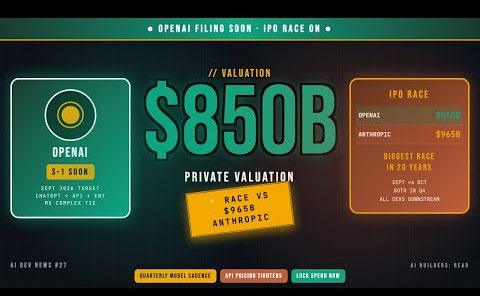
These days, the topic that keeps coming up among people working on Wall Street is the IPO talk surrounding OpenAI and Anthropic.
Just 2-3 years ago, when ChatGPT first came out, everyone thought, "Oh, there's a cool new chatbot." But now, the situation has completely changed.
In the U.S., these two companies have become the massive pillars dominating the global generative AI market.
According to the rumors circulating on Wall Street, the prospect of their IPOs feels much more realistic than before. There are widespread reports that Anthropic has already submitted its IPO paperwork confidentially and has entered the countdown phase, while OpenAI is also reportedly busy calculating the timing for its own IPO.
Although everyone is keeping things under wraps until the official announcement, the market has already marked these two giants as candidates for the next generation of mega IPOs.
Interestingly, even though no date has been set yet, major investment banks like Goldman Sachs, Morgan Stanley, and JP Morgan are already fiercely competing for the lead underwriter position. The reason is simple: the stakes are enormous.
Some market analysts predict that if OpenAI goes public, its corporate value could reach up to $1 trillion, which is over 1,300 trillion won in our currency.
Anthropic also boasts a significant valuation and is considered a formidable competitor.
From the perspective of investment banks like ours, just securing one historic deal like this could yield hundreds of millions of dollars in commission revenue. It's a business that can't be ignored.
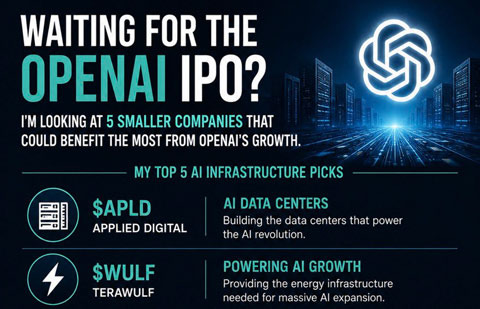
Investors in Korea should not just watch this news passively.
These days, the most common question I get from retail investors trading U.S. stocks is, "When can I buy OpenAI stock?" Right now, it's not publicly traded, but once it rings the bell on the New York Stock Exchange, it's clear that money from around the world will flow in.
And there's another crucial aspect to consider: semiconductors.
Ultimately, if these companies go public and raise substantial capital, that money will flow into data center expansions and infrastructure investments, making companies like NVIDIA and SK Hynix the biggest beneficiaries of this trend. This is not just about one tech company going public; it directly relates to the operational rates of semiconductor factories in Korea.
Of course, while these companies may seem like glamorous protagonists on the surface, they are spending astronomical amounts on data center maintenance and model development.
They are not in a position to show profits in the next quarter. This means that even after going public, they are likely to keep asking the market for more money, indicating the need to closely monitor their cost control alongside revenue growth.
In conclusion, this battle is not just another typical IPO news. Just as Google aspired to the throne during the dot-com era and Apple stood at the center of the smartphone era, this is a historic title match determining who the true 'master of the AI era' will be.
That's why Wall Street players are rushing in, and Korean investors are also on high alert.
In the coming months, it will be hard to find anything more provocative and significant in this field.
 NightVibe
 mooncitywalker2017
 EggRollIntel







 mapsina |
 Mr. Largo |
 Victory 1988 |
 Infinite Style |
 novapixel |
 newyorker 101 |
 International Court |
 Poppin News |
 Encyclopedia of New York and Surrounding Areas |
 Things to Do to Buy a House |
  Kondae Garusong Blog |
  quiet river |
  shinee cho |
  alamo |
  Lol Life |
  Waiting for Godot |
  parlon |
  Say Yes in English |
  Sayonara H |
  rigid |
  Ohio Ohayoung Hello |
  U.S. Military Recruitment Information |
  You Turn Me On |
  DaeBak Electronics CNET |
  Anjollinya Blog |
  solid90 |
  elion |
  xylora |
  Study Abroad Life Know-How Tips |
  cheesepup |