
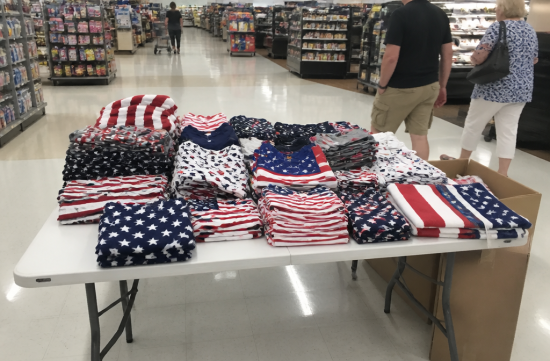
In early July, I walked into a store and paused briefly at the entrance. There were piles of t-shirts, shorts, swimsuits, and beach towels featuring the American flag design.
In the adjacent aisle, there were paper cups and napkins printed with stars and stripes. I found it amusing to imagine how people in Korea would react if they saw swimwear with the Taegeukgi design stacked like that.
But there's something even more interesting. The U.S. federal law explicitly states not to do that.
In Title 4, Section 8 (d) of the U.S. Code, it says that the flag should not be used as clothing, bedding, or curtains.
The section right below it (j) is even more direct. It states that no part of the flag should be used as a costume or athletic uniform.
There is only one exception. It specifies that military personnel, firefighters, police officers, and members of patriotic organizations can wear flag patches on their uniforms.
So what about those t-shirts piled up in the store? The answer lies in the distinction between an actual flag and a flag design.
The law targets the act of cutting actual flag fabric and wearing it. A cotton t-shirt printed with stars and stripes is just a red and blue design.
And there's one more crucial fact. There are no penalties associated with these provisions.
The original English text uses "should" instead of "shall." This means it's not a law that punishes violations, but rather a guideline for good etiquette.
This all started back on June 14, 1923, during a national flag conference attended by various groups, including the Army and Navy, where guidelines were agreed upon.
These guidelines were codified into law in 1942. On June 22 of that year, it was formalized as Public Law 77-623, but no penalties were ever attached.
However, it wasn't just ignored. In fact, those who tried to punish improper handling of the flag often lost in court.
A notable case is Smith v. Goguen in 1974. A young man in Massachusetts was arrested for sewing a flag patch onto the back of his jeans and was sentenced to six months in prison.
The Supreme Court struck down the state law by a 6-3 vote, stating that the term "disrespectful" was too vague and could be applied arbitrarily by the police.
The ruling included a statement suggesting that the state legislature likely did not intend to criminalize all unofficial uses of the flag.
In 1989, in Texas v. Johnson, even the act of burning the flag was recognized as free speech. Congress quickly passed the Flag Protection Act, but it was struck down again in 1990 in United States v. Eichman by a 5-4 vote.
In summary, the law does not dictate how to treat the flag; it ultimately leaves it up to individual sensibilities.
What remains is etiquette. It's something that isn't visible but is vaguely understood by everyone.
The same section (i) also states that the flag should not be used in advertisements. It mentions not printing it on disposable items like paper napkins or boxes.
When you look at store displays around July 4th, this provision is practically nonexistent. Yet, no one enforces it.
On the other hand, there are places where the regulations are clearly upheld. For instance, the flag patch on the right shoulder of military uniforms.
The blue part with stars is intentionally sewn upside down so that it appears to be waving in the wind as the person moves forward. This is done to create that effect.
After hearing this explanation, I began to understand the distance between t-shirts and patches. One belongs to the realm of personal taste, while the other is about duty.
Every summer, when I'm invited to backyard parties, I tend to check the cooler first, where I often find cans of soda adorned with stars and stripes.
The cans pulled from the ice water are so cold they make my hands numb, and the first sip scratches my throat as it goes down. Nearby, someone is guarding the grill in shorts featuring the American flag.
Honestly, I don't mind the clothing, but I do feel a bit uneasy about the disposable napkins. Since they are items meant to be used and thrown away, I hesitate just a little at that point.
That said, I don't intend to criticize anyone. This is a country that has chosen not to enforce strict rules, so it's up to each person to draw their own line.
The way people treat the flag is much more ingrained in their habits than what is written in the law. I think this is one of the most American lessons I've learned while living here.
 USAARMY
 AutumnLink





 Khan Film Blog Production |
 Unknown Dog Walk blog |
 Yoyma |
 breaddough |
 Sunshine Blog |
 vegas mom |
 zanero |
 Home Run King Byeon Seung-yeop Blog |
 US Legal Consultation on Trials |
 memorabilia |
  Texas Real Estate Blog |
  U.S. Retirement Pension Information |
  Seattle - Emerald City |
  Texas Migration Story |
  California Dreamer |
  Bearded Strawberry Smoothie |
  JESIKYEOALBA BLOG |
  Heart Ticker |
  Jellia Angel |
  Moo Tang Clan |
  yenne |
  neroyo |
  Peter Pan Pet |
  solvix18 |
  Next Year, Let's Become Rich |
  Investment Campus Home Ownership |
  virex |