

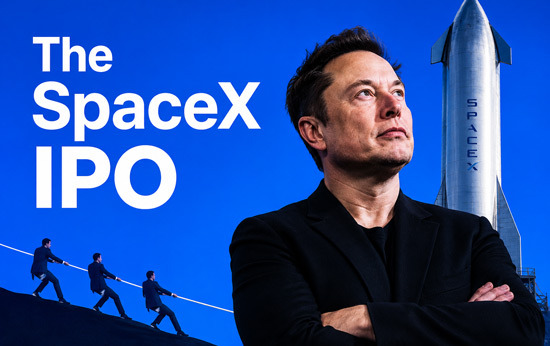
When the private space company SpaceX was first announced, most people thought of it as just a reckless "rocket company."
Even when Elon Musk made headlines saying they would go to Mars, send astronauts in groups of 100, and secure contracts with NASA, the prevailing sentiment was one of skepticism about how much money they could actually make. Many predicted it would be like pouring water into a bottomless pit due to the enormous costs associated with the space industry.
However, according to reports, SpaceX is currently preparing for an IPO (Initial Public Offering) with an astronomical target valuation of about $175 billion (approximately 240 trillion won), planning to raise around $75 billion through this process.
If this scale is realized, it is likely to be recorded as one of the largest IPOs in U.S. history. A colossal company, following in the footsteps of global tech giants like Nvidia, Apple, and Microsoft, is being born in space.
In fact, the reason SpaceX has gained such an overwhelming valuation is not just because they are good at launching rockets. The real money-making venture lies elsewhere: the global space internet service, Starlink.
And behind this success story is a remarkable bet made by Google a decade ago.
Google's Bet from 10 Years Ago: The Prelude to a '100x Jackpot'
What's even more painful is not just Elon Musk's genius, but the foresight of Google (Alphabet), which partnered with him 10 years ago. Eleven years ago, in 2015, Google, along with Fidelity, made a significant investment of about $900 million to $1 billion (around 1 trillion won at the time) in SpaceX. At that time, the risk of failure in the space internet business was so high that no one was willing to invest. However, Google recognized SpaceX's potential and is reported to hold about 6.1% of SpaceX's shares.
If this IPO proceeds at the expected valuation of $175 billion, the value of Google's 6.1% stake would skyrocket to approximately $10.67 billion (around 147 trillion won).
* Initial investment: approximately $1 billion
* Estimated stake value: approximately $10.67 billion
* Return on investment: simply calculated at over 100 times (over 10,000%)
This is an overwhelming return that is hard to find in the history of global investments. Google is already reflecting significant unrealized gains on its books. According to Alphabet's recent quarterly earnings report, the increase in value of its private investment assets (Other Bets and equity valuations) has resulted in hundreds of billions of dollars in unrealized gains, with Wall Street experts analyzing that SpaceX is a key player in that equity.
Having invested 1 trillion won and now receiving back over 140 trillion won in assets, Google is essentially sitting back and enjoying an astronomical cash bonus.
How Starlink Turned a Rocket Company into a Giant with Cash Flow
In the past, it was common to accept communication disruptions as a natural inconvenience in deep mountains, deserts, ships at sea, or even on airplanes. However, Starlink has launched thousands of satellites into low Earth orbit, completely covering these shadowed areas.
Now, not only individuals in remote areas but also global airlines, shipping companies, and even military forces around the world, as seen in the Ukraine war, are using Starlink as a necessity. Recent statistics show that Starlink's global paid subscribers have already surpassed 10 million.
* Number of subscribers: surpassed 10 million
* Explosive cash flow generation based on monthly subscription fees
* Establishment of a monopoly revenue structure through B2B and government/military contracts
While the past space industry was a "consumption-type business" funded by taxes, Starlink has completely transformed into a "corporate cash cow" that collects subscription fees in dollars from customers worldwide every month. This solid cash flow justifies both Google's stake value and SpaceX's $175 billion valuation.
When you think about it, Elon Musk is a truly strange yet formidable person. He created Tesla to make cars and then surpassed traditional manufacturers in Detroit to build the world's largest electric vehicle company.
He established SpaceX to build rockets and now sends rockets to space more frequently and at lower costs than NASA, a government agency. Recently, he even founded the AI company xAI, increasing its corporate value to tens of trillions of won. He is someone who turns every unrealistic idea into real money.
Honestly, from the perspective of an ordinary office worker, it feels more like a gap than envy.
While we deal with clients, solve problems, miss deadlines, stay up all night, and stress over budget shortages, he is launching rockets into space and deploying thousands of satellites, creating a company worth hundreds of trillions of won.
Watching the news of Google's big win and SpaceX's IPO, one clear truth comes to mind.
People think of SpaceX as a romantic "space company" looking toward the distant future, but the real driving force that brought this company from a space base to the pinnacle of the stock market is not the grand slogan of colonizing Mars. It is the actual customers—10 million people worldwide—who are paying their Starlink fees in dollars every month.
Ultimately, no matter how great and majestic the dream of space may be, it is the solid "cash flow" that hits the bank account every month that allows one to soar into the high skies without getting tired. This harsh yet obvious essence of business has been dramatically proven by the alliance between SpaceX and Google.
 Trail85
 CrazyTomato
 LifeIsTiming






 washington mom |
 Victory 1988 |
 El Dorado |
 lightyear |
 Moscow Kim |
 Weekend Movie Blog |
 Beauty, Health, Lifestyle Blog |
 coloradoman |
 Superman Cat Blog |
  apricotla |
  Soy Angelino |
  nati8 |
  NE Hodori Preik |
  celtics |
  Balancework |
  round1 |
  Way to easy |
  musicque |
  road98 |
  Churros Train Conductor |
  gleeful |
  Burbank Lee |
  Olivia's Blog |
  Bushing Around Life |
  Active |
  Cherokee Rose |
  Kor. Master |
  Holey Moley |