
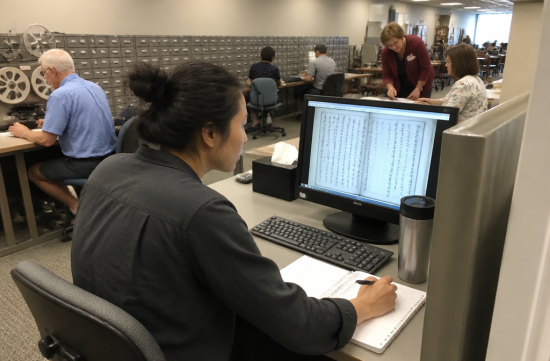
With Thanksgiving week upon us, it seems there are noticeably more tourists passing through downtown Temple Square. However, I noticed a group of people with particularly serious expressions lining up to enter one of the nearby buildings.
That building is the FamilySearch Library. It is known as the largest genealogy library in the world, and honestly, I initially thought, "Why Salt Lake City of all places?"
It's not New York or Washington D.C., yet records from around the world are gathered in this quiet city at the foot of the Wasatch Mountains, which is quite fascinating. So, I decided to dig deeper to find out the reason.
The key lies in religion. This library is operated by The Church of Jesus Christ of Latter-day Saints, commonly known as the Mormon Church.
This church teaches that descendants can perform proxy ordinances for ancestors who did not receive them while alive. To do this, one must first know exactly who their ancestors are.
Thus, genealogy research is not just a hobby but a part of their faith. Once I understood this, it made sense why people are so earnest about it.
It seems to resonate with the way Koreans honor their ancestors during holidays and cherish their family lineage. Although the methods differ, the desire to remember one's ancestors is similar.
Moreover, the headquarters of this church is right in Salt Lake City. The city itself began with the pioneers who settled in this valley in 1847, alongside the church.
The official starting point was November 13, 1894. During the presidency of Wilford Woodruff, the Utah Genealogical Society was established.
Interestingly, this month marks the 132nd anniversary of that society's founding. I felt a bit pleased when I noticed the date.
Shortly after the society was formed, a research library opened, which initially was a small space sharing an office building with the church's historical department. It's hard to imagine that given its current size.
The building now located west of Temple Square was dedicated in 1985. In 1987, it was named the Family History Library.
Then, in January 2023, it was renamed the FamilySearch Library to align with the online service, although locals still often refer to it by its old name.
However, the truly astonishing part is what lies within the mountains. In Little Cottonwood Canyon, there is a place called the Granite Mountain Records Vault.
Many people pass through that canyon on their way to Alta or Snowbird during ski season, right? This vault was carved out of the northern granite mountain. It's surprising to think that something like this existed in a mountain I've always just passed by.
Built in the 1960s, this facility has stored microfilm collected from around the world for decades. Due to security reasons, the general public cannot access it.
According to the church, they protect over 3.5 billion images combined from microfilm, microfiche, and digital media. I was momentarily stunned by that number.
Currently, efforts are ongoing to digitize these films, so many can be viewed from home on the FamilySearch website. It's amazing that records once stored in a mountain vault can now be accessed on a living room laptop.
It's said that the cool and dry granite environment is ideal for film preservation. After hearing why they chose to carve into the mountain, I nodded in understanding.
There's good news for Koreans here as well. This collection includes a significant number of Korean genealogies.
FamilySearch has a collection titled "Korea, Collection of Genealogies, 1200-2014." Most of the materials are said to be from Jeonbuk National University in Jeonju.
If you search the catalog, you'll find familiar family names like Gimhae Kim, Yeongmin Lee, and Miryang Park listed. Seeing the titles in Hanja reminded me of my grandfather's attic.
Unfortunately, not all materials can be accessed directly from home. Due to contracts or privacy issues, some images can only be viewed in person at a FamilySearch center or library.
In such cases, you can create a free account, log in, and visit a downtown library or nearby center to access them. Admission to the library is free.
It's nice that anyone can use the library, even if they are not a church member, and there are no membership fees. Volunteers are also very helpful in teaching newcomers how to search.
Operating hours and reservation requirements may change, so be sure to check the official website before you go, especially during holiday periods. Parking is convenient at nearby paid lots or by using the TRAX light rail.
Looking back, it's no coincidence that this library is in Salt Lake City. The church, which considers finding ancestors a matter of faith, built and established its headquarters in this city, and that dedication has accumulated over 130 years.
Whether or not one resonates with the religious reasons, I think it's wonderful that because of these records, someone can rediscover a forgotten name. For us immigrants, whose roots have become blurred, it holds even more significance.
This Thanksgiving, when your family gathers, ask the elders about our family lineage. Just having that information will make searching much easier.
After the holiday, I plan to visit the snow-covered canyon and then head to the library with a warm coffee in hand. I really want to check if our family name is there!
 GalaxyTrain
 TofuGymKing


 moodansa 77 |

 Conflite Teacher |
 US Snowboard Information Exchange |

 There Are Such Things in the World |
 San Diego TOP Idol |
 U.S. Weather Bureau News |

 KGOMIO Blog |

 morvex37 |



 Raymond K. |
 gravity |
 714 Success Era Real Estate |
 Investment Beginner Company Information Encyclopedia |
 musicque |
 The Gelaton |
 ovelion |
 Chicagonian |
 Freedom Yea |
 AZ Road Master |
 glenix39 |
 Something is popping in the situation |
 orvella |
 vella |
 comets |
 Banana |
 Yes Dorian |
 Minnesota Sonata N |
 zentar |
 mykiwi blog |