
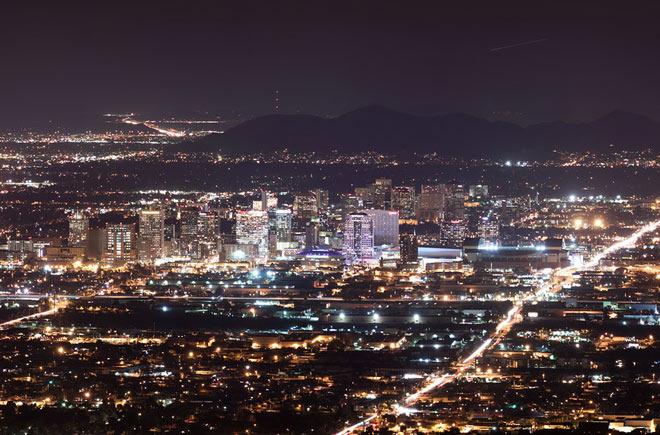
The population increase in Arizona may sound like an economic boom on the surface, but looking deeper, it reveals a "growth that brings problems along with it."
While people are flocking in, security cannot keep up with the pace, creating a structure that feels as precarious as an overinflated balloon.
Arizona is one of the fastest-growing states in the U.S. Warm weather, a perception of low tax burdens, and the attraction of tech companies and factories are among the many reasons. Particularly, a mass migration from California, where high housing prices are unbearable, has accelerated the population surge.
The problem is that this surge is happening too quickly. When people move in, it is natural that basic infrastructure such as roads, homes, hospitals, and security should also increase, but currently, in Arizona, housing prices are skyrocketing, roads are congested, and public infrastructure is woefully inadequate. The criticism that "there are more people, but has life improved?" is not unfounded.
This situation is also leading to security issues. There are ongoing concerns that violent incidents and residential burglary crimes are actually increasing in some areas. As the population concentrates, community stability weakens, and there tends to be a lack of bonds among local residents. Even if many newcomers arrive, a sense of 'local identity' in the area does not develop without time.
In such a loose environment, there are easy openings for crime to take root. Moreover, while newly developed housing areas or suburban regions have beautifully increased in homes, police presence has not been proportionately deployed. Police stations are far away, and patrol personnel are insufficient. When crime increases, local governments begin to respond, but it must be acknowledged that the number of people has already grown too large for the response to keep pace.
Additionally, the skyrocketing housing prices are not unrelated to the increase in crime. When housing prices and rents soar, the burden of living expenses grows, and economic polarization within the area intensifies. In some regions, as soon as luxury housing complexes are established, the disparity between rich and poor becomes glaringly apparent, creating a 'neighborhood gap.' This imbalance exacerbates security issues, which is the same in any city.
Of course, this does not mean that all of Arizona is a crime hell. It is merely a convergence of typical problems that arise in cities with growing populations. However, the real issue is that "the speed of problem-solving is slower than the speed of population increase." It would have been less risky if growth had occurred after stabilizing infrastructure and security, but here, the influx of outsiders and corporate investments have been accelerated too much.
Ultimately, Arizona's population surge is not just a 'simple boom.' It is a state where opportunities and risks have come in simultaneously. This area may be a city people want to live in now, but it could also be a city that is unprepared. Having succeeded in attracting outsiders, I believe it is now necessary to prepare to retain those people.
Otherwise, a city that was once said to be 'good to live in' could change its name to 'an unsafe city' at any moment.







 ultron78 |
 garlic bread |
 Sugar Cream Door Bulletproof Noodles |
 urbanmint |
 |
| 
 Kitchen Ideas |
 Toaster Pizza Magic Show |


 business lim |
  Finding Superfoods |
  lightyear |
  song bang |
  vexomo |
  Indiana Jones |
  meloncat |
  novapixel |
  mortrix |
  Esther 1983 |
  fortbliss |
  Moscow Kim |
  My Two Way |
  toastyfox |
  FLORIDA Acus |
  tracker |
  TONTON COFFEE |
  sunrise |
  uplifted |
  Folding Instructions |