

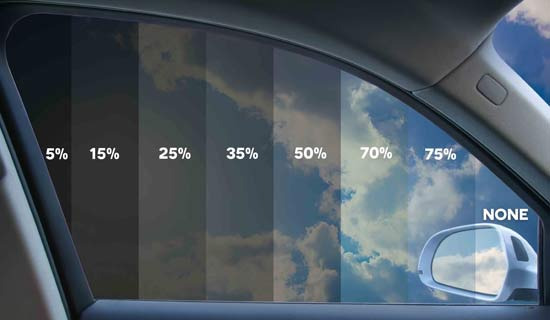
When I first moved to Phoenix, I didn't understand why people were so obsessed with tinting.
Even when I lived in California, I had window tinting, but I thought it was just to make the car look cool and to keep it a little less hot in the summer.
However, after living in Phoenix for a few years, my perspective changed haha.
First of all, the summers here are truly beyond imagination. When the news says it's 110 or 115 degrees, the numbers don't really register.
But when you open the door of a car parked in the lot on a summer afternoon, you immediately understand. It feels like someone is holding a giant hairdryer to your face, blasting hot air.
The steering wheel is hard to hold with bare hands, and the seatbelt buckle can burn you if you touch it wrong. The sunlight, in a word, hurts haha.
What's even more surprising is that no matter how strong you set the air conditioning inside the car, only the left side of your face feels unusually hot.
30 minutes on the way to work, 30 minutes on the way home. It repeats every day. At first, I thought it was just my imagination.
But one day, I was shocked to hear something from a dermatologist.
In the U.S., photos of truck drivers or long-distance drivers are often released, showing that the skin on the left side of their faces is much older than the right side.
There are more wrinkles and significant pigmentation. The reason is simple. It's UVA.
Most people think of sunburn when they hear the term ultraviolet rays.
That's UVB. Fortunately, UVB is mostly blocked by regular car windows.
The problem is UVA. This one sneaks in quietly. It doesn't make your skin red. It doesn't hurt.
But after a few years, dark spots appear, blemishes increase, and skin elasticity decreases.
It's literally a silent assassin for your facial skin.
When I first came to Phoenix, I bought a used car that was already tinted.From the outside, it looked quite dark. So I naturally thought it would block ultraviolet rays well.
But it turned out to be a completely different story. Many people think of it like sunglasses. They say, "Isn't darker better?"
But tinting isn't about the color. It's about performance.
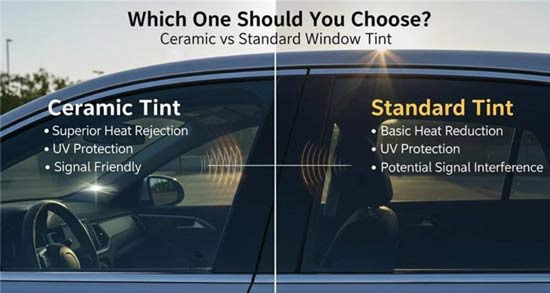
A few years ago, I got into a friend's car that had almost clear film. But my friend smiled and said,
"This is a ceramic film that blocks 99% of UV."
It turns out that high-quality ceramic films that are almost transparent can often be much more expensive than the dark films that look black from the outside.
Especially in Phoenix, the TSER, or total solar energy rejected, is also important.
No matter how much you turn on the air conditioning, if hot heat keeps coming in, the interior heats up quickly.
So people here prefer products with higher heat-blocking performance over simply dark films.
These days, the most popular method among Phoenix residents is to install clear ceramic film on the front windshield.
From the outside, it doesn't show at all. But when you actually drive, the difference is significant.
The dashboard temperature decreases, and the phenomenon of your arms and face getting hot also reduces.
In the end, I believe that preventing skin aging starts not at the cosmetics store but in the car.
In a city like Phoenix, where the sun is strong all year round, car tinting is not just an option.It helps reduce air conditioning electricity costs, protects the interior, and most importantly, it serves as equipment to protect my skin.
After living here for a few years, you naturally come to understand why people rush to the tint shop as soon as they buy a new car.
For Phoenix residents, tinting is not a choice for style but survival equipment in the war against sunlight.
 PastaPilot
 SGWasabi
 NewMexicoPal







 fortbliss |
 Folding Instructions |
 yentra |
 Cali M Law Group |
 quanta7 |
 Kitchen Ideas |
 Toaster Pizza Magic Show |


 business lim |
  Finding Superfoods |
  lightyear |
  song bang |
  vexomo |
  Indiana Jones |
  meloncat |
  novapixel |
  mortrix |
  Esther 1983 |
  Moscow Kim |
  My Two Way |
  toastyfox |
  FLORIDA Acus |
  tracker |
  TONTON COFFEE |
  sunrise |
  ultron78 |
  uplifted |