
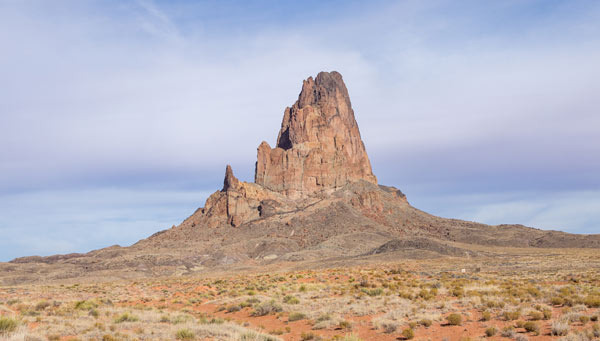
As you pass through the area around Kayenta in Arizona, you will notice very unusual landscapes.
In the middle of an endless desert, towering rock mountains suddenly stand tall. The surrounding land is flat, making it look as if gigantic sculptures have been deliberately placed there. The reason this area strongly evokes the feeling of the Wild West in movies is precisely because of these 'rock mountains.' But why do these boulders stand alone in the desert? This is not just a bizarre landscape; it is the result of a long battle between the desert and the rocks.
The main reason is the difference in erosion. The area around Kayenta has been eroded by wind and rain over many years. However, not all rocks erode at the same rate; hard rocks remain while softer layers disappear more quickly. As a result, only the strong rocks remain like 'columns.' In simple terms, the entire land is continuously eroded, but only the hard parts withstand and rise up. The rocks appear to be elevated because the surrounding land has eroded, not because they were originally high.
The rocks in this area are primarily sandstone, but the strength varies by layer. Some layers are hard, while others crumble easily like sand. When strong rocks are on top and weak rocks are below, the lower layers erode first, leaving the upper parts to form 'mushroom-shaped' or 'columnar' structures. Because the desert winds blow strongly and the weather is dry, it is the wind that has sculpted the cliffs and columns over time instead of water.
In the vicinity of Kayenta, it is common to see flat layers rising moderately high. This is the trace left by the erosion of 'plateaus' and 'mesas.' There was once a large, wide rocky land like a plateau. Over time, that plateau shrank into a table-like mesa, then eroded further into a hill-like butte, and eventually, only narrow towers resembling fingers remain. Most of the rock mountains in Kayenta are somewhere in this process. In simple terms, they are the result of a massive plateau being broken down over time.
Here, tectonic movements also play a role. This area was once layered by ancient seas, rivers, winds, and earthquakes. The plains where water flowed transformed into deserts, and places that were once seas became rock mountains. Because large areas often sank or rose, the geological layers around Kayenta can be seen as 'a record of past climate changes and tectonic movements' rather than a single mass. This record remains as natural sculptures, creating the visible landscape.
Finally, the desert environment helps maintain this landscape. With little rain, the rocks do not erode much, and because plants do not take root, the soil or sand remains unstable. If trees or grasses were dense, the land would erode less, and these peculiar rock mountains might not be as visible. The desert does not hide the rocks. Therefore, areas like Kayenta become fascinating places that reveal the Earth's 'rock records' as they are.
In summary, the rock mountains of Kayenta are the result of hard rocks surviving the erosion of the desert. Over many years, water and wind have eroded the land, and new tectonic movements and climate changes have layered to create the current landscape. Although it appears to be a quiet and serene desert, it actually bears the traces of millions of years of intense movements and changes.







 Kitchen Ideas |
 Toaster Pizza Magic Show |


 The Long Shot |
  Atlanta Mama |
  Baguette Blog |
  US Embassy |
  Korean Mom |
  My NYC |
  moo moo |
  Mr Oh |
  forevergee |
  festival |
  manchester |
  constant |
  Leapfrog Move |
  vibranto |
  Tora Tora |
  yellowbutter |
  Dolly |
  NYC saladbar |
  Finding Superfoods |
  lightyear |
  song bang |