


In immigrant life, it's important to know the local hospitals before you or your family get sick.
After moving, when someone got sick, I just searched for the nearest emergency room on Google Maps, but later I found out that Tucson has hospitals of a different caliber.
Banner University Medical Center Tucson (Banner University Medical Center Tucson, hereafter BUMCT) is that hospital.
This is not just a local hospital; it is an educational hospital directly connected to the University of Arizona College of Medicine, which means the level of medical care is on a different level.
In fact, according to the 2025–2026 U.S. News & World Report rankings, it was selected as the number one hospital in Tucson and the fourth in Arizona, becoming a well-known presence in the area.
The biggest feature of this hospital is that it has a complex medical system so well established that it feels like "there's no treatment that can't be done here."
It is the only Level I Trauma Center serving both adults and children in Southern Arizona.
When emergencies like traffic accidents or severe trauma occur in this area, they ultimately converge on this hospital. It plays a crucial role in emergency medical care.
Looking at the facilities, it's easy to understand why it receives such evaluations.
There is a children's hospital, Diamond Children's Medical Center, attached to it, which is the only pediatric specialty hospital in Southern Arizona.
Additionally, it includes a National Cancer Institute (NCI) designated center for cancer treatment, allowing for a structure that operates simultaneously in research and clinical care beyond simple treatment.
In fact, fields like oncology, urology, and geriatrics have received "High Performing" ratings, and the ENT department is also ranked nationally.
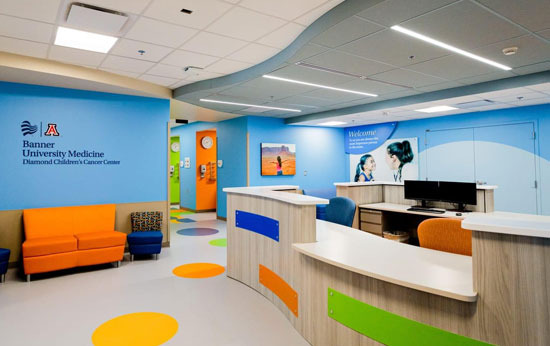
One interesting aspect is the structure of the emergency room. This hospital has the only certified geriatric emergency room in Southern Arizona.
Older patients require much more careful attention than those in a general emergency room, so having such a system in place is a point that showcases the hospital's level of care.
Another notable feature is the transplant program. There is a multi-organ transplant system that handles several organs simultaneously, and particularly in the fields of blood and bone marrow transplants, it receives quite high praise in the Southwest region. In simple terms, cases that other hospitals find difficult often come here.
When you visit, the operations are quite systematic. General visiting hours are relatively generous, from 6 AM to 10 PM.
However, the ICU has family-centered restrictions, and visiting is blocked during shift changes, ensuring basic control is firmly in place.
Security is also in line with current trends, requiring equipment checks at the entrance, so first-time visitors often feel like they are at an airport.
Parking is surprisingly convenient. Free parking is available relative to the size of the hospital, and as long as you get your ticket validated, you can use the covered parking area.
Parking stress can be quite significant when visiting hospitals, but this is definitely an advantage.
Food and amenities are also above basic standards. There is a cafeteria on the first floor, and there are kiosks for coffee, making it a bit easier for visitors to wait.
Overall, this hospital is more of a healthcare hub covering all of Southern Arizona than just a "local hospital."
For those living in Tucson or considering moving there, having this hospital is a significant advantage in terms of stability in life.
Especially for those with families or who place importance on medical infrastructure, this is a noticeable benefit.





 daddyyo |
 Top Beaches |
 Diana Blues |
 Dragon Lee |
 Churros Train Conductor |
 TOTO Together |
 Arizona Cowboy |

 Project Tomorrow |
 lavender |
  Bridgo |
  Tamfa Fan |
  Sunny Sunday |
  mini hometown |
  torvia |
  Chichiki Chicago Train |
  Univ Student |
  See It |
  Con Cheese |
  softmoony |
  Breaking Bad Drama |
  New York Queens Native Blog |
  Shinbaram Dr. Blog |
  vivavida |
  Way to easy |
  limestone |
  oster |
  neapolis |