

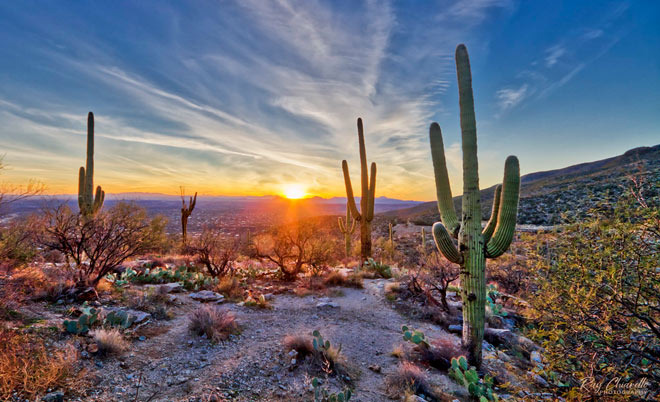
Upon arriving in Arizona, the first thing that catches the eye is the towering cacti standing proudly at the corners of mountain paths.
They occupy their spots as if declaring, "I am the master of this desert." I thought all cacti were the same, but seeing them in person reveals a variety of types, each with its own strong personality, making them feel like true desert inhabitants.
The representative cactus is the Saguaro cactus. In southern Arizona, such as Tucson, Phoenix, and Scottsdale, you can see this one anywhere. It can grow as tall as 10 to 15 meters, and it doesn't grow quickly. It takes an average of 50 years for a single arm to appear. If you see multiple arms, it means that it has survived in the desert for over 100 years.
In other words, the cactus in front of me may have lived longer than my grandfather. This is why the people of Arizona have a strange reverence for the Saguaro. It is not just a simple plant but rather close to a "cactus elder."
Why can the Saguaro endure in this desert? The most important reason is its ability to store water. When it rains, it absorbs and stores water in its body, and during dry days, it slowly consumes that water. Its round and rubbery appearance is due to its structure designed to hold water. The spines are not just decorative; they also serve as a shield to disperse strong sunlight and prevent animals from eating it.
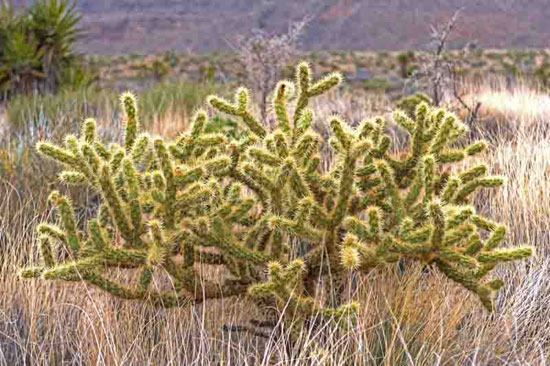
On the other hand, the Cholla cactus is not as massive as the Saguaro, but it best represents the "harshness of the desert."
It looks pretty at first glance, but when you get close, the spines stick to your clothes and skin. Even a slight brush can cause the spines to detach and stick, which is why locals call it the "jumping cactus." First-time viewers may find it attractive and try to touch it, only to regret it later.
Then there's the Prickly Pear, which looks a bit different. It has a paddle-like shape resembling a hand, and its fruits are colorful and beautiful. You can actually pick and eat the fruits, and they are also made into tea, jam, and candy. Seeing it sold as "cactus-flavored drinks" in Arizona supermarkets shows how familiar it is.
These cacti share a common survival strategy: "they adapt without moving." The desert has very little water, extreme temperature differences, and limited food. While most animals might need to move, cacti instead take root in place.
They spread their roots wide to absorb even a little rain, store water in their bodies, and protect themselves with spines. They demonstrate that survival is possible without great speed or strength.
The people of Arizona do not see these cacti as mere plants. There are even preservation regulations in place.
If you move or damage a Saguaro without permission, the fines can be significant, and homeowners must obtain permission to relocate a cactus in front of their house. They are treated as "neighboring residents."
Thus, in Arizona, cacti hold even more significance. They are not just plants but the very way of life taught by the desert.







 Kitchen Ideas |
 Toaster Pizza Magic Show |


 The Long Shot |
  Balancework |
  laro90 |
  MEDBIO American Doctor Blog |
  SWAT TEAM BLK |
  DREAM BIG |
  frostbite |
  330 Forever My Love |
  El Dorado |
  dralix58 |
  Gorama Round |
  Skydiving |
  dreamport |
  Yellow Snowman |
  velvetnom |
  Anytime Journey |
  Mrs. Duluth |
  jaxter |
  Atlanta Mama |
  Baguette Blog |