

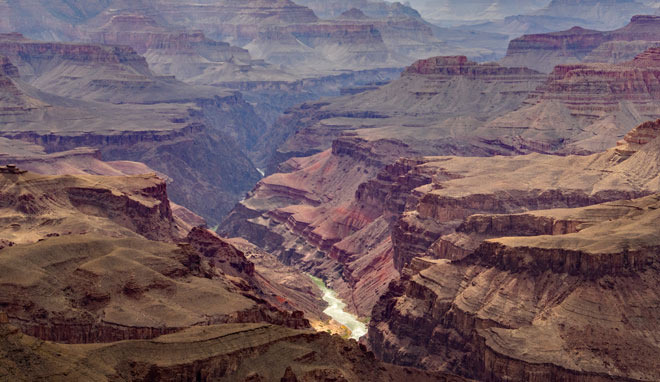
The Grand Canyon is not just a landmark for Arizona; it is a key tourist resource that supports the state's economy.
Arizona excels at transforming its landscapes of deserts, canyons, cacti, and red rocks into a thriving tourism industry. Among these, the Grand Canyon holds significance beyond being just a large spectacle. It is the heart of Arizona's economy, culture, and tourism, serving as a regional brand that attracts people from all over the world.
There are several gateways to view the Grand Canyon, but the most commonly chosen entry point when traveling in Arizona is the South Rim. It is easily accessible and close to viewpoints, accommodations, and the nearby cities of Flagstaff and Williams. The South Rim is open most of the year, and with the shuttle bus system, visitors can easily move between various viewpoints along the canyon, making it manageable even for novice travelers. At some viewpoints, the sunset casts a red glow over the canyon, which is the most popular time to visit.
In contrast, the North Rim is much quieter and harder to access. Due to its higher elevation, it can be closed in winter because of snow, and it does not have as many commercial facilities as the South Rim. However, it offers a deeper sense of tranquility and majesty, making it preferred by travelers who want to fully experience nature rather than large tour groups. Planning and booking accommodations in advance is essential to visit this area.
There are various ways to enjoy the Grand Canyon tourism beyond just "viewing the viewpoints". Notable activities include hiking, rafting, and helicopter tours. The Bright Angel Trail is the most popular hiking route starting from the South Rim, and if one is physically able, they can experience going down to the canyon floor and back. Of course, the round trip can be challenging for beginners, so many travelers opt to go only partway. Once at the bottom, one can truly realize that the Grand Canyon is not just "visible land but a space to enter".
Rafting tours on the Colorado River are also popular. Sections with gentle currents can be enjoyed by beginners, and looking up from the river offers a completely different perspective of the canyon. Helicopter tours, while expensive, provide the advantage of seeing the "vast structure of the entire canyon" at a glance, which cannot be captured in photos or videos. Many hesitate due to the cost, but it is often considered a worthwhile choice when thinking of the once-in-a-lifetime scenery.
While touring, one can also notice impressive aspects of Arizona beyond the natural scenery.
First, there is the need to prepare for climate changes. It can be hot during the day, but mornings and evenings can be chilly. Due to extreme temperature variations at different elevations, local guides always emphasize bringing outerwear.
Second, the importance of hydration is crucial. Due to the desert climate, moisture evaporates quickly, making it essential to drink water frequently.
Third, strict protective regulations are in place. Violating rules against littering, damaging nature, or contacting wildlife can result in hefty fines. Arizona understands that preserving the lifespan of tourist sites is directly linked to protecting its economy.
Ultimately, viewing the Grand Canyon in Arizona is not just about enjoying the scenery. In that moment of gazing at the canyon, one can feel the weight of billions of years of accumulated geology and see the systems of people who live based on this nature.
The cities that have commercialized the grand landscape, the strategies of earning money while protecting nature, and the travelers enduring the wind under the sunlight. The Grand Canyon is a tourism product created by nature and a living resource that Arizona wisely maintains.






 candytip |
 Gold Bar |
 Pirate Ship Popcorn Maker |
 Montgomery Mom |
 Anjollinya Blog |
 Kitchen Ideas |
 Toaster Pizza Magic Show |


 business lim |
  manchester |
  constant |
  Leapfrog Move |
  vibranto |
  Tora Tora |
  yellowbutter |
  Dolly |
  US Embassy |
  NYC saladbar |
  Finding Superfoods |
  lightyear |
  song bang |
  vexomo |
  Indiana Jones |
  meloncat |
  novapixel |
  mortrix |
  Esther 1983 |
  fortbliss |
  Moscow Kim |