

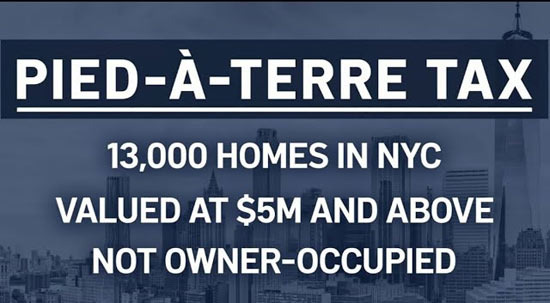
New York has ultimately passed a new tax on ultra-expensive second homes, known as the 'pied-à-terre tax.'
This policy imposes an additional tax on individuals who own luxury condos or residential buildings as investments without residing in New York City.
The New York State Legislature plans to use this tax to reduce New York City's budget deficit and secure approximately $500 million in revenue.
This policy seems to align well with the realities of New York.
Many of Manhattan's ultra-expensive apartments serve more as asset storage than for actual living purposes.
As wealthy individuals from around the world purchase New York real estate as a safe asset, the prices of luxury homes have continued to rise, while the rental burden on ordinary citizens has also increased, leading to ongoing criticism.
In particular, complaints have grown that "the city center is becoming increasingly difficult for ordinary workers to live in" as living costs and rents have surged sharply since the pandemic.
The new tax will be gradually implemented starting in 2026. According to the New York City Department of Finance, it targets non-residential second homes valued at over $1 million.
For properties valued between $1 million and $3 million, a tax rate of 4% will apply; for those between $3 million and $5 million, 5.25%; and for properties over $5 million, 6.5%. On the surface, this appears to be a significant tax burden.
However, some analyses suggest that the actual burden may be lower than expected.
This is because New York's property assessment system often maintains outdated methods, resulting in assessed values that are frequently lower than current market values.
Some experts explain that there are cases where properties are assessed at only about 10% of their market value.
Thus, while the visible tax rates are high, the actual tax burden may be reduced due to the low assessment standards.
Through Truth Social, President Trump used strong language, stating, "Mayor Adams is destroying New York."
He claimed, "There are no opportunities left in New York," criticizing the policy for weakening the city's competitiveness.
Additionally, President Trump stated, "Policies that only shout 'tax, tax, tax' are completely wrong," arguing that excessive tax policies will ultimately drive wealthy individuals and investors out of New York.
He continued, "People are fleeing, so this approach needs to change immediately," emphasizing that "history has shown that such policies never succeed."
One reason President Trump is sensitive to this tax policy is that he himself is likely to be subject to it.
Although Trump is from New York, his legal residence is registered in Mar-a-Lago, Florida.
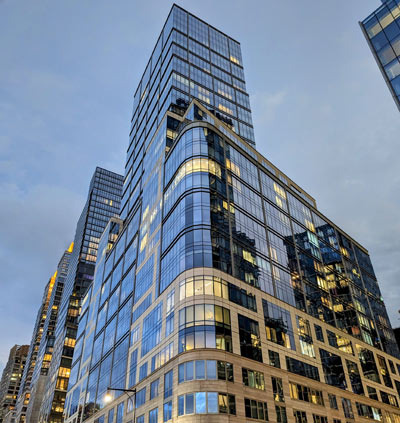
Therefore, his ultra-expensive penthouse in Trump Tower on Fifth Avenue in Manhattan is likely to be classified as a 'non-resident luxury home.'
In particular, the Trump Tower penthouse is considered a prime asset that falls under the new tax criteria of luxury real estate valued at over $5 million.
If the bill is enacted, there is a possibility that he will incur additional taxes each year. There are interpretations in the political arena suggesting that President Trump's opposition is due to his own interests.
However, this policy is not just about taxes. It is also connected to the direction of the city of New York.
Recently, New York has been facing multiple burdens simultaneously, including subway safety issues, public service budget shortages, increased costs for immigrant support, and housing shortages.
Ultimately, securing funding to maintain the city has become a critical challenge.
As a city that attracts global finance and real estate capital, New York has approached this by requiring a certain level of additional burden from high-end property owners.
On the other hand, there are concerns from the real estate industry. It is argued that transactions in the ultra-expensive real estate market may shrink, and some investors may move to areas with lower tax burdens, such as Florida or Texas.
In fact, areas like Miami and Palm Beach have rapidly grown as funds from New York's wealthy have flowed in. Florida is often compared to New York due to the absence of a state income tax.
Nevertheless, New York still possesses world-class symbolism and economic power.
Given that finance, culture, media, and fashion industries are concentrated there, many analyses suggest that the demand for ultra-expensive real estate is unlikely to disappear entirely.
Ultimately, this tax is viewed as a policy that goes beyond just taxing the wealthy, showing how New York will adjust its housing issues in the future.
 midnightforestbuilder1948
 OceanBuddy







 Sugar Cream Door Bulletproof Noodles |
 urbanmint |
 |
| 
 Premium Gas Camp |
 CA Real Estate |
 newyorker 101 |
 Lunch and Dinner Mexican Taco |
 Things to Do to Buy a House |
 Living in America and Writing Essays |
 Poppin News |
  UCLA Captain |
  lattecu |
  dynamite |
  frostingline |
  Hakuna Matata |
  Your Curiosity Resolved |
  Way to easy |
  Chino Min |
  nexabyte |
  moonshine 7 |
  Sunset Oregon |
  victoria 68 |
  golfmaster |
  Montgomery Mom |
  squidogame |
  Noodle Noodle |
  Rhode Island Good People |
  Big North |
  Famous Attractions in the United States |
  Jin Soo V |