


This month, I signed the loan application and came out. My bank balance is exactly 0, just like a bulls-eye. But this time, there's something more concerning than money.
Last week, someone in the department office asked, "Have you tested for radon in your home?" Honestly, at first, I thought it was the name of a ramen brand. When I got home and looked it up, I felt a bit chilled.
Radon is a radioactive gas that occurs naturally from the decay of uranium in the ground. It has no color or smell, so there's no way for people to detect it. It seeps in through cracks in the foundation or plumbing holes and accumulates in the basement.
The problem is that Iowa ranks among the highest in the nation for this issue. According to the Environmental Protection Agency (EPA), Iowa is classified as a high-risk radon area (Zone 1) for the entire state.
I also checked the saying that's been going around: "7 out of 10 homes in Iowa exceed the standard." There is indeed a statement in the Iowa Department of Public Health (Iowa HHS) data from the EPA survey that says 7 out of 10 homes exceeded the standard.
However, this is based on older survey standards, and the numbers vary slightly across different reports. A statement released by the American Lung Association in January of this year indicated that 58% of homes tested in Iowa had levels above the standard.
The same report also estimates that up to 5 out of 7 homes in Iowa could be high. Regardless of which number you look at, it means that more than half are above the standard, so it's too risky to assume our home is fine.
For reference, the national average is about 1 in 15, so it feels a bit unfair in comparison. Rent is relatively cheap, but it seems we pay a price for this.
The standard is 4 picocuries per liter of air (4 pCi/L). The EPA recommends mitigation measures if levels exceed this, and suggests considering action for levels between 2 and 4.
The reason we need to pay attention is that the EPA identifies radon as the leading cause of lung cancer among non-smokers. For smokers, it is the second leading cause.
Nationwide, radon-related lung cancer deaths are estimated at 21,000 per year. The scariest part is that even people who have never smoked can be affected.
So when should you test? Many say winter is the best time, and the reason is quite simple. With the windows tightly closed and heating running, indoor air gets trapped, resulting in values that are closer to normal living conditions.
There's also an explanation that as warm air rises, the pressure below decreases, causing more ground gases to be drawn in. This is why measurements often come out higher in winter than in summer.
When using a short-term testing kit, the EPA recommends keeping windows and outside doors closed for at least 12 hours before starting the test. Briefly opening them while entering or exiting is fine.
The kit should be placed on the lowest level of the home where people live. If you use the basement as a room, that's the right spot. It's best to avoid damp areas like kitchens or bathrooms.
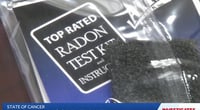
Now for the most important part: the money. This was the most welcome news for someone living on loans. The Iowa Department of Public Health is distributing free radon kits in collaboration with the American Lung Association.
One kit per household, while supplies last. The application form varies by county, so you need to select the appropriate one from the state government radon page for your county.
If the free kits run out, you can purchase them from the Johnson County Public Health. A short-term kit (3 to 7 days) costs $12 for in-person purchase and $15 by mail.
Long-term kits (3 to 12 months) are $30 for in-person and $33 by mail, and you can call 319-356-6040. $12 is less than what I spend on coffee in a week. This is worth getting a loan for.
If you have questions, you can call the Iowa Radon Helpline at 1-800-383-5992. They are available from 8:30 AM to 4:30 PM on weekdays, and if you leave a message outside of those hours, they will get back to you.
If your results come back over 4, there's no need to panic right away. The state government advises not to make decisions based on just one test result. It's best to test again for confirmation.
However, if the levels are still high, you should look for a certified mitigation professional. The Iowa HHS website has a list of certified measurement and mitigation professionals along with a map.
If you're a tenant, the first step is to discuss the results with your landlord. I'm also planning to send an email to the management office based on this result. I'm already nervous about how they will react.
Even after installing a mitigation system, it's not the end. Johnson County recommends retesting every two years, and after major renovations, retesting is also advised.
There's also news from schools. Iowa schools are required to conduct radon testing by July 1, 2027, under the Gail Orcutt Radon Safety Act.
If you have a persistent cough or are concerned about lung health in your family, please consult a doctor regardless of radon levels. The kit measures the air in your home, but it doesn't indicate your health status.
I plan to close the basement windows and set up the kit this weekend. If the free application is delayed, I'll just buy it for $12. My bank account is already at 0, but I can't afford to have my lungs at zero too.
I can't be the only one who didn't know about this, right? Let's all test our homes this winter. Even if next month's bank balance is uncertain, we can definitely take care of our indoor air quality.
 NyaNyaNya
 FishBunOp


 ovelion |

 Exploring American Life Information |

 Rolling Joy Life |
 solvix18 |
 Thoroughly Prepared Pioneer Spirit |

 Iowa School News |

 pet dog |

 bulls eye |

 Shining Our Own World |
 Raymond K. |
 gravity |
 714 Success Era Real Estate |
 Investment Beginner Company Information Encyclopedia |
 musicque |
 The Gelaton |
 Chicagonian |
 Freedom Yea |
 AZ Road Master |
 glenix39 |
 Something is popping in the situation |
 orvella |
 vella |
 comets |
 Banana |
 Yes Dorian |
 Minnesota Sonata N |
 zentar |