

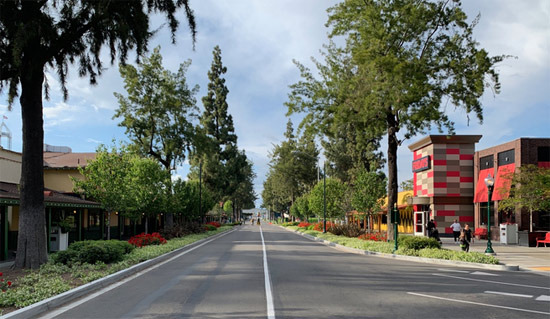
In LA, trash, tents, and discarded items are commonly found on the streets, while the roads in OC are almost at the level of newly built suburban areas.
There are quite a few reasons for this difference.
The first is a very practical issue: money and management entities.
Downtown LA has an old urban structure, with many historically neglected areas, and a concentration of homeless individuals, low-income residents, and various services in one place. The infrastructure is old, but people and vehicles keep flocking in, leaving no room for the roads and sidewalks to hold up. In contrast, OC has many master-planned towns designed from the start to be "livable." Places like Irvine, Tustin Ranch, and Mission Viejo were created with the concept of "wide roads, organized sidewalks, and separation of commercial and residential areas" from the beginning. So, while LA has developed organically over decades, OC is more like a textbook version of a city, designed by real estate companies and the city to be "pretty enough to sell at a high price." The roads had to be clean for the sake of property values, and that culture continues to this day.
The second is the intensity of management.
No one makes a big deal if there's one more trash bag on the streets of downtown LA. The scale is so large that public officials can't keep track of everything. But OC is different. Especially in middle-class and upper-class neighborhoods, there are many residents who dislike even a single disheveled road or tree. HOAs, city halls, police, and code enforcement work together to maintain the image of "a quiet and clean neighborhood." If you leave strange items in front of your house for too long or put out trash bags on the street, you can expect a letter from the HOA. In downtown LA, the sheer number of people and complex interests lead to disputes over "who will clean it up," but in OC, the responsibility is clear in organized areas. This means stricter rules and more frequent enforcement.
The third is the different usage of streets.
Downtown LA is a place where people and cars mix all day long. People coming to work, homeless individuals, tourists, event participants, drinkers, and protesters all share the same space. This makes it impossible for the streets to stay clean. In contrast, the roads in OC are mostly closer to "car-only lanes." There are far fewer pedestrians, and with a lower density of shops, the chances of spilling or dropping something on the road are reduced. Roads that only see cars are naturally less messy than downtown streets where many people walk.
The fourth is image management.
Many cities in OC thrive on the brand of being "safe and clean suburban towns." Good schools, quiet neighborhoods, and clean streets are the key assets that support property values, so the city has no choice but to consistently invest in public officials and cleaning personnel. Conversely, while downtown LA has many positives, it has already established an image of being "complex and somewhat messy urban center," so even with the same budget, the perceived cleanliness is bound to be lower. Additionally, with homeless shelters, cheap motels, and old buildings mixed in, it's true that even if something is cleaned up, it can still look the same.
Lastly, to be honest, there is the "complaint style."
OC residents are good at reporting various issues via email, phone, or city hall. If a tree branch blocks the road, if illegal dumping is suspected, or if there is graffiti on a wall... these reports keep coming in, so the city cannot ignore them. In downtown LA, many people feel the problems, but with so many larger issues overlapping, smaller complaints can easily get buried.
So, the cleanliness of Orange County's roads compared to LA's is not a coincidence but a system.
The result of a city structure designed from the start, residents obsessed with cleanliness, enforcement by HOAs and city halls, streets dominated by cars instead of people, and the cold calculation that "cleanliness increases property values" all come together to create this outcome. The rougher appearance of downtown LA is not simply due to "poor management" but is a complex mix of history, density, class, and policy.
Thus, the sparkle of OC's roads can ultimately be seen as a result of strong control and rules in place.







 US Embassy |
 fortbliss |
 Folding Instructions |
 yentra |
 Cali M Law Group |
 Pirate Ship Popcorn Maker |
 Total Beauty |
 Baguette Blog |
 California Information News |
 ROLDU WAY |
  Anytime Journey |
  Mrs. Duluth |
  jaxter |
  Atlanta Mama |
  Korean Mom |
  My NYC |
  moo moo |
  Mr Oh |
  forevergee |
  festival |
  manchester |
  constant |
  Leapfrog Move |
  vibranto |
  Tora Tora |
  yellowbutter |
  Dolly |
  NYC saladbar |